

On this page
An amoeba is a unicellular organism that lacks a mouth or a fixed digestive system. Found in freshwater environments like ponds and slow-moving streams, it relies on its highly flexible cell membrane to survive. Instead of having specialized organs, it alters its own shape to eat, a process central to biology exams and fundamental to understanding how single cells sustain themselves.
What is phagocytosis in amoeba?
Phagocytosis is the biological process of a cell engulfing solid particles to form an internal vesicle. For an amoeba, this is a form of holozoic nutrition, where the organism takes in whole food particles and breaks them down internally. This contrasts with saprophytic nutrition, where organisms like fungi absorb dissolved nutrients from decaying matter.
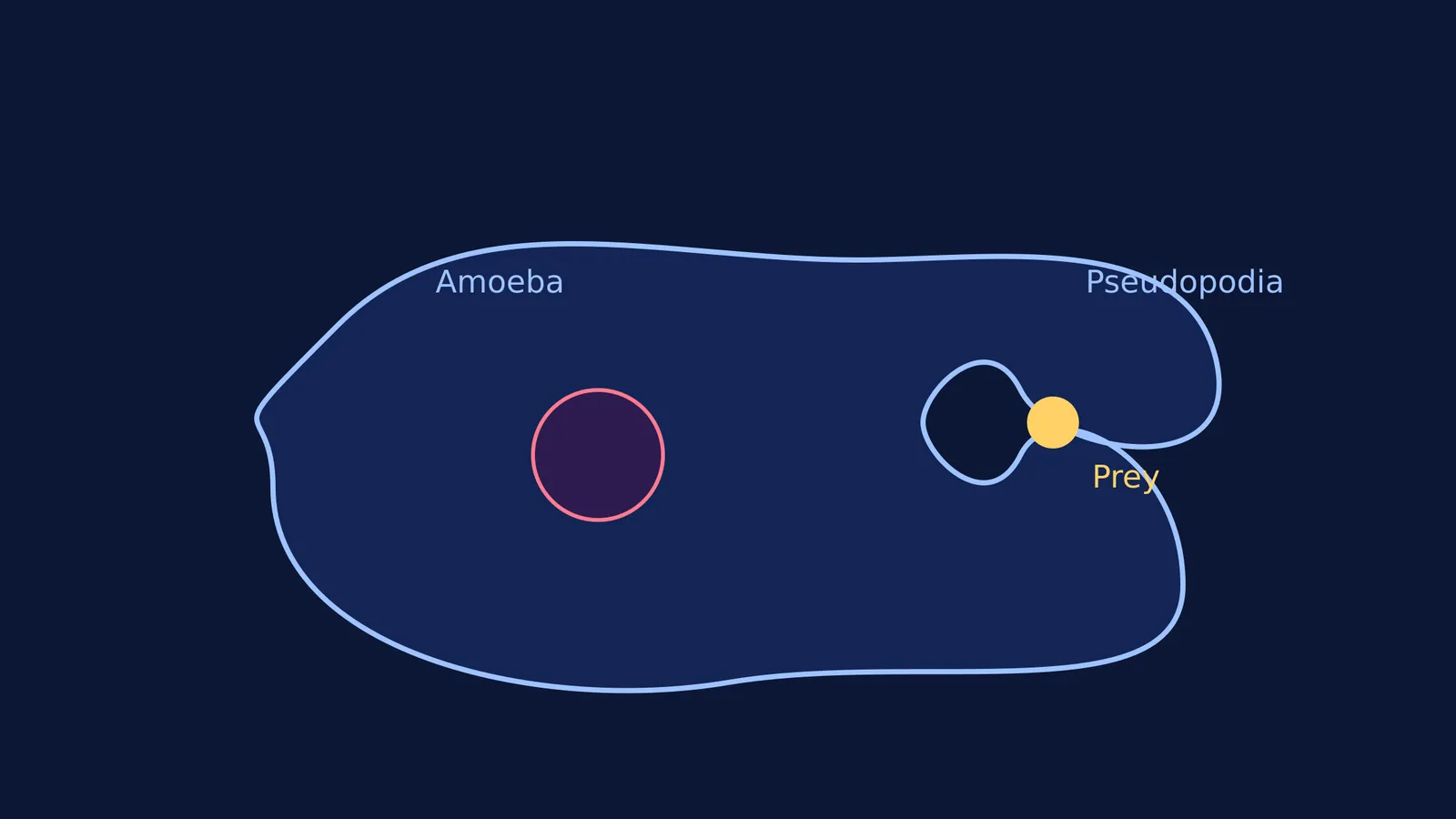
Instead of hunting with claws, the amoeba extends temporary, finger-like projections of its cell surface called pseudopodia (meaning "false feet"). As it senses chemical signals from prey—such as a smaller *Paramecium* or a bacterium—the cytoplasm flows forward, pushing the flexible cell membrane around the target. This targeted movement towards chemical signals is known as chemotaxis.
How does an amoeba take in food step by step?
The process follows four main stages, starting from the moment the organism detects its food.
Ingestion: The pseudopodia extend and completely fuse over the food particle. This traps the prey inside a membrane-bound sac called a food vacuole, isolating it from the rest of the cell.
Digestion: The food vacuole acts as a temporary stomach. Specialized organelles called lysosomes, which contain strong digestive enzymes, merge with the food vacuole. These enzymes break down the complex organic substances into simpler, soluble molecules.
Absorption and assimilation: The simpler, digested substances diffuse directly out of the food vacuole and into the surrounding cytoplasm. The amoeba then uses these nutrients for energy production, cell growth and repair.
Egestion: Because an amoeba has no permanent excretory organ, the remaining undigested waste is simply shifted to the surface of the cell. The membrane then ruptures to throw the waste out into the surrounding water.
Students exploring cell biology in the Fermi Concept Library often find that drawing this process helps lock the steps in memory. You can also map out the flow using techniques from concept maps for science to link ingestion directly to egestion.
How long does digestion take?
While it seems like a slow, floating drift under a microscope, an amoeba's hunting is highly calculated. A 2018 study at the University of California estimated that the handling time for *Amoeba proteus* preying on a *Paramecium* is roughly 14.5 hours. This accounts for the time spent capturing and initiating the digestion of a single prey item.
When amoebae are crowded together, their capture rate drops. A classic 1968 study by George William Salt demonstrated that as predator density increases, the amoebae capture paramecia less rapidly and ingest fewer of them before dividing. This shows that their feeding habits adapt dynamically to their environment.
How do you write the perfect exam answer?
Questions about amoeba nutrition are frequent in high school biology. To secure full marks, your answer must be structured and use the correct scientific vocabulary. Here is a practical checklist for your next test:
Draw the diagram: Always sketch the amoeba with at least one food particle and clearly extended pseudopodia. Ensure your labels do not cross each other.
Use the keyword "pseudopodia": Do not just say "it stretches its body". You must use the term pseudopodia and define it as temporary finger-like extensions.
Mention the food vacuole: Clearly state that the pseudopodia fuse over the food to create this temporary stomach.
Explain diffusion: When describing absorption, explicitly state that nutrients "diffuse" into the cytoplasm.
Include egestion: Many students forget the final step. Describe how the cell membrane ruptures to expel the undigested waste.
If you are revising for your board exams, connecting this mechanism to the broader picture of Class 10 life processes is a practical way to prepare for long-answer questions. Organising these facts into a clear, numbered list will make your answer easy for the examiner to read and grade.


