

On this page
Chapter 3 of NCERT's Class 11 book Indian Constitution at Work asks a simple-sounding question: once people have voted, how do you turn votes into seats? This guide compares the two systems, works one real result both ways, and explains reserved constituencies.
What is the first-past-the-post system?
Under first past the post (FPTP), the country is divided into constituencies, each constituency elects one representative, and the candidate with the most votes wins, as the NCERT chapter Election and Representation explains. The winner does not need more than half the votes, only more than anyone else, which is why the chapter also calls it the plurality system.
The Lok Sabha has 543 constituencies, each electing one member under FPTP (NCERT, Chapter 3).
Votes for losing candidates win nothing. NCERT's 1984 Lok Sabha table shows the Congress winning 415 seats with 48% of the votes, while the BJP got 7.4% of the votes and 2 seats (NCERT, Chapter 3).
What is proportional representation, and where does India use it?
Under proportional representation (PR), each party gets the same proportion of seats as its proportion of votes, and voters usually choose a party rather than a candidate (NCERT, Chapter 3). In Israel and the Netherlands the whole country is one constituency. In Israel a party needs at least 3.25% of the votes to win any seats, the chapter notes.
India uses a third variant, the single transferable vote (STV), for indirect elections. The Constitution says the President is elected by proportional representation by means of the single transferable vote (Article 55), and Rajya Sabha members are elected the same way by their state's MLAs (Article 80).
Worked example: Tamil Nadu 2016 under both systems
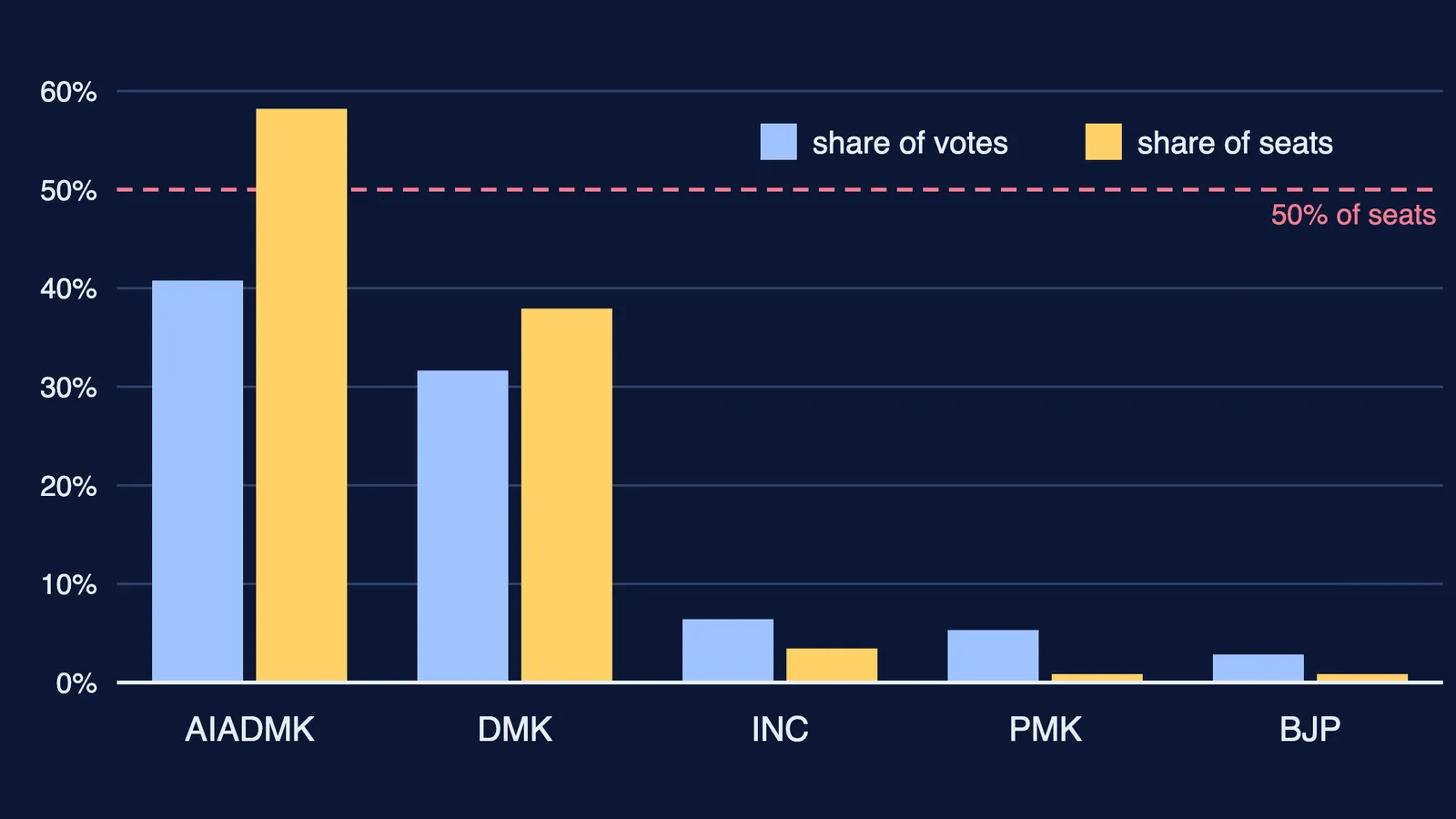
The chapter gives the 2016 Tamil Nadu Assembly result, with polling in 232 seats, and asks what PR would have done (NCERT, Chapter 3). Multiply each party's vote share by 232 and round:
AIADMK: 40.77% of votes, 135 seats won; under PR, 40.77 x 2.32 = about 95 seats
DMK: 31.64% of votes, 88 seats won; under PR, about 73 seats
INC: 6.42% of votes, 8 seats won; under PR, about 15 seats
PMK: 5.32% of votes, 0 seats won; under PR, about 12 seats
BJP: 2.84% of votes, 0 seats won; under PR, about 7 seats
A majority of 232 is 117. Under FPTP the AIADMK's 135 seats gave it a majority on its own. Under simple PR no party reaches 117, so any government would need a coalition. The sketch ignores thresholds and the 1.30% NOTA vote, but it shows the trade-off: FPTP handed the largest party a clear majority, while PR would have given smaller parties seats closer to their share of votes.
Why did India choose FPTP?
NCERT gives four reasons. FPTP is simple for ordinary voters. Each locality has one representative people can hold accountable. It usually gives the largest party bonus seats, helping a parliamentary government keep a majority. And it pushes social groups to unite to win a locality, where PR might encourage each community to form its own party (NCERT, Chapter 3).
What are reserved constituencies, and who decides them?
In a reserved constituency, every voter can vote, but only candidates from the group the seat is reserved for can stand. The Constitution makers preferred this to British-era separate electorates, where only a community's voters chose its representative (NCERT, Chapter 3).
Seats are reserved for Scheduled Castes and Scheduled Tribes in the Lok Sabha (Article 330) and in state assemblies (Article 332).
Of the 543 Lok Sabha seats, 84 are reserved for Scheduled Castes and 47 for Scheduled Tribes, as on 26 January 2019 (NCERT, Chapter 3).
The reservation was first made for 10 years and has been extended by amendments up to 2030 (NCERT, Chapter 3); Article 334 now sets eighty years from the Constitution's start.
The Delimitation Commission, appointed by the President, decides which seats are reserved. ST seats go to the constituencies with the highest share of ST population. For SC seats the Commission picks constituencies with a higher SC share but also spreads them across the state, because the SC population is spread throughout the country (NCERT, Chapter 3).
How do you revise this chapter for the exam?
Draw the FPTP versus PR comparison from memory: constituency size, members per seat, candidate or party, seat-vote match, examples.
Redo the Tamil Nadu sum without looking.
Work the STV quota for 120 MLAs electing 3 members (answer: 31).
Write two lines on how SC and ST seats are picked differently.
Revise the Class 9 basics in our guide to electoral politics and how an Indian election works, and the division of power in federalism for Class 10.
If you are not sure where to start on this chapter, Fermi's AI tutor can work out what you already know and build a plan for the session, so you sit down to a clear next step.


