On this page
Chapter 1 of NCERT's Class 11 textbook *Knowledge Traditions and Practices of India* (Reprint 2026-27) traces how India's languages and literatures grew, from oral storytelling to printed newspapers (NCERT chapter PDF).
Which part of the CBSE KTPI syllabus does this chapter cover?
The CBSE 2026-27 curriculum for KTPI (code 073) numbers its Class 11 chapters differently from the NCERT book (CBSE KTPI curriculum 2026-27). The closest match is curriculum chapter 3, "Indian literature part I - introduction of Indian literature", which carries written-exam marks rather than internal assessment only.
That curriculum chapter gets 28 periods, 21% weightage and 15 of the 70 written-exam marks. The 15 marks belong to the curriculum chapter as a whole; no figure is printed for this book chapter alone. The other 30 marks are internal assessment: two research-based projects (10 each, 20 in all), a portfolio (5) and a viva voce (5).
Its learning outcomes go beyond recall: compare genres, critique an author's style, and connect literary works with issues in society today.
What does the chapter say about language?
Sanskrit Bhāṣā (language) comes from the root Bhāṣ, to speak.
Languages keep changing as long as people speak them, so a language lives only through its users.
The book names ancient Indian grammarians, Panini among them, as the earliest masters of linguistics.
India has five major language families: Dravidian, Indo-Aryan, Tibeto-Burmese, Austro-Asiatic and Semito-Hamitic.
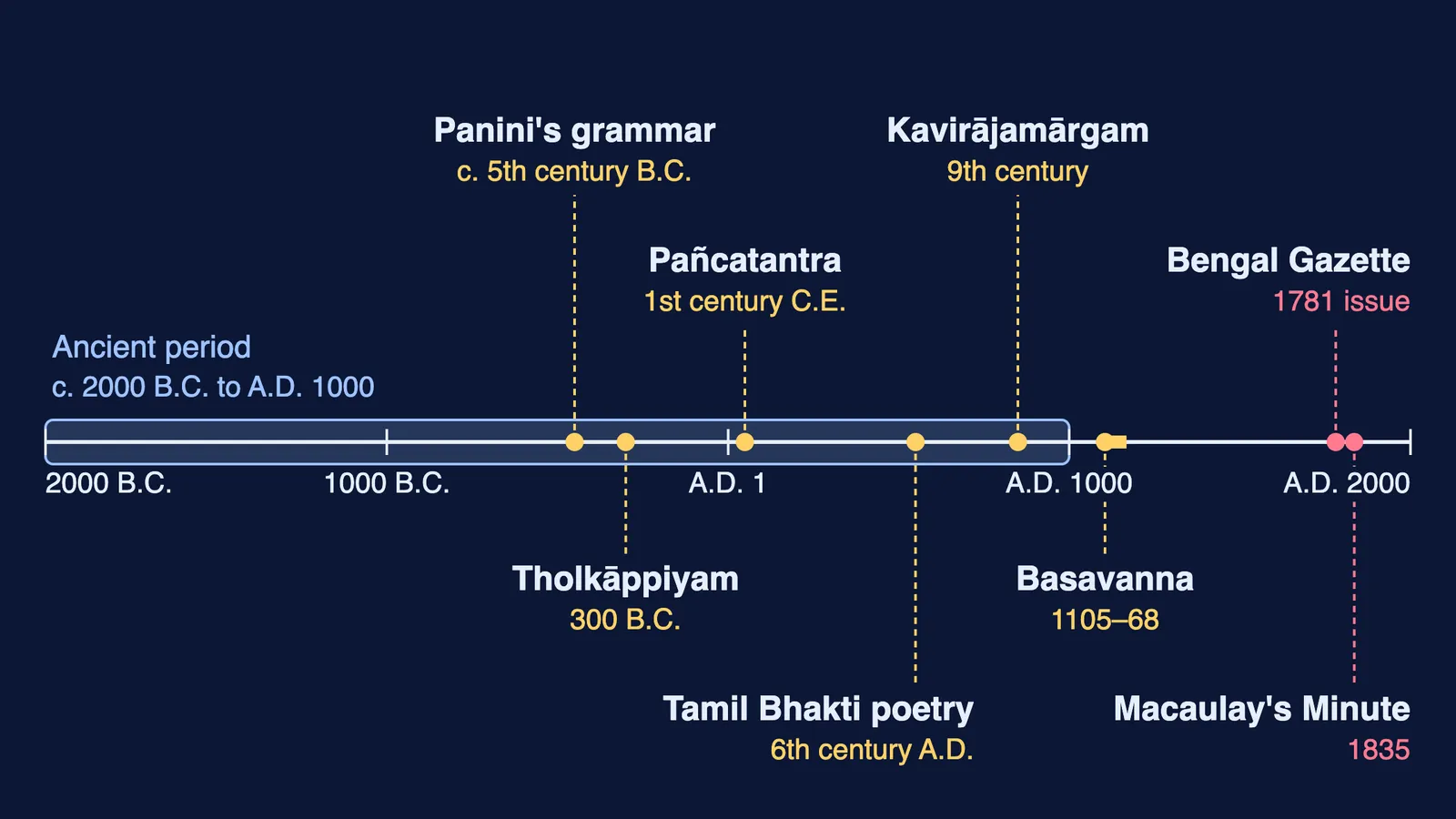
Panini gave Sanskrit a systematic grammar in about the fifth century B.C. People spoke dialects called Prakrits; Buddhist texts used Pali, one of them. Tamil is the most ancient Dravidian language. Later spoken forms, the Apabhramshas, became the base of modern Indian languages.
How does the book divide Indian literature into periods?
Ancient period (roughly 2000 B.C. to A.D. 1000). Writing was mainly in Sanskrit, Tamil, Pali and Prakrit.
The book sorts Sanskrit literature of the Vedic age into Śruti ("heard and revealed"): the four Vedas, Brāhmaṇas, Āraṇyakas and Upaniṣads; and Smṛti ("remembered and later recorded"): the Vedāṅgas, the epics and the Purāṇas.
Post-Vedic Sanskrit drama came from Bhāsa (thirteen surviving plays), Kālidāsa, Śūdraka and Bhavabhūti.
In Pali we have the Dhammapada and Jātaka tales; Gāthā Sattasai is a third-century Prakrit work.
Ancient Tamil (Sangam) literature includes Tholkāppiyam, a Tamil grammar the book dates to 300 B.C., the akam and puram forms, and the epics Silappadikaram and Manimekalai. (The book spells it "Tholkapiayam"; English spellings of Tamil titles vary, even within the book.)
Kannada's earliest surviving work is Kavirājamārgam (ninth century).
The book attributes the Rāmāyaṇa (24,000 verses) to Vālmīki and the Mahābhārata (one lakh verses) to Vedavyāsa. The 700-verse Bhagavad-Gītā sits in its sixth parva of 18.
Fables: the Pañcatantra (believed to be by Vishnu Sharma, first century C.E.), the Jātakas and the Hitopadeśa, whose four books are Mitralābha, Suhṛdbheda, Vigraha and Sandhi.
Medieval period. Bhakti poetry rose in the Tamil land in the sixth century A.D. with the Alvars and Nayanmars. In the Kannada region Basavanna (1105–68) began the movement whose literature is called Vacanasāhitya. Jñānadeva, Nāmadeva and Tukārām wrote in Marathi; Kabir and Guru Nanak in the north. The book highlights women poets: Lal Ded and Habba Khatoon in Kashmiri, Mirabai in Rajasthani, Andal in Tamil and Akka Mahadevi in Kannada. Urdu brought qasida, marsiya and masnavi; Ghalib wrote ghazals.
Modern period. Printing presses by 1800 and newspapers helped prose grow. The book mentions Hicky's Bengal Gazette, Udant Martand (a Kolkata weekly of 1826), Bankimchandra's magazine Bangadarshan and Bharatendu Harishchandra's Kavivachansudha. A note on "firsts": the book calls both Udant Martand and the Bengal Gazette India's first newspaper. Our timeline shows the Gazette at 1781, the date of the front page the book prints.
After Macaulay's Minute on Education (1835), English spread in public life; Henry Derozio and Michael Madhusudan Dutt pioneered Indian writing in English, and Rabindranath Tagore became India's Nobel laureate in literature. The book treats translation as a creative genre, with A.K. Ramanujan's English version of a Kuruntokai poem by Kapilar as its example.
How should you revise this chapter?
Redraw the timeline from memory, then check each date against the book.
List each language with its works and authors.
Read one translated piece the chapter mentions and write five lines on its style.
For context, see our Bhakti-Sufi Traditions guide and, on language and culture, Culture and Socialisation for Class 11.
Practice questions
Class 11 KTPI has no CBSE sample paper, so the mark values below are our suggestion.
(1 mark) Which tinai is linked with the sea? (a) Mullai (b) Neytal (c) Kurinchi (d) Palai
(1 mark) Name the language in which the Jātaka tales were written.
(2 marks) Tell Śruti and Smṛti apart, with one example of each.
(2 marks) Why does the chapter say a language cannot exist apart from its users?
(5 marks, case-based) A school reading features Tamil, Kannada, Marathi and Kashmiri. Suggest a poet or work from the chapter for each, and explain what translation adds.
(5 marks) How did printing presses and newspapers change Indian literature in the 1800s?
Answer to Q1: (b) Neytal.
Planning revision across subjects? Fermi's AI tutor works out what you already know and builds a plan for the session.