On this page
Chapter 6 of the NCERT textbook *Knowledge Traditions and Practices of India* for Class XI (chapter PDF, Reprint 2026-27) traces Indian mathematics from early number names to the work of Mādhava and Nīlakaṇṭha around AD 1500.
Is Mathematics in India in the Class 11 KTPI exam?
No, not in the written paper. The CBSE KTPI curriculum for 2026-27 (code 073) lists its own Class XI chapter 8, "Mathematics in India", as "For internal assessment only". The 70 written marks go to five other chapters.
NCERT numbers it chapter 6; the curriculum lists the same title as chapter 8.
Internal assessment in the same curriculum is worth 30 marks:
Research based project (2 x 10, one per term): 20 marks
Portfolio: 5 marks
Viva voce: 5 marks
Two projects come from the four internal-assessment chapters; other topics use presentations such as a debate or scrapbook.
What does NCERT Chapter 6 cover?
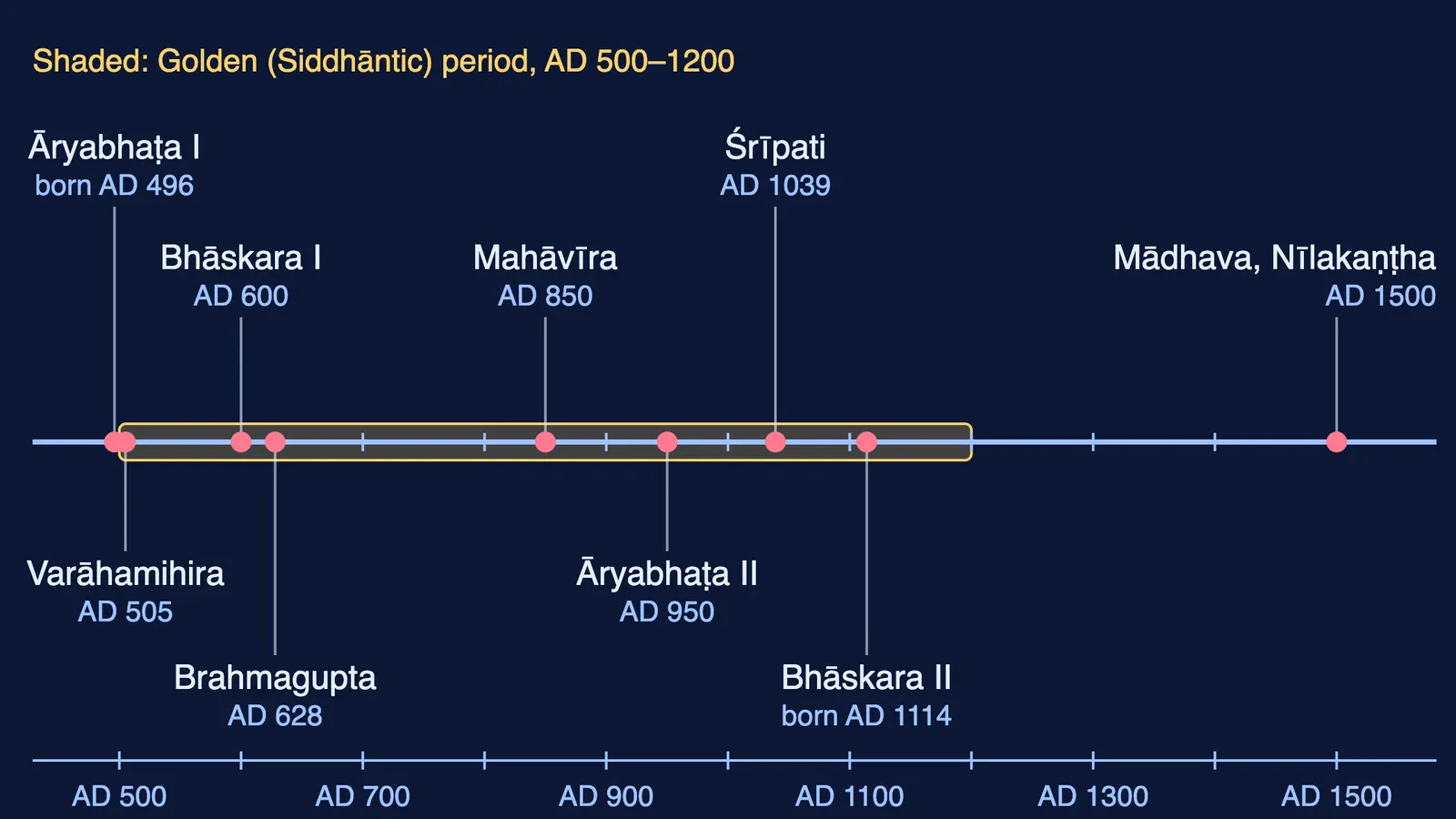
Numbers and zero: base ten, very large number names in Vedic texts, Brāhmī numerals from Asoka's time, and Āryabhaṭa I (born AD 496) writing a circle for an empty place (more in who invented zero).
The golden (Siddhāntic) period, AD 500–1200: from Āryabhaṭa I to Bhāskara II (born AD 1114).
Eight operations: addition, subtraction, multiplication, division, square, square root, cube and cube root, with Sanskrit terms such as saṁkalita for addition and guṇana for multiplication.
Pāṭi methods: working on a dust board where digits were rubbed out and replaced.
Geometry: the Sulbasūtras and fire-altar construction.
Algebra and trigonometry: bījagaṇita, kuṭṭaka, sine and cosine, and values of π.
How did the pāṭi methods work?
Once a digit has been used, it is erased and the result takes its place. Two examples with our own numbers, checked by hand and in Python:
Multiply 243 by 13 (kapaṭa-sandhi, direct process). The multiplier 13 sits above the multiplicand 243, and work starts from the rightmost digit of 243.
3 x 13 = 39; the 3 is rubbed out and 39 written in its place. Board: 2439.
Move 13 one place left. 4 x 3 = 12, plus the 3 below is 15: write 5, carry 1. 4 x 1 + 1 = 5 replaces the 4. Board: 2559.
Move 13 again. 2 x 3 = 6, plus the 5 below is 11: write 1, carry 1. 2 x 1 + 1 = 3 replaces the 2. Board: 3159.
Rubbing out 13 leaves the product, 3159.
Square root of 33124 (Āryabhaṭa's method). Mark odd and even places from the right, which groups the digits as 3 | 31 | 24.
The largest square in 3 is 1. Root so far: 1; remainder 2.
Bring down 3 to get 23. Divide by twice the root (2). Trying 9 leaves 5, and 51 − 81 is negative, so drop to 8: remainder 7, then 71 − 64 = 7. Root: 18.
Bring down 2 to get 72. Divide by 36: quotient 2, remainder 0. Then 4 − 4 = 0. Root: 182.
Check: 182 x 182 = 33124. The book's example never needs a lowered quotient, so watch for it.
What did the Sulbasūtras, algebra and trigonometry add?
The Sulbasūtras of Baudhāyana, Āpastamba and Kātyāyana gave rules for building fire altars, including a statement of the result we call the Pythagoras theorem. With it you can build one square whose area is the sum of two given squares: sides 5 and 12 give a square of side 13, since 25 + 144 = 169. See our Baudhayana-Pythagoras theorem guide.
Brahmagupta called algebra kuṭṭaka, after the pulveriser method for first-degree indeterminate equations. The chapter says Āryabhaṭa I described jyā (R sin θ) and ko-jyā (R cos θ) within a circle; our post on the jyā sine table goes further.
For π, the book lists 3.1416 (Āryabhaṭa I), 3.14159265359 (Mādhava) and 355/113 (Nīlakaṇṭha). Against today's value, 3.1416 is off by about 0.0000073 and 355/113 by about 0.00000027.
Practice questions for viva and projects
Class 11 KTPI has no CBSE sample paper, and this chapter is internal assessment only, so these labels are our suggestion.
(1 mark) Name the two separate works Bhāskara II wrote, one on mathematics and one on algebra.
(2 marks) Why was addition sometimes done "in the inverse order" on a pāṭi?
(2 marks) Multiply 314 by 21 using the direct kapaṭa-sandhi steps. (Answer: 6594)
(5 marks, case-based) Find the square root of 23716 by Āryabhaṭa's method, showing where a quotient must be reduced. (Answer: 154)
(5 marks) Compare the three π values in the chapter and rank them by closeness to today's value.
Project ideas: a dust-board multiplication demonstration, a glossary poster of operation names, or a timeline from the book's dates.
Stuck on where to begin a project? Fermi's AI tutor works out what you already know and builds a plan for the session.