On this page
Ask who invented zero and you will not get one name. Zero arrived in steps, mostly in India, over several hundred years: first as a dot that held an empty place, then as a number with its own arithmetic, then as the round symbol carved in stone.
Why did numbers need a zero at all?
Our numerals use place value: the same digit means more or less depending on where it sits. In 270, the 2 means two hundreds because something fills the ones place. Take that something away and 27, 207 and 270 all look like a 2 and a 7 with a gap that a careless copyist could close. If place value itself feels rusty, our post on reading decimal place value: tenths, hundredths and thousandths walks through it.
So zero's first job was humble: a mark that said "nothing here, but keep the column".
What is the Bakhshali manuscript, and how old is its zero?
The Bakhshali manuscript was found in 1881, buried in a field in the village of Bakhshali near Peshawar, in what is now Pakistan, according to the Bodleian Library's 2017 announcement. It is 70 fragile leaves of birch bark, and it has been kept at the Bodleian in Oxford since 1902.
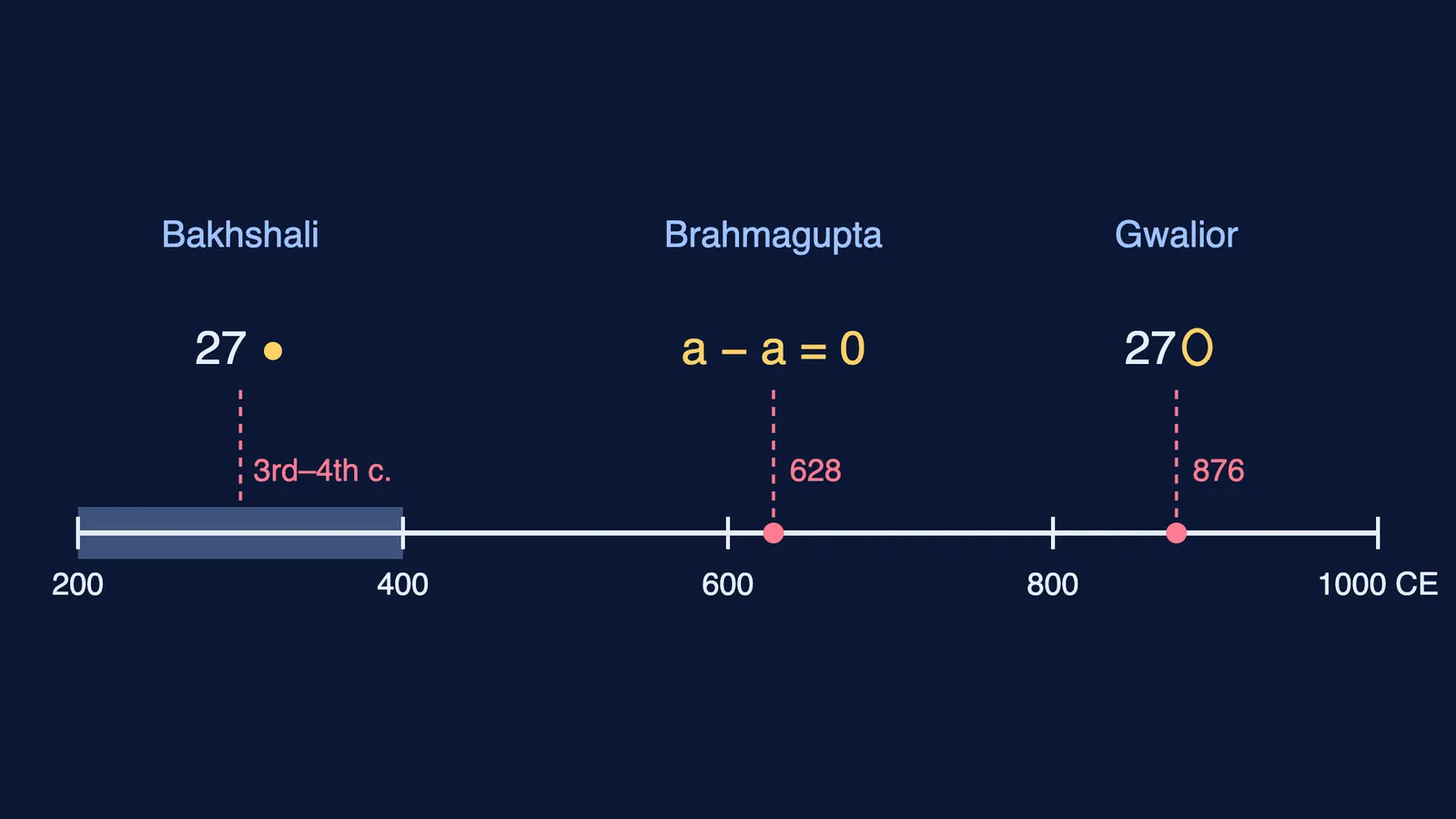
Its numbers use a dot as a placeholder, marking orders of magnitude such as tens, hundreds and thousands. The Bodleian says this dot later grew a hollow centre and became the zero symbol we use today.
In 2017 the library radiocarbon-dated the bark and reported that parts of the manuscript date from as early as the 3rd or 4th century, about five centuries older than the 8th-to-12th-century date scholars had estimated (Bodleian Library). The leaves come from at least three different periods.
Is the Bakhshali date settled?
Not quite. Five historians of Indian mathematics, Dominik Wujastyk, Takao Hayashi, Agathe Keller, Clemency Montelle and Kim Plofker, replied in the journal History of Science in South Asia. They argue that the oldest leaf cannot date the whole text: the latest leaf tells you when the copying happened. They also argue that some zeros in the manuscript already work as numbers in their own right, not only as placeholders.
What did Brahmagupta add in 628?
Brahmagupta (598 to 670) wrote the Brahmasphutasiddhanta in 628 at Bhillamala, today's Bhinmal, according to the MacTutor History of Mathematics biography. In it he defined zero as the result of subtracting a number from itself. The Bodleian calls it the first document to discuss zero as a number.
He gave rules in terms of fortunes (positive numbers) and debts (negative numbers). Four of those MacTutor quotes:
A debt minus zero is a debt.
A fortune minus zero is a fortune.
Zero minus zero is a zero.
The product of zero multiplied by a debt or fortune is zero.
All four still hold. When he tried to extend arithmetic to division by zero, he also wrote: "Zero divided by zero is zero." MacTutor says he is "certainly wrong" there, and modern maths leaves 0 ÷ 0 undefined. Our post on why you can't divide by zero, with 5/0 and 0/0 explained shows why. His algebra went further too: see Brahmagupta's identity and why sums of two squares multiply.
Where is the Gwalior zero, and what does it say?
The Chaturbhuj temple is cut into a rock face in Gwalior Fort, Madhya Pradesh. One of its inscriptions, which gives the date 876 CE (Samvat 933), records that the community planted a garden of 187 by 270 hastas that gave the temple 50 garlands every day (Chaturbhuj Temple, Wikipedia). The last digits of 270 and 50 are O-shaped zeros: carved in stone, in the shape you still write.
So who invented zero, and can you check it yourself?
The fair answer is that zero was built in India over centuries: dots in the Bakhshali manuscript, rules from Brahmagupta in 628, and the round zero at Gwalior in 876. You can run the same steps in five minutes:
Write 270, 207 and 27 using a dot for each empty place: 27•, 2•7 and 27. Erase the dots and they blur.
Check Brahmagupta's rules against modern ones: 5 - 0 = 5, 0 - 0 = 0 and 0 × 8 = 0. All three still work.
Test his rule for 0 ÷ 0. If 0 ÷ 0 = k, then k × 0 = 0, and that is true for every k. No single answer exists, so the result is undefined.
Work out the Gwalior garden. 187 × 270 = 50,490 square hastas. With the 1 hasta = 1.5 feet given in the Wikipedia article, that is 280.5 ft × 405 ft, or about 113,600 square feet.
If place value or the rules for zero still feel shaky, the Fermi Concept Library has a lesson for every concept in mathematics, each with its place in the map.
Next time you write a zero, remember it took three steps and several hundred years.