On this page
Chapter 2 of the new Class 8 maths book starts with one old question, how to double a square, and ends with the rule every right triangle obeys.
What does Chapter 2 of Ganita Prakash Part II cover?
The chapter is in NCERT Ganita Prakash, Textbook of Mathematics for Grade 8, Part II (code hegp2, First Edition December 2025). Its seven sections move from doubling and halving squares to √2, the general theorem, whole-number triples, Fermat's problem and applications.
CBSE publishes no separate 2026-27 curriculum for Classes 6 to 8; these classes follow the NCERT book, and the chapter is assessed by the school.
The book dates the Śulba-Sūtra of Baudhāyana to c. 800 BCE. The theorem also bears the name of Pythagoras (c. 500 BCE), some two centuries later; the joint name makes clear which theorem is meant.
How does doubling a square lead to √2?
Doubling each side gives four times the area. Baudhāyana's answer (Verse 1.9 in the book) is to build the new square on the diagonal. Extra horizontal and vertical lines show why: the old square holds two identical small triangles, the new one four. Reversing it halves a square.
Now take an isosceles right triangle with equal sides a and hypotenuse c. The square on c is double the square on a, so c² = 2a².
Worked example 1. The equal sides are 7 cm. Then c² = 2 × 49 = 98. Since 9² = 81 and 10² = 100, c lies between 9 and 10. Also, 9.8² = 96.04 and 9.9² = 98.01, so 9.8 cm < c < 9.9 cm.
With sides of 1 unit, c² = 2, so c = √2. The book traps √2 between 1.414 and 1.415, then shows it is neither a terminating decimal nor a fraction m/n. The fraction proof, credited to Euclid's Elements (c. 300 BCE), uses a fact from Part I: in a square number, every prime appears an even number of times.
Why does a² + b² = c² work?
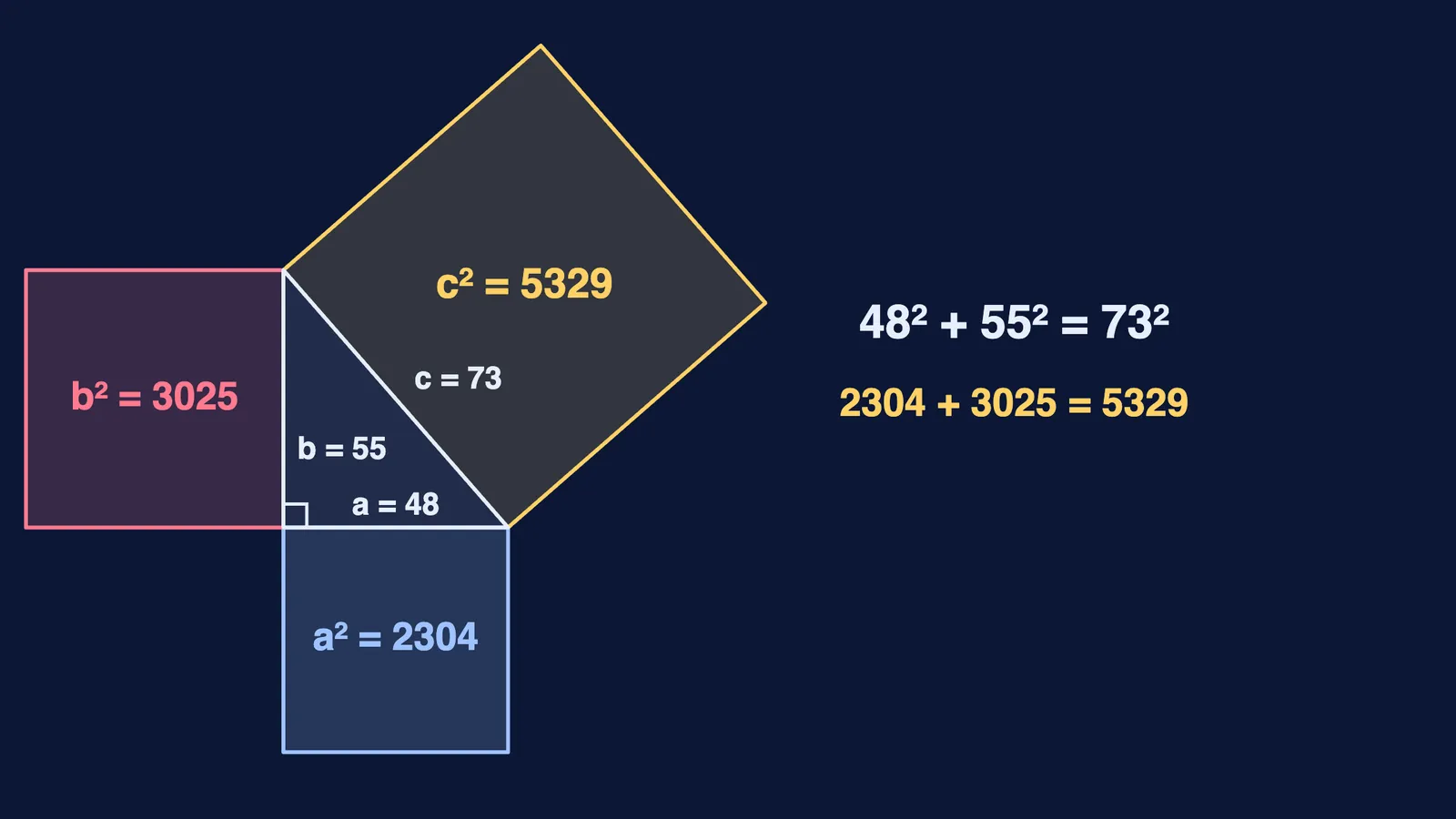
For two squares of different sizes, Baudhāyana (Verse 1.12) uses a right triangle with the two squares' sides as its shorter sides: the square on its hypotenuse has their combined area. Verse 2.1 explains why. Join the squares, mark off a rectangle in the larger one using the smaller side, and draw four identical right triangles. They enclose a figure with equal sides and right angles, a square with the same total area.
That gives the theorem: for a right triangle with shorter sides a and b and hypotenuse c, a² + b² = c².
Worked example 2 (the picture above). Combine squares of side 48 and 55. Then c² = 48² + 55² = 2304 + 3025 = 5329 = 73², so the new square has side 73.
Worked example 3. A right triangle has hypotenuse 89 cm and one side 39 cm. Then b² = 89² − 39² = 7921 − 1521 = 6400, so b = 80 cm.
How do you find Baudhāyana triples?
Whole numbers (a, b, c) with a² + b² = c² are Baudhāyana (or Pythagorean) triples. Multiplying all three by a positive integer k gives a scaled triple; one with no common factor above 1 is primitive.
To make more triples, the book uses the sum of odd numbers: (n − 1)² + (2n − 1) = n². Whenever the odd number 2n − 1 is itself a square, you get a triple.
Worked example 4. 361 = 19² is odd, and 361 = 2 × 181 − 1, so n = 181. Then 180² + 361 = 32400 + 361 = 32761 = 181², which gives the triple (19, 180, 181).
The chapter then turns to Fermat's question for cubes and higher powers, settled by Andrew Wiles in 1994, and to a lotus problem from Bhāskarāchārya's Līlāvatī. See also how to generate Pythagorean triplets and our squares and square roots guide for Class 8.
Within Part II, Chapter 7 (Area) later returns to triangles and quadrilaterals.
Practice questions for Class 8
Marks are our suggestion; your school sets its own pattern.
Is (22, 120, 122) a Baudhāyana triple? Is it primitive? (1 mark)
An isosceles right triangle has hypotenuse √162. Find its equal sides. (2 marks)
A square has diagonal 11 cm. Find its area without finding its side. (2 marks)
Show that 1.73 < √3 < 1.74. (2 marks)
A reed stands 2 units above still water. Pushed sideways, its tip touches the water 6 units from where it stood. How deep is the water? (3 marks)
A rectangular frame is 33 cm tall, and a straight brace joining opposite corners is 65 cm long. How wide is the frame? (3 marks)
Answers: 1. Yes; not primitive, it is 2 × (11, 60, 61). 2. 9. 3. 60.5 cm², half of 11². 4. 1.73² = 2.9929 and 1.74² = 3.0276. 5. 8 units, from x² + 36 = (x + 2)². 6. 56 cm, as 65² − 33² = 4225 − 1089 = 3136 = 56².
Not sure where to start? Fermi's AI tutor works out what you already know and builds a plan for the session.