On this page
Chapter 7 of the new Class 8 Social Science book asks what it takes to make anything, from a school bag to a phone. It is the only economics chapter in Exploring Society: India and Beyond, Part I (book code hees1, first edition July 2025, reprinted March 2026), on pages 163 to 183, under Theme E, Economic Life Around Us.
Classes 6 to 8 follow the NCERT book: CBSE's 2026-27 curriculum page lists documents for Classes 9 to 12 only, so there is no separate syllabus or marks split. The chapter is assessed by the school.
What are the four factors of production?
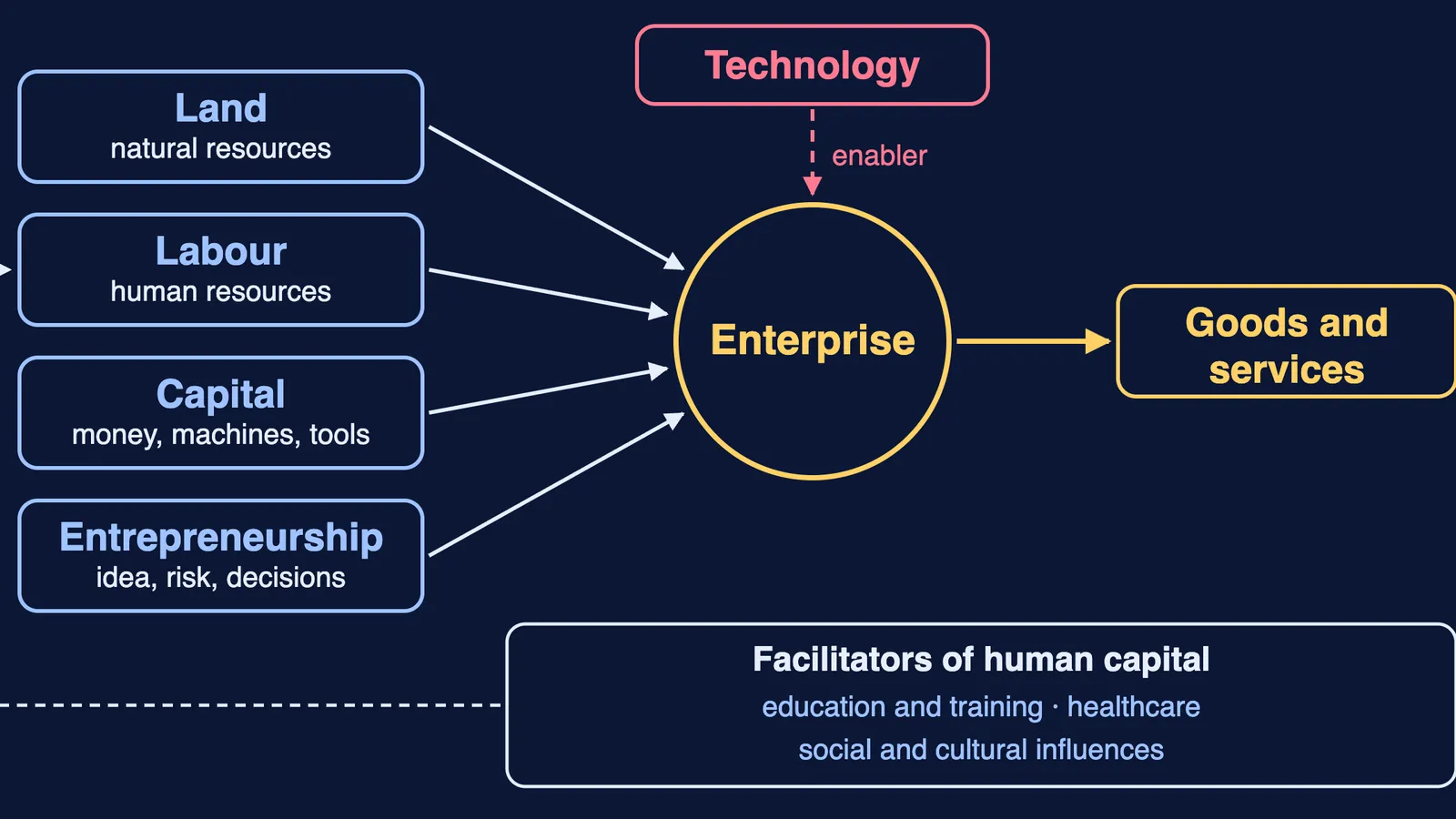
The chapter defines factors of production as the resources or inputs used to produce goods and services. It sorts them into four types:
Land: not just the ground, but all natural resources, such as soil, water, forests, sunlight, minerals and natural gas. A business buys land or rents it.
Labour: the physical and mental effort people put into production.
Capital: money plus human-made assets such as machines, tools, carts, computers and buildings.
Entrepreneurship: starting an enterprise to solve a problem, taking the risk, combining the other factors and making the key decisions.
Technology is not one of the four types. The book calls it a facilitator and an enabler of production that lets enterprises produce more from the same or fewer inputs, such as UPI payments or GPS routes.
What is human capital, and what builds it?
Human capital is the skill and knowledge behind labour: the quality and efficiency of labour, not just the effort. The chapter names three facilitators: education and training, healthcare, and social and cultural influences, such as the Japanese idea of kaizen, or continuous improvement.
Using World Bank estimates, it gives India's 2023 adult literacy rate as 85 per cent for males and 70 per cent for females. Citing the Economic Survey of India 2024, it adds that 65 per cent of Indians are under 35, which could bring a demographic dividend if they get education, health and skills.
For capital, the book lists savings, family and friends first, then bank loans with interest, and for large companies the stock market. Its entrepreneur case study is J.R.D. Tata, who started Tata Airlines in 1932.
Worked example: sorting a tiffin service's inputs
This example is ours, not the book's. Kavya starts a home tiffin service with ₹60,000: ₹20,000 savings, ₹10,000 from family and a ₹30,000 bank loan. She sells 40 tiffins a day for 25 days at ₹90, so 1,000 tiffins bring in ₹90,000 a month.
Land: kitchen rent ₹7,000, plus water and cooking gas ₹4,000.
Labour: two helpers at ₹9,500 each, ₹19,000.
Capital: a loan instalment (part of the loan plus interest) of ₹3,500, and the stoves and vessels she bought are capital too.
Ingredients: ₹30,000. Which factor are vegetables and rice? The book's own exercise asks you to sort such items, so discuss it in class.
Entrepreneurship: Kavya chooses the menu and carries the risk. What is left is hers: ₹90,000 − ₹63,500 = ₹26,500.
Now ingredient prices rise to ₹37,000. Costs rise to ₹70,500 and Kavya keeps ₹19,500. To keep ₹26,500 she needs ₹7,000 more across 1,000 tiffins, or ₹7 extra each, a price of ₹97. Raising prices is only one option; discuss others in class.
How are the factors connected?
The chapter says the mix depends on the product. Farming, construction and handicrafts are labour-intensive; semiconductor chips and satellites are capital-intensive. More machines on farms can lower the need for labour.
A missing or misused factor can slow or stop production, and the book notes that supply-chain disruptions halted production during the COVID-19 pandemic. The book also notes that India was the world's second-largest maker of mobile phones after China in 2025.
It ends with producers' duties to nature and to workers, and states that India was the first country to bring in a Corporate Social Responsibility law, in 2014, which required companies to put 2 per cent of their average profit from the previous three years into CSR.
Practice questions and where this chapter fits
Marks are our suggestion; your school sets the real paper.
Classify each as land, labour, capital or entrepreneurship: a borewell, a delivery van, a trained baker, the owner who decides prices. (2)
How is human capital different from labour? Give one example of your own. (2)
Explain two facilitators of human capital. (3)
Why is a satellite capital-intensive while a hand-woven basket is labour-intensive? (3)
A phone factory cannot get one imported part. Explain what happens to production and suggest one way to lower the risk. (5)
The chapter builds on Chapter 1, Natural Resources and Their Use, for land, and Part II continues the theme with Dynamics of Population. See human resources and population in the older Class 8 book, the Class 9 guide to scarcity and choice and how startups turn ideas into businesses in Class 9.
Not sure where to start revising? Fermi's AI tutor works out what you already know and builds a plan for the session.