On this page
"The Rise of the Marathas" is Chapter 3 of NCERT's new Class 8 Social Science book, Exploring Society: India and Beyond, Part 1 (book code hees1, first edition July 2025, reprinted March 2026)(NCERT chapter PDF; book prelims). CBSE publishes no separate 2026-27 curriculum for Classes 6 to 8 (its 2026-27 curriculum page lists Classes 9 to 12), so Class 8 follows the NCERT book and is assessed by the school.
Who were the Marathas, according to the chapter?
The chapter describes the Marathas as people of the Deccan plateau, mainly today's Maharashtra, identified by the Marathi language, whose literature goes back to the 12th century. The Yadavas ruled from Devagiri (today's Daulatabad) until the Khiljis overcame them in the early 14th century.
Bhakti saints such as Dnyaneshwar, Namdev, Tukaram and Ramdas brought texts like the Bhagavad Gītā into Marathi, giving society a cultural base that later helped the Marathas organise politically.
How did Chhatrapati Shivaji build a kingdom?
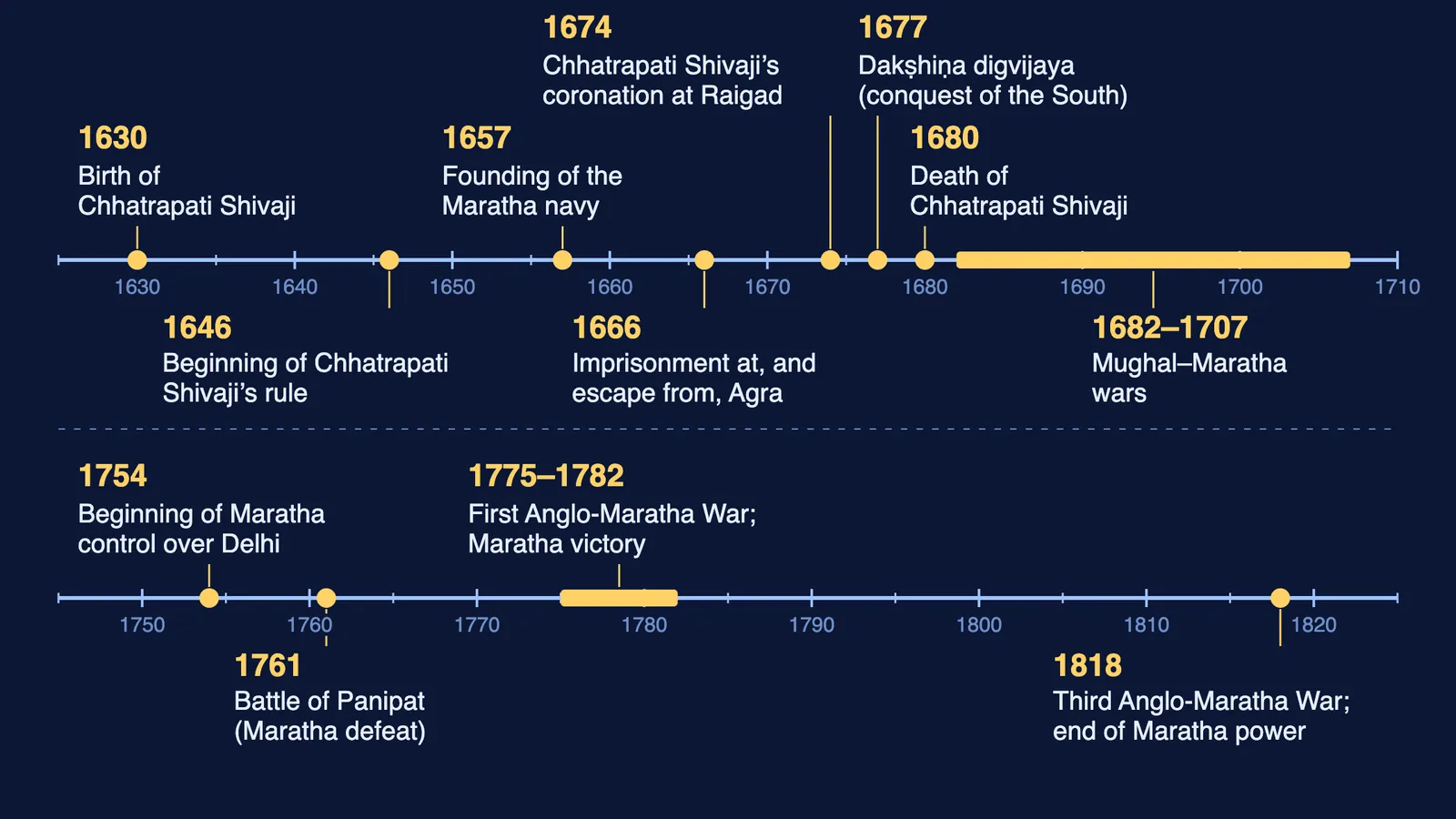
Chhatrapati Shivaji was born in 1630 to Shahji and Jijabai and grew up in his father's jāgīr at Pune (NCERT). At 16 he began taking and strengthening forts around Pune, working towards Swarājya, a sovereign kingdom.
Navy: founded in 1657 to secure the west coast; Bijapur had no full-time naval force guarding its coast.
Guerrilla warfare: small, fast groups using surprise and the hill terrain. Afzal Khan of Bijapur was killed near Pratapgad.
Surat: after Shaista Khan's three-year campaign and a night raid on his camp, Shivaji sacked this Mughal port, taking treasure worth almost one crore rupees.
Setback and escape: after the Purandar treaty with Jai Singh, he escaped house arrest at Agra in 1666 inside gift baskets.
Coronation: crowned at Raigad in 1674, he began his own era, the Rājyābhiṣheka shaka, then led a conquest of the South in 1677. He died in 1680.
What happened to the Marathas after Shivaji?
Aurangzeb captured and executed Sambhaji and took Raigad. Rajaram moved to Gingee, carrying the war south (NCERT). Aurangzeb died without defeating them, and Tarabai, Rajaram's queen, sent armies north into Mughal lands.
Power then shifted from the Chhatrapati to chiefs, above all the Peshwa (prime minister); Bajirao I and Nanasaheb Peshwa led the expansion. After a heavy defeat at Panipat in 1761, the Marathas recovered under Peshwa Madhavrao I, and Mahadji Shinde retook Delhi in 1771. Three Anglo-Maratha wars between 1775 and 1818 ended Maratha power. The chapter's conclusion is that Britain won India chiefly from the Marathas, ahead of the Mughals and every other power.
How were the Marathas governed?
Shivaji paid officials treasury salaries instead of hereditary posts or land grants, transferred them regularly, and was advised by an aṣhṭa pradhāna manḍala, a council of eight ministers (NCERT).
Taxes: chauth (25 per cent) and sardeshmukhi (a further 10 per cent) were collected from provinces not directly ruled, in return for protection.
Army: infantry, cavalry and navy; bārgīrs rode horses paid for by the state, shiledārs supplied their own.
Forts and sea: forts guarded routes and sheltered troops. Kanhoji Angre later led the navy to many victories, and the Marathas challenged the paid European trade passes (cartaz).
Justice: a local panchāyat of officials and leading men gave verdicts, with appeal to a chief; kotwāls kept order in towns.
The culture section covers Shivaji's Sanskrit seal, Ahilyabai Holkar's temples, ghats and wells, and Serfoji II of Thanjavur, under whom modern Carnatic music and the early stages of Bharatanatyam took shape. (The chapter's Let's Explore box spells it "Bharatnatyam"; the main text and this post use "Bharatanatyam".)
What does a strong answer look like?
Worked example. Question (our own): "Give two reasons the Marathas could resist a much larger Mughal army."
Name the reason: hill forts. Explain: they controlled routes and sheltered troops between raids. Evidence: Shivaji's finance minister, Ramachandrapant Amatya, called forts the core of the state.
Name the reason: guerrilla warfare. Explain: speed, surprise and terrain knowledge beat bigger forces. Evidence: the rout of Afzal Khan's army near Pratapgad.
Close with the result: Aurangzeb died in the Deccan without subduing them.
Use reason, explanation, evidence for every short answer.
Practice questions (mark labels are our suggestion):
Why did Shivaji pay officials salaries rather than give them land? (2 marks)
Arrange in order: Panipat, coronation at Raigad, escape from Agra, Delhi retaken. (2 marks)
How did the Marathas respond to the European system of paid trade passes? (3 marks)
How did the Peshwa's role change after Shivaji's time? (3 marks)
Compare Tarabai's and Ahilyabai Holkar's contributions. (5 marks)
How does this chapter connect to the rest of the book?
Chapter 2, "Reshaping India's Political Map", covers the Delhi Sultanate and the Mughals the Marathas later fought (NCERT Chapter 2). Chapter 4, "The Colonial Era in India", then explains colonialism and British rule (NCERT Chapter 4). For background, see our notes on the Mughal empire from Akbar to Aurangzeb and the old-syllabus guide to eighteenth-century political formations. Next, read how the East India Company moved from trade to territory.
Not sure where to start a new topic? Fermi's AI tutor works out what you already know and builds a plan for the session.