

On this page
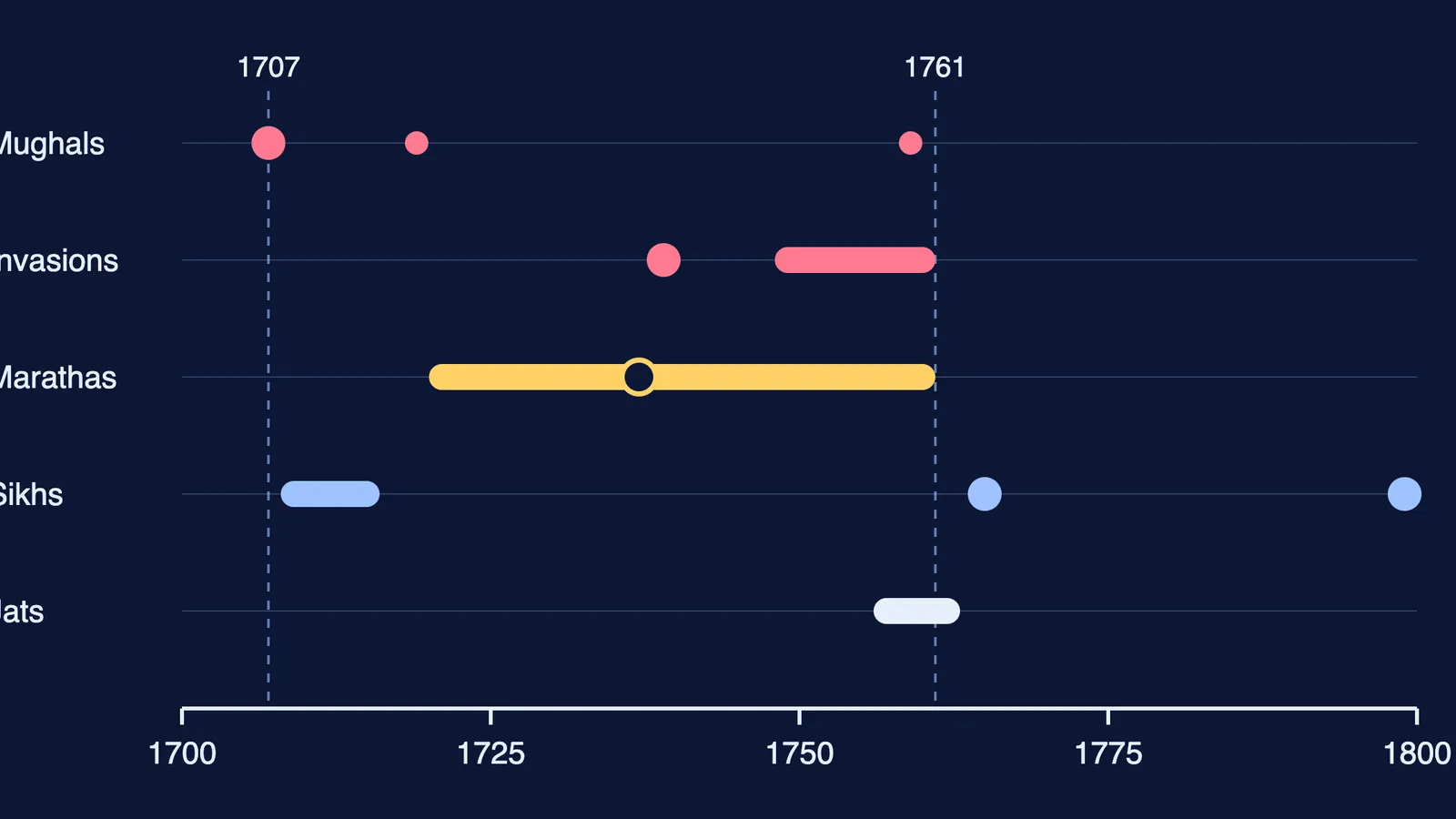
The NCERT chapter Eighteenth-Century Political Formations (Chapter 8 of Our Pasts II) asks one question: what happened when the Mughal centre could no longer hold? The answer is a map that changed fast, between Aurangzeb's death in 1707 and the third battle of Panipat in 1761.
NCERT is replacing its old Class 7 books with Exploring Society: India and Beyond, and Scroll reported in April 2025 that Part 1 drops the Mughal and Delhi Sultanate chapters; it was unclear whether Part 2 would cover them. Ask your teacher which book your exam follows before you revise.
Why did the Mughal Empire decline after 1707?
The NCERT chapter describes several causes. Learn them as five points:
Aurangzeb drained the empire's armies and treasury in a long war in the Deccan.
Later emperors could not control powerful mansabdars. Governors (subadars) took over revenue and military offices (diwani and faujdari), so less revenue reached the capital.
Peasant and zamindari rebellions spread in northern and western India.
Nadir Shah, the ruler of Iran, sacked Delhi in 1739, and the Afghan ruler Ahmad Shah Abdali invaded north India five times between 1748 and 1761.
Nobles split into two factions, the Iranis and Turanis, and later emperors became their puppets; Farrukh Siyar and Alamgir II were assassinated.
As the emperor weakened, governors and great zamindars consolidated their authority in regions such as Awadh, Bengal and Hyderabad. If you need the earlier story, our Mughal empire Class 7 summary covers Akbar to Aurangzeb.
Who built new states in the eighteenth century?
All facts in this section are from the NCERT chapter.
The Rajputs
The kings of Amber and Jodhpur had served the Mughals and now pushed outward. Sawai Raja Jai Singh of Amber founded his new capital at Jaipur and received the subadari of Agra in 1722. Maratha campaigns from the 1740s checked their growth.
The Sikhs
After Guru Gobind Singh died in 1708, the Khalsa revolted under Banda Bahadur and ran its own administration between the Sutlej and the Jamuna. Banda Bahadur was captured in 1715 and executed in 1716. The Sikhs then organised into bands called jathas and later misls, whose combined army was the dal khalsa. Under the rakhi system, cultivators received protection for a tax of 20 per cent of their produce. Maharaja Ranjit Singh reunited the groups and made Lahore his capital in 1799.
The Marathas
Shivaji (1630-1680) built a stable kingdom with the support of warrior families (deshmukhs) and mobile peasant-pastoralists (kunbis). After his death, a family of Chitpavan Brahmanas serving as Peshwa (principal minister) held effective power, and Poona became the capital. Between 1720 and 1761 the Marathas took Malwa and Gujarat, became overlords of the Deccan by the 1730s, and raided Delhi in 1737. Their campaigns made other rulers hostile, so few supported them at Panipat in 1761.
The Jats
Under Churaman, the Jats came to dominate the region between Delhi and Agra by the 1680s. Their power peaked under Suraj Mal, who consolidated the state at Bharatpur in 1756-1763.
What do chauth and sardeshmukhi mean?
Both are in the chapter's keyword list, so learn them exactly. The definitions are from the NCERT chapter.
Chauth was 25 per cent of the land revenue claimed by zamindars; in the Deccan, the Marathas collected it.
Sardeshmukhi was 9-10 per cent of the land revenue paid to the head revenue collector in the Deccan.
A misl was one of the Sikh bands that together formed the dal khalsa.
How should you revise this chapter?
A 40-minute plan for the night before a test:
Minutes 0-10: write the five causes of decline from memory, then check them against the book.
Minutes 10-25: make one row per power (Rajputs, Sikhs, Marathas, Jats): leader, region, one date, one key term.
Minutes 25-35: draw one cause-and-effect chain, like the worked example below.
Minutes 35-40: answer the exercise question "Why did the Marathas want to expand beyond the Deccan?" in four sentences.
Worked example of a chain: Aurangzeb's Deccan war drains money, so later emperors cannot control governors; revenue stops reaching Delhi; the centre weakens further after Nadir Shah's raid in 1739; regional powers fill the gap.
Our guide to making a cause-and-effect chart for a history chapter shows the full method, and if a chatbot gave you a date, check AI's history dates against NCERT before you learn it.
Fermi teaches STEM, not history. For your science and maths chapters, Fermi's AI tutor works out what you already know and builds a plan for the session, so you start with a clear next step.


