

On this page
If your Class 7 history book is NCERT's *Our Pasts II*, revising the Mughal chapter comes down to three things: the rulers in order, how the empire was run, and what it built. This page puts all three on one sheet, with a 20-minute plan to make it stick.
First, check which book your school uses. NCERT's new Class 7 social science book, *Exploring Society: India and Beyond*, has no sections on the Mughals in its first part, India TV reported in April 2025; a second part was due later. Our guide on how to check the deleted NCERT syllabus shows how to confirm what your school follows.
Who were the six Mughal emperors, in order?
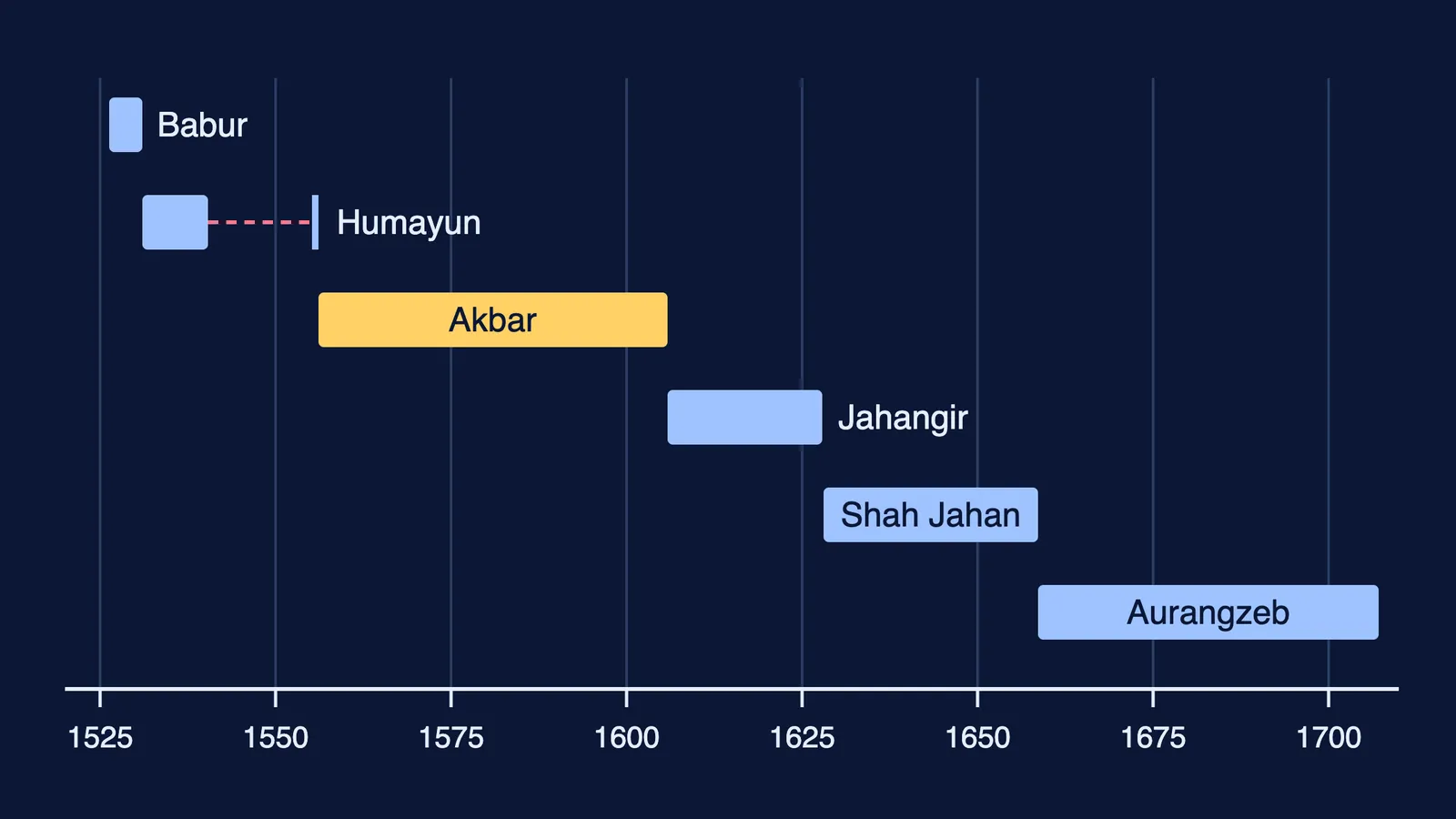
The Mughals descended from Genghis Khan on their mother's side and from Timur on their father's side, according to NCERT's chapter The Mughals. The chapter has no table of rulers, so reign dates and most events below follow the list of Mughal emperors on Wikipedia.
Babur (1526-1530): defeated Ibrahim Lodi, the Sultan of Delhi, at Panipat in 1526 and captured Delhi and Agra.
Humayun (1530-1540 and 1555-1556): was overthrown by Sher Shah Suri, fled to Persia, and won the throne back in 1555.
Akbar (1556-1605): came to the throne as a child under the regent Bairam Khan and built up the mansabdari system; his minister Todar Mal set up zabt, and Jahangir described Akbar's policy of sulh-i kul, or universal peace.
Jahangir (1605-1627): married Mehrunnisa in 1611; she received the title Nur Jahan.
Shah Jahan (1628-1658): commissioned the Taj Mahal and the Red Fort; was deposed and imprisoned by his son Aurangzeb.
Aurangzeb (1658-1707): NCERT's campaign map marks Bijapur (1685) and Golconda (1687) in the Deccan. Later, nobles holding provinces like Hyderabad and Awadh founded their own dynasties, while still recognising the emperor in Delhi.
To remember the order, use the first letters B, H, A, J, S, A: Big Horses Always Jump Steep Arches.
What was the mansabdari system?
A mansabdar was an individual who held a mansab, a position or rank used to fix a noble's rank, salary and military responsibilities, as NCERT's Class 7 chapter explains. Learn it as a chain of four links:
Zat: a number that set rank and salary. The higher the zat, the more prestige and pay.
Sawar: the cavalrymen a mansabdar had to keep. He brought them for review and registration, had their horses branded, then was paid.
Jagir: the salary came as a revenue assignment, not cash from the treasury. Most mansabdars did not live in or govern their jagirs; their servants collected the revenue.
Strain: by Aurangzeb's reign, mansabdars had multiplied, jagirs were scarce and often yielded less than granted, so jagirdars extracted all they could and peasants suffered.
Two sets of NCERT numbers are worth quoting. Under Akbar there were 29 mansabdars with a zat of 5,000; by Aurangzeb's reign there were 79. In the twentieth year of Shah Jahan's reign, the 445 highest-ranking mansabdars, 5.6 per cent of 8,000, received 61.5 per cent of the empire's estimated revenue as salaries for themselves and their troopers.
The chapter pairs this with zabt: Akbar's revenue minister Todar Mal surveyed crop yields, prices and cultivated areas for ten years, 1570 to 1580, and tax on each crop was then fixed in cash.
Which Mughal buildings should you know?
For each building, learn who built it and one date.
Humayun's tomb, Delhi: built for Humayun's widow, Empress Bega Begum, between 1565 and 1572; the first garden-tomb on the Indian subcontinent (Humayun's tomb on Wikipedia).
Fatehpur Sikri: founded by Akbar in 1571 and his capital until 1585 (Fatehpur Sikri on Wikipedia).
Taj Mahal, Agra: commissioned by Shah Jahan in 1631 for the tomb of Mumtaz Mahal; the mausoleum was completed in 1648 (Taj Mahal on Wikipedia).
Red Fort, Delhi: Shah Jahan's palace-fortress, completed in 1648 (Red Fort on Wikipedia). NCERT notes the Prime Minister speaks from its ramparts on Independence Day.
How do you revise the Mughal chapter in 20 minutes?
Keep the book closed; check it after each step.
Minutes 0-5: write the mnemonic, then the six names and their dates. Circle any you missed.
Minutes 5-10: draw the mansabdari chain, zat to sawar to jagir to peasant, and write one line under each link.
Minutes 10-15: match each building to its builder and city.
Minutes 15-20: answer one question aloud in five sentences: why did a rise in the number of mansabdars hurt peasants?
That last question is about cause and effect, and a cause-and-effect chart for a history chapter turns it into a picture you can redraw in the exam. If you used an AI chatbot to make notes, check its history dates against NCERT before you learn them.
If this is one of several chapters before a test and you do not know where to start, Fermi's AI tutor can work out what you already know and build a plan for the session, so you sit down to a clear next step.


