On this page
Chapter 4 of the new Class 8 Social Science book asks how European traders, and then the British Crown, came to rule India, and what that meant for its people. It sits in Exploring Society: India and Beyond, Part I (book code hees1, first edition July 2025, reprinted March 2026), on pages 83 to 116.
Classes 6 to 8 follow the NCERT book. CBSE's 2026-27 curriculum page lists documents for Classes 9 to 12 only. This chapter is assessed by the school.
What does the chapter cover?
The chapter PDF opens with four big questions: what colonialism is, why Europeans came, India's economic standing, and British rule's impact. Its sections:
The age of colonialism. Colonialism, in the book's sense, is one country taking control of another region, settling there and imposing its own systems.
Europeans in India. The Portuguese, the Dutch, the French, then the British.
From traders to rulers, then famine and the drain of wealth.
Changing landscapes: industry, village governance, law, education, railways.
Resistance up to 1857, Crown rule from 1858, and the legacy of colonialism.
How did the four European powers differ?
One fact per power, from the chapter:
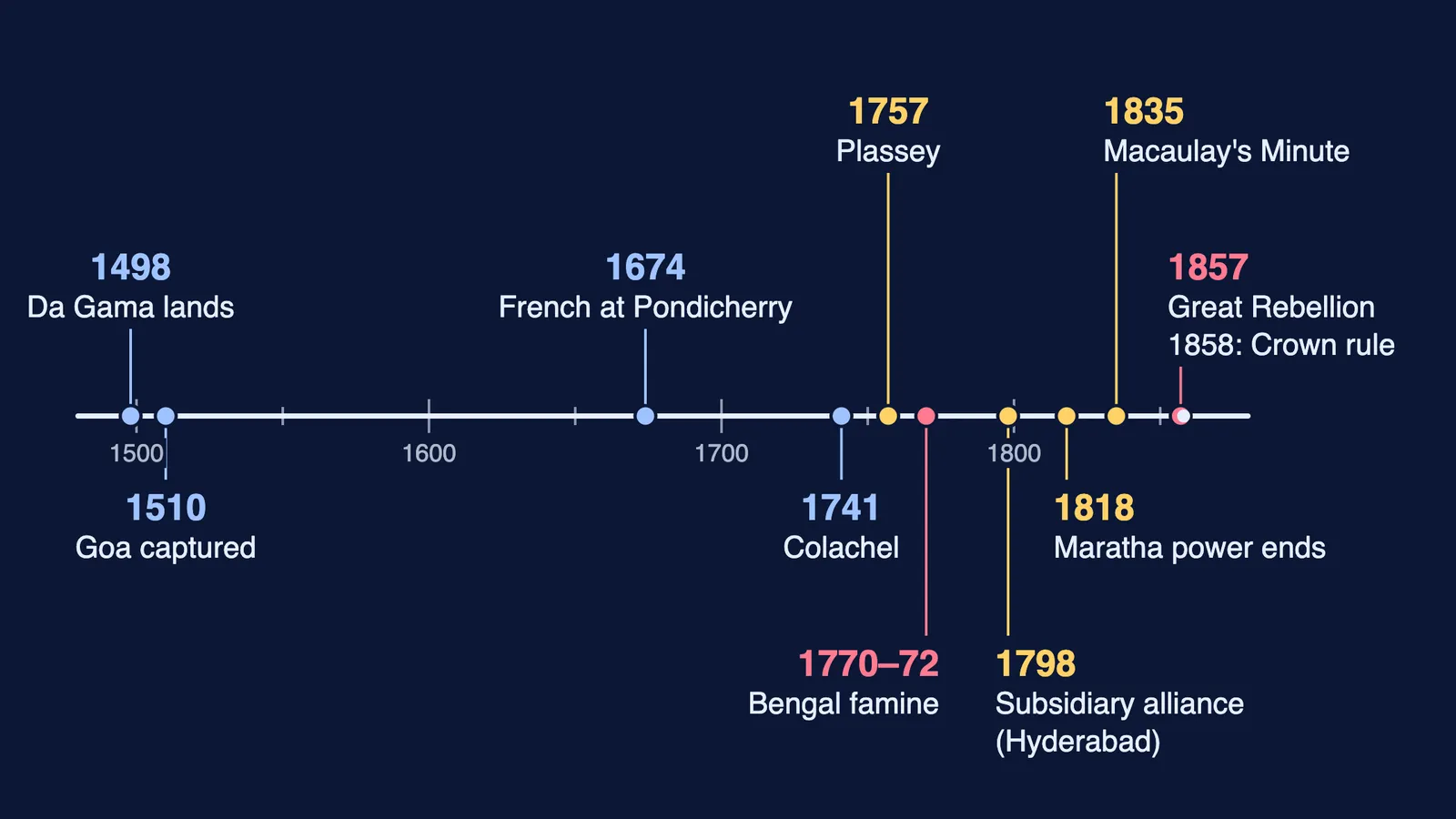
Portuguese: Vasco da Gama landed near Kozhikode in 1498. They took Goa in 1510 and made ships in the Arabian Sea buy a permit called a cartaz.
Dutch: mainly traders, strongest in the Malabar region. Their presence declined after King Marthanda Varma of Travancore defeated them at Colachel in 1741.
French: at Pondicherry from 1674. Dupleix, who led French India as Governor-General in 1742-1754, trained Indian soldiers called sepoys and backed puppet rulers. The Carnatic Wars (1746-1763) checked them.
British: the English East India Company held a royal charter from Queen Elizabeth I and began with posts at Surat, Madras, Bombay and Calcutta.
How did a trading company become a ruler?
The chapter answers with methods, not one war:
Divide and rule: taking sides in rivalries and succession disputes. At Plassey in 1757, Robert Clive made a secret deal with Mir Jafar, military commander of Nawab Siraj-ud-daulah, whose troops stood aside.
Subsidiary alliance: a ruler accepted a British Resident, paid for British troops and handled foreign relations only through the British. Hyderabad joined in 1798.
Doctrine of Lapse: a princely state was annexed if its ruler died without a natural male heir, setting aside adoption.
The chapter then counts the cost. It says the Bengal famine of 1770-1772 followed two years of crop failure and harsh Company revenue demands, and killed nearly one-third of the population, or an estimated 10 million people; the book names no source for this figure. It covers the drain of wealth compiled by Dadabhai Naoroji and R.C. Dutt. It argues that railways mainly carried raw materials to ports and were mostly paid for by Indian taxes, and covers Macaulay's 1835 Minute on education.
Who resisted, and how did Company rule end?
Sannyasi-Fakir rebellion in Bengal after the 1770 famine.
Kol Uprising (1831-1832) in Chota Nagpur, and the Santhal Rebellion (1855-1856) led by Sidhu and Kanhu Murmu.
Indigo Revolt (1859-1862) of Bengal peasants against European planters.
Vellore (1806), then the Great Rebellion of 1857: Mangal Pandey at Barrackpore, sepoys marching from Meerut to Delhi, and leaders such as Rani Lakshmibai and Begum Hazrat Mahal.
In 1858 the British Crown took control from the Company.
Worked example: a 5-mark answer on economic standing
Question (marks are our suggestion): "Using the figures the chapter cites, explain how India's place in the world economy changed under colonial rule."
One point per mark, each tied to the chapter and to whoever it credits:
Before: estimates, chiefly those of economist Angus Maddison, suggest India produced at least one-fourth of world GDP until the 16th century.
Industry: heavy British duties on Indian textiles and low tariffs on British goods ruined India's textile industry; iron, steel and paper suffered too.
Drain: Naoroji (1901) and Dutt compiled the drained wealth from British reports; their studies showed many billions of pounds.
A recent estimate: Utsa Patnaik puts the drain for 1765 to 1938 at 45 trillion U.S. dollars, at today's value.
After: the chapter itself says India's share of world GDP fell to hardly 5 per cent by Independence. It names no economist for this figure.
Practice questions and where this chapter fits
Marks are our suggestion.
Name the battle of 1741 and explain why the book calls it rare. (2)
What was a cartaz, and how did it help the Portuguese control trade? (2)
Give two reasons the chapter offers for the severity of colonial-era famines. (3)
Why does the chapter say the Kol Uprising began, and who took part? (3)
Compare the Santhal Rebellion and the Indigo Revolt: who rose, against whom, and how each ended. (5)
It follows Chapter 3, The Rise of the Marathas. Part II continues in Chapter 2, India's Long Road to Independence. From the older textbook, see how the Company moved from trade to territory, the causes and course of 1857 and a freedom struggle timeline from 1857 to 1947.
Not sure where to begin revising? Fermi's AI tutor works out what you already know and builds a plan for the session.