

On this page
Class 8 questions on When People Rebel: 1857 and After come back to four things: why people rebelled, how a mutiny at Meerut spread, who led it, and what changed afterwards. This guide follows the NCERT chapter When People Rebel: 1857 and After from Our Pasts III.
Why did people rebel in 1857?
The NCERT chapter sorts the causes by who was angry:
Rulers: the Company refused Rani Lakshmibai's adopted son as heir to Jhansi and refused Nana Saheb his adoptive father's pension. Awadh was taken over in 1856. In 1856, Governor-General Canning decided that Bahadur Shah Zafar would be the last Mughal king.
Peasants and zamindars: they resented high taxes and rigid revenue collection, and many who could not repay moneylenders gradually lost their lands.
Sepoys: they were unhappy with pay and conditions, and a law of 1856 made new recruits agree to serve overseas, which many believed would cost them their religion and caste.
Religion and reform: laws against sati and for widow remarriage, and an 1850 law letting converts to Christianity inherit ancestral property, made many feel their religion was under attack.
The trigger was the new rifle cartridge, suspected of being coated with the fat of cows and pigs.
How did the revolt spread from Meerut to Delhi?
These are the dates the NCERT chapter gives, in order:
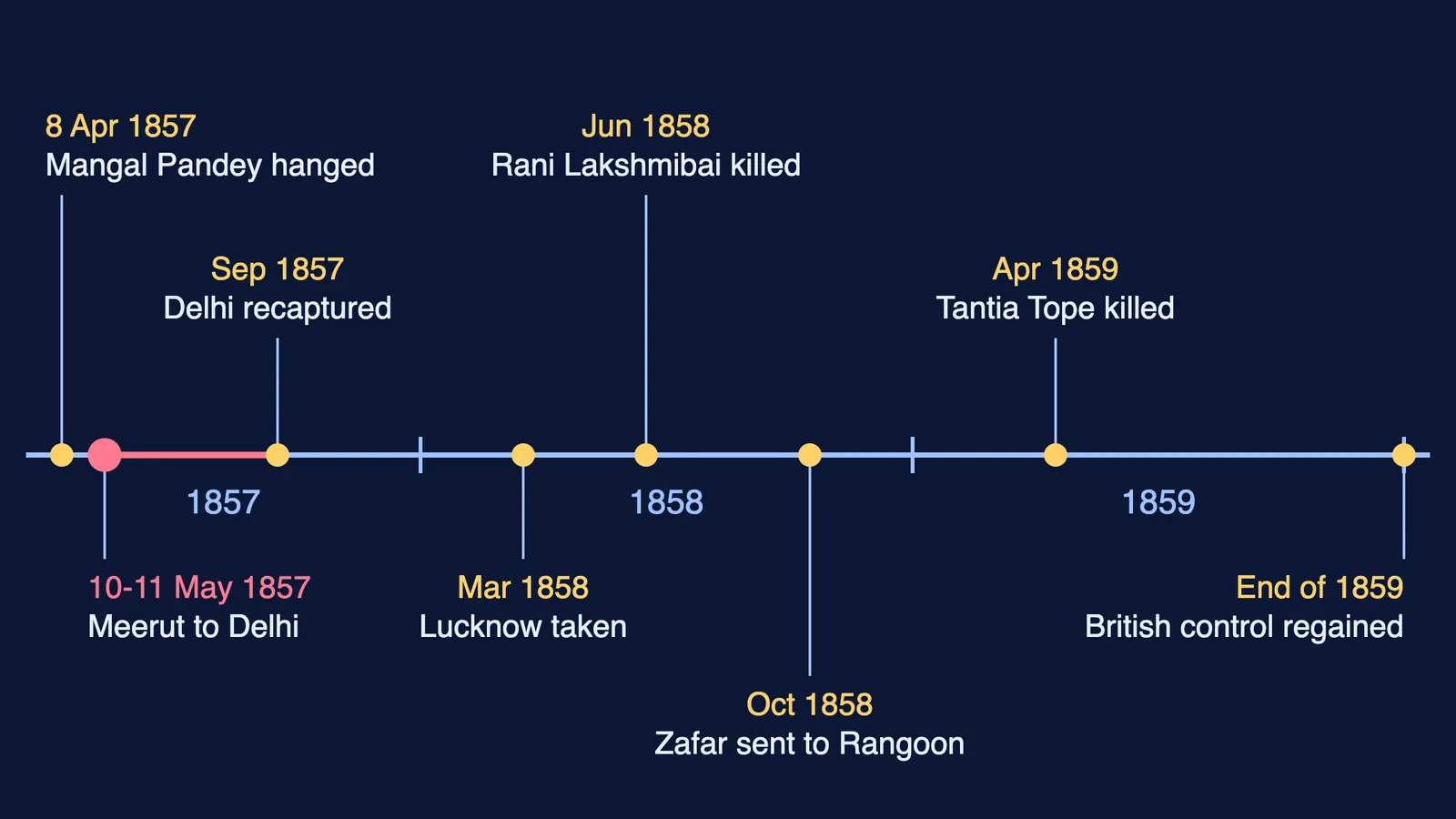
8 April 1857: Mangal Pandey was hanged for attacking his officers in Barrackpore.
9 May 1857: 85 sepoys at Meerut who refused to drill with the new cartridges were dismissed and sentenced to ten years in jail.
10 May 1857: the other soldiers at Meerut freed them, killed British officers, seized guns and declared war on the firangis.
11 May 1857: after riding all night they reached Delhi, the regiments there joined them, and they proclaimed Bahadur Shah Zafar their leader.
Zafar wrote to rulers across the country asking them to unite against the British. After about a week, regiment after regiment mutinied and joined troops at Delhi, Kanpur and Lucknow, and townspeople and villagers rallied behind local leaders. That is how a mutiny, which NCERT defines as soldiers as a group disobeying their officers, became a popular rebellion.
Who were the key leaders of 1857?
Match each leader to a place, using the NCERT chapter:
Bahadur Shah Zafar, Delhi: the Mughal emperor the rebels proclaimed their leader.
Nana Saheb, Kanpur: expelled the British garrison and proclaimed himself Peshwa.
Begum Hazrat Mahal, Lucknow: her son Birjis Qadr was proclaimed Nawab, and she helped organise the uprising.
Rani Lakshmibai, Jhansi: fought alongside Tantia Tope, Nana Saheb's general.
Rani Avantibai Lodhi, Ramgarh (Mandla): raised and led an army of four thousand.
Kunwar Singh, Bihar: an old zamindar who fought for many months.
Bakht Khan, Delhi: a soldier from Bareilly who became a key military leader.
How did the British crush the revolt?
The Company recaptured Delhi in September 1857, according to the NCERT chapter. Zafar was sentenced to life imprisonment, sent to Rangoon in October 1858, and died there in November 1862. Lucknow fell in March 1858, Rani Lakshmibai was killed in June 1858, and Tantia Tope was captured, tried and killed in April 1859. The British had regained control by the end of 1859.
What changed after 1858?
The NCERT chapter lists six changes:
An Act of 1858 transferred the Company's powers to the British Crown. A Secretary of State for India took charge, and the Governor-General became the Viceroy.
Ruling chiefs were promised no more annexations and could pass kingdoms to heirs, including adopted sons, under the British Queen as Sovereign Paramount.
The proportion of Indian soldiers in the army was cut and more European soldiers were added, and more recruits came from the Gurkhas, Sikhs and Pathans instead of Awadh, Bihar, central and south India.
Muslims' land and property was confiscated on a large scale, because the British blamed them for the rebellion.
The British promised to respect Indian religious and social customs.
Policies protected landlords' and zamindars' rights over land.
A 20-minute revision plan
Minutes 1 to 5: write the four Meerut-to-Delhi dates from memory, then check them.
Minutes 6 to 10: write cause and change pairs: heirs refused, then adopted heirs allowed; sepoys rebelled, then fewer Indian soldiers and more recruits from the Gurkhas, Sikhs and Pathans; reforms feared, then a promise to respect customs.
Minutes 11 to 15: cover the places in the leaders list and recall each one aloud.
Minutes 16 to 20: answer the textbook question on how British policies changed after 1857, in six points.
For the bigger picture, see how the East India Company went from trade to territory and place 1857 on our freedom struggle timeline for Class 8. For maths and science, Fermi's AI tutor can work out what you already know and build a plan for the session.


