On this page
Number Play is Chapter 5 of Ganita Prakash, Grade 8 Part I, NCERT's new maths book (code hegp1, First Edition July 2025, reprinted January 2026, pages 112 to 135). It asks why divisibility shortcuts work.
CBSE's curriculum page for 2026-27 lists Classes 9 to 12 only. There is no separate CBSE curriculum for Class 8, which follows the NCERT book, so the chapter is assessed by your school.
What does Number Play cover in Class 8 Ganita Prakash?
Three sections, in this order:
Is This a Multiple Of? Sums of consecutive numbers, parity of expressions, adding even numbers to get multiples of 4, 'Always True, Sometimes True or Never True' statements, and remainder forms such as 5k + 3.
Checking Divisibility Quickly. Why the tests for 10, 5 and 2 work, shortcuts for 9, 3 and 11, combined tests for 6 and 24, and digital roots, which the book notes Aryabhata II (c. 950 CE) described in his Mahāsiddhānta.
Digits in Disguise. Cryptarithms, now with multiplication.
Its summary lists four divisibility facts; one says a common divisor of two numbers also divides their sum and difference.
Why do all the plus-minus expressions have the same parity?
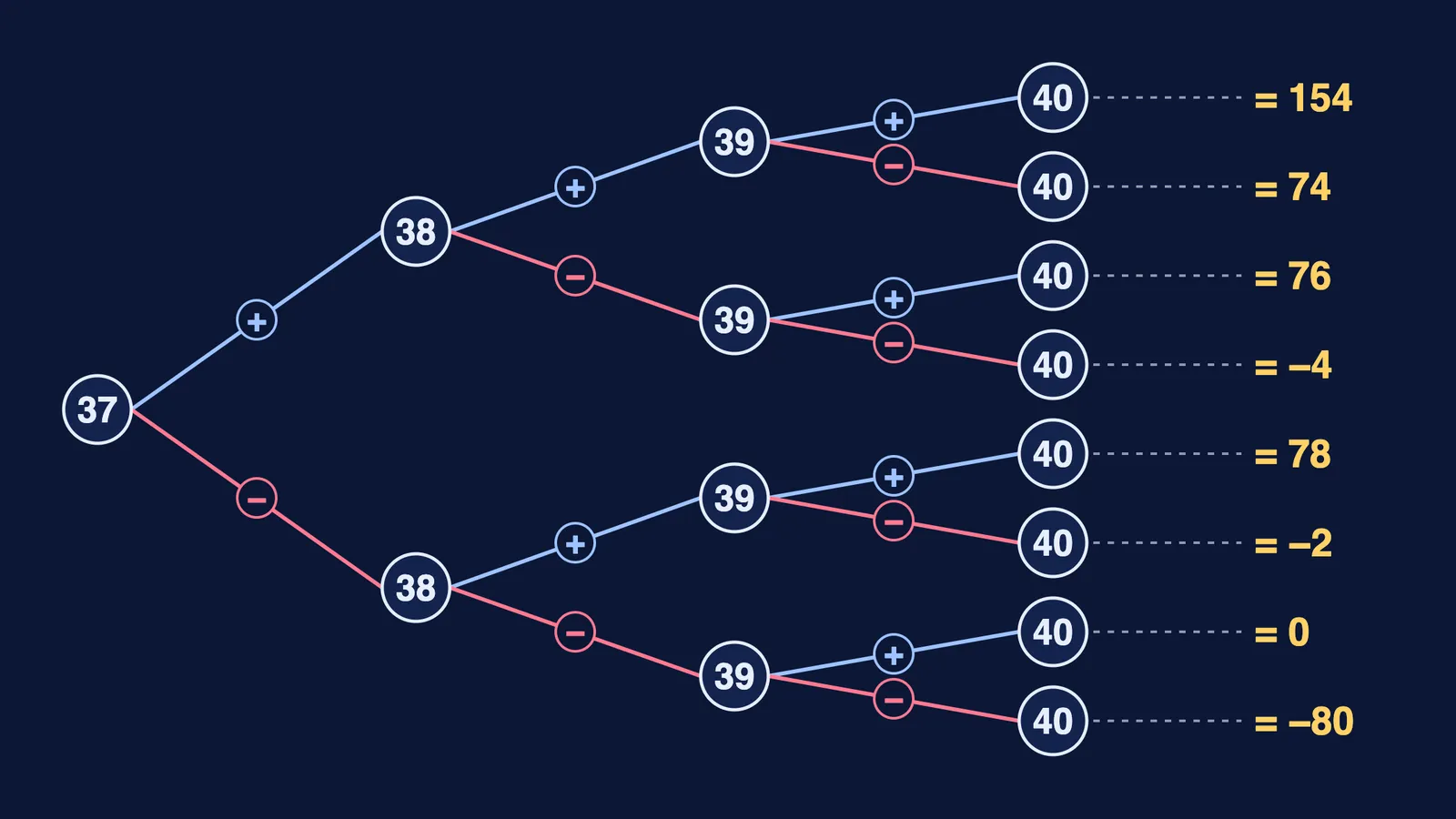
Signs between four consecutive numbers give eight expressions. With our numbers 37, 38, 39 and 40, the results are 154, 74, 76, −4, 78, −2, 0 and −80: all even, as the diagram shows.
Flipping one sign, say +38 to −38, changes the value by 2 × 38 = 76, an even number, so parity stays the same. Every expression comes from 37 + 38 + 39 + 40 = 154 by flips, so all eight are even.
How do the shortcuts for 9, 3 and 11 work?
Ten, a hundred and a thousand each exceed 9, 99 or 999 by one. So a number and its digit sum give equal remainders when divided by 9, or by 3. For 11, place values swing between just above and just below a multiple of 11, so the digits get alternating signs, with '+' on the units digit. Our guides explain why the digit-sum test works for 3 and 9 and why the alternating sum works for 11.
Worked example (ours): find the remainders when 58,463 is divided by 9 and by 11.
Digit sum: 5 + 8 + 4 + 6 + 3 = 26, then 2 + 6 = 8, the digital root, so the remainder is 8. Check: 58,463 − 9 × 6,495 = 8.
Alternating sum: 3 − 6 + 4 − 8 + 5 = −2, so 58,463 is 2 short of a multiple of 11 and the remainder is 9. Check: 58,463 − 11 × 5,314 = 9.
Combine tests with care: 36 passes for 4 and 6 but not 24, since LCM(4, 6) = 12. Test 3 and 8 instead.
How do you sort 'Always', 'Sometimes' or 'Never' statements?
Write the general form. 'A multiple of 35 plus a multiple of 56 is a multiple of 7' is always true: 35a + 56b = 7(5a + 8b). 'Two numbers that each leave remainder 5 on division by 8 add to a multiple of 8' is never true: (8a + 5) + (8b + 5) = 8(a + b + 1) + 2. For example, 53 + 69 = 122 = 120 + 2. For 'sometimes', give an example and a counterexample.
Practice questions (our suggestion)
Our own questions, not the book's; marks are our suggestion.
Without evaluating, show that no choice of signs in 61 ± 62 ± 63 ± 64 gives 35. (2 marks)
Always, sometimes or never: 'A number divisible by 6 and by 25 is divisible by 300.' (2 marks)
Without long division, find the remainders when 52,673 is divided by 9 and by 11. (3 marks)
Solve the cryptarithm AB × 7 = CAB. (3 marks)
Find every digit d for which 6d28 is divisible by 24. (3 marks)
Answers: 1. All share the parity of 61 + 62 + 63 + 64 = 250, even; 35 is odd. 2. Sometimes: LCM(6, 25) = 150, and 150 is not a multiple of 300, while 300 is. 3. Digit sum 23, then 5, so remainder 5; 3 − 7 + 6 − 2 + 5 = 5, so remainder 5. 4. A = 5, B = 0, C = 3: 50 × 7 = 350. 5. 16 + d must be a multiple of 3, so d is 2, 5 or 8; of 228, 528 and 828 only 528 is divisible by 8, so d = 5 and 6,528 = 24 × 272.
How does this chapter connect to the rest of the book?
It builds on Class 7, whose Number Play chapter covered parity and cryptarithms (read our Class 7 Number Play guide). Chapter 6, We Distribute, Yet Things Multiply, follows, and Part II's Algebra Play returns to divisibility tricks.
Not sure which step of a proof you are missing? Fermi's AI tutor works out what you already know and builds a plan for the session.