On this page
Add up the digits; if the total is divisible by 3, so is the number. The rule is easy to state. The reason it works fits in three lines.
Why does the sum of digits test work for 3 and 9?
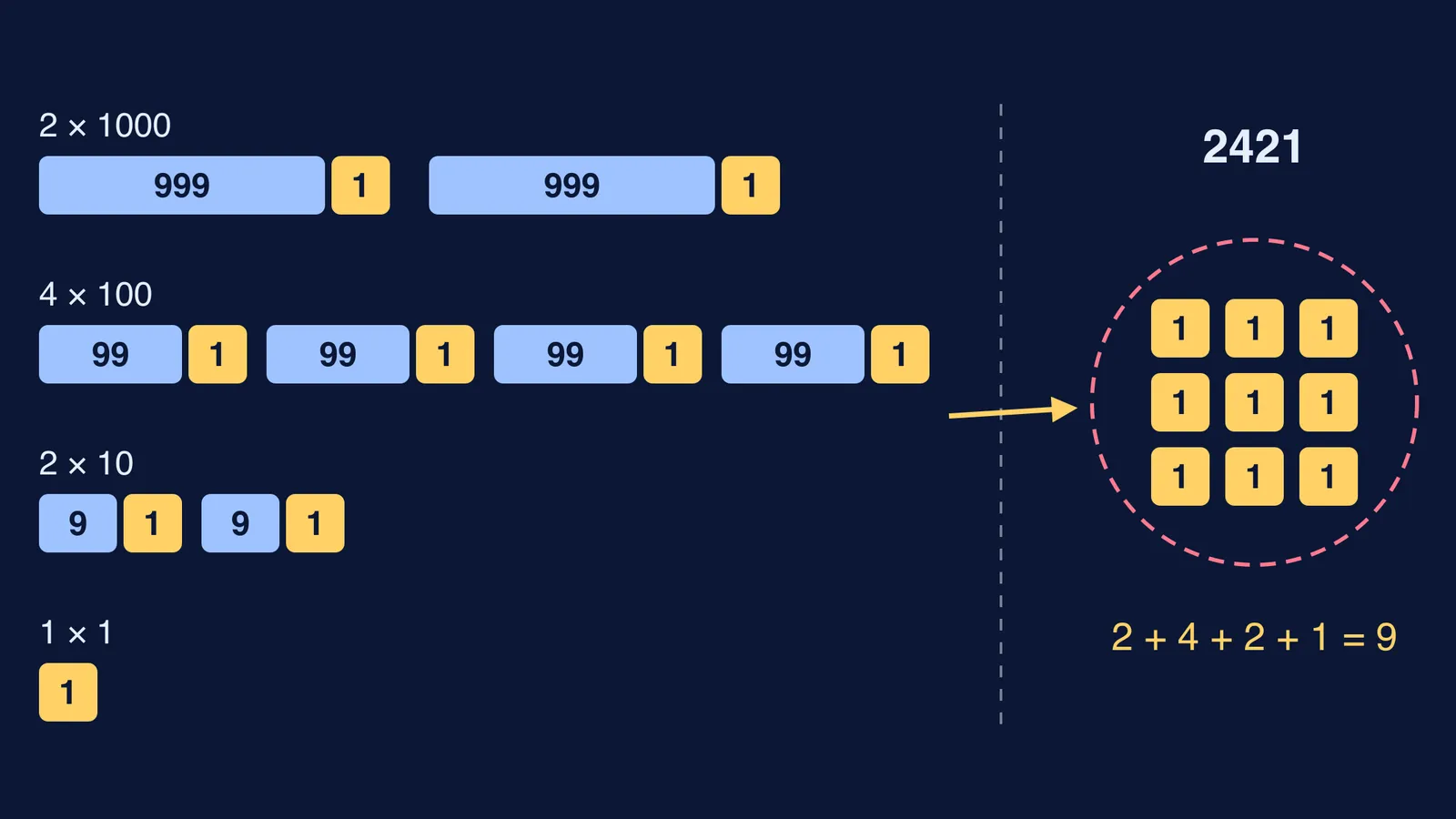
Start with place value. Any whole number is its digits multiplied by powers of 10. For example, 8472 = 8 × 1000 + 4 × 100 + 7 × 10 + 2.
Now look at the powers of 10 themselves. Each one is a string of 9s plus one: 10 = 9 + 1, 100 = 99 + 1, 1000 = 999 + 1, and so on. NCERT's Class 8 textbook, Ganita Prakash, Chapter 5 "Number Play", builds the rule from exactly this pattern.
Regroup: 8472 = (8 × 999 + 4 × 99 + 7 × 9) + (8 + 4 + 7 + 2).
The first bracket is a multiple of 9. The second is the digit sum, 21. So 8472 is "a multiple of 9, plus 21": a number and its digit sum differ by a multiple of 9.
What is the general proof?
Write a number N with digits a, b, c and so on, so that N = a × 10ᵏ + b × 10ᵏ⁻¹ + ... + (last digit) × 1. Let S be the sum of the digits. Subtract S from N:
N − S = a × (10ᵏ − 1) + b × (10ᵏ⁻¹ − 1) + ...
Each 10ᵏ − 1 is written as k nines, 99...9, which equals 9 × 11...1. So every term on the right is a multiple of 9, and N − S is a multiple of 9.
So N and S leave the same remainder on division by 9, and, since 9 is a multiple of 3, on division by 3. That gives the rule both ways:
N is divisible by 9 if and only if S is divisible by 9.
N is divisible by 3 if and only if S is divisible by 3.
In remainder notation, 10 ≡ 1 (mod 9), so every power of 10 behaves like 1; Wikipedia's article on divisibility rules gives this version of the proof for 3.
Worked example: is 8472 divisible by 3 or 9?
Add the digits: 8 + 4 + 7 + 2 = 21.
21 is divisible by 3, so 8472 is divisible by 3. Check: 8472 = 3 × 2824.
21 is not divisible by 9, so 8472 is not divisible by 9.
Find the remainder: add again, 2 + 1 = 3. So 8472 leaves remainder 3 on division by 9. Check: 8472 = 9 × 941 + 3.
The NCERT chapter notes that adding digits repeatedly until one digit is left gives the remainder on division by 9. One caution: if that last digit is 9, the remainder is 0.
Why doesn't the digit sum work for 7 or 11?
Because the trick depends on 10 − 1 = 9, and the only numbers that divide 9 are 1, 3 and 9. For 7, the powers of 10 do not all leave remainder 1: 10 leaves remainder 3 and 100 leaves remainder 2, so a plain digit sum tells you nothing.
11 is a near miss. 10 is one less than 11, so the powers of 10 alternate between one more and one less than a multiple of 11. That is why the test for 11 subtracts alternate digits, as we explain in why the alternating-sum rule for 11 works.
Which mistakes should you check for before an exam?
Reversing the 3 and 9 rule. Divisible by 9 means divisible by 3, not the other way round. The NCERT chapter gives 15, 33 and 87 as multiples of 3 that are not multiples of 9.
Trusting casting out nines too far. Checking multiplication with digit sums uses the same idea. Wolfram MathWorld says the method was probably developed on the Indian subcontinent and is sometimes called "the Hindu check", and that it misses errors which keep the digit sum the same, such as swapped digits or an extra zero. Our guide to checking multiplication by casting out nines walks through it.
Missing-digit questions. If 4_72 must be divisible by 9, the known digits add to 13, so the blank must lift the sum to 18: the digit is 5, and 4572 = 9 × 508. There are more of these in finding the missing digit for divisibility by 9.
If a remainder or divisibility step keeps tripping you up, the Fermi Problem Library has worked problems with a step-by-step solver that explains the reasoning rather than printing an answer. To revisit place value or remainders on their own, each one has its own lesson in the Fermi Concept Library.