

On this page
Questions like "If 21y5 is a multiple of 9, find y" turn up in school tests and aptitude sections. You never need to divide: you need one rule, a quick addition, and the habit of asking whether there is a second answer.
Why does the digit sum decide divisibility by 9 and 3?
NCERT's Class 8 textbook Ganita Prakash, Chapter 5 "Number Play" gives the rule in both directions: if a number is divisible by 9, the sum of its digits is divisible by 9, and if the digit sum is divisible by 9, so is the number.
The reason is place value. Since 10 = 9 + 1, 100 = 99 + 1 and 1000 = 999 + 1, every place value is one more than a multiple of 9, as Wolfram MathWorld's page on divisibility tests sets out. Remove the multiples of 9 from 7309 and what is left is 7 + 3 + 0 + 9 = 19; repeating gives 1 + 9 = 10, then 1. So 7309 leaves a remainder of 1 when divided by 9 (7308 is 9 × 812).
The rule for 3 works for the same reason, because every power of 10 also leaves a remainder of 1 when divided by 3. A number is divisible by 3 if its digit sum is divisible by 3.
How do you find a missing digit so a number is divisible by 9?
Use three steps.
Add every digit you know.
Find the next multiple of 9 at or above that sum.
The missing digit is the gap. Then check whether the gap plus 9 is still a single digit.
Worked example 1: 21y5. Known digits: 2 + 1 + 5 = 8. The next multiple of 9 is 9, so y = 1. Adding 9 more would need y = 10, which is not a digit. One answer: 2115, which is 9 × 235.
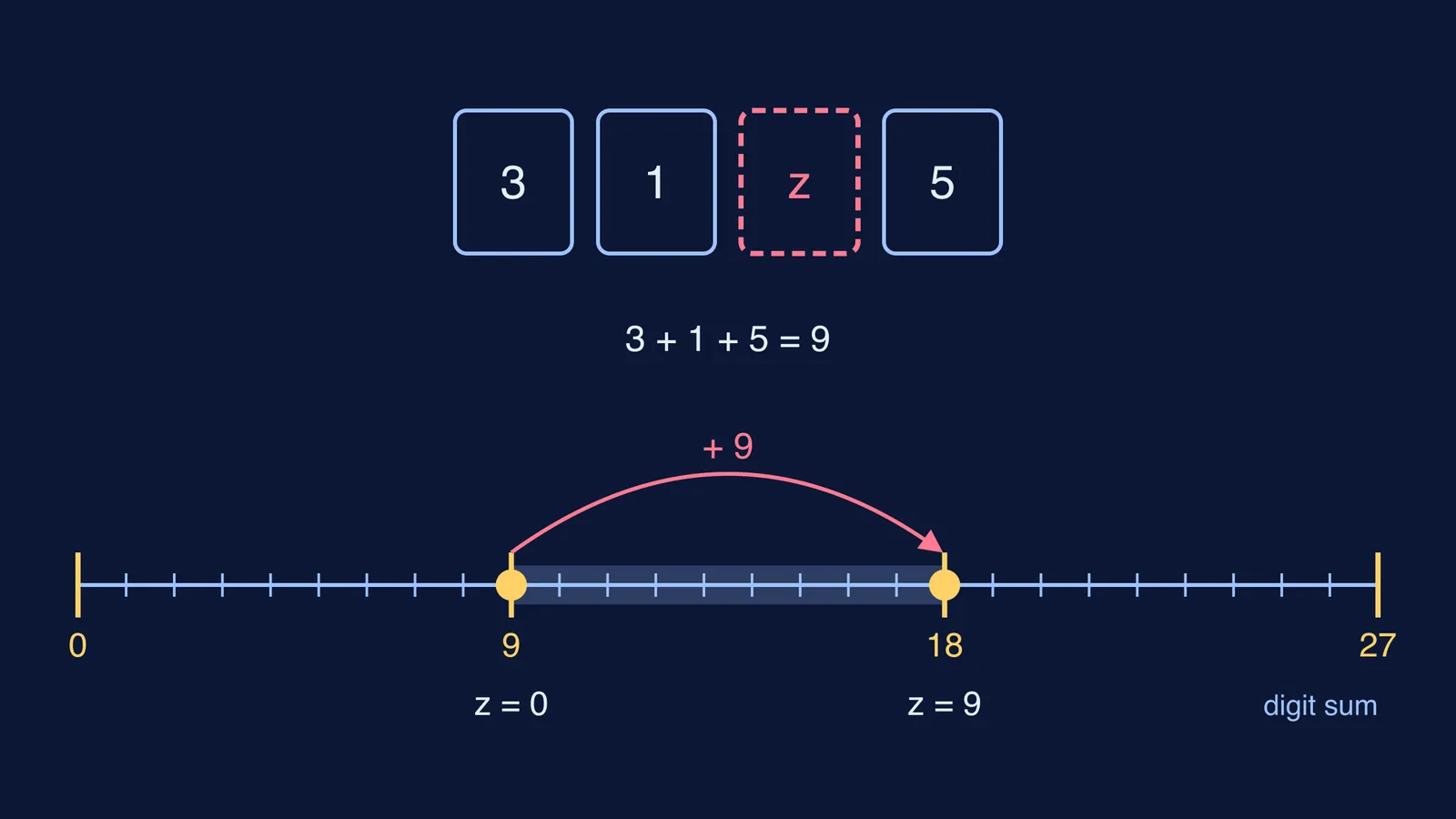
Worked example 2: 31z5. The NCERT chapter asks you to "explain why there are two answers to this problem." Known digits: 3 + 1 + 5 = 9, already a multiple of 9. So z = 0 works (sum 9), and z = 9 works too (sum 18). Both 3105 and 3195 are divisible by 9.
When does a missing digit have two or more answers?
For 9, the blank adds between 0 and 9 to the sum. That range holds one multiple of 9, or two when it starts on one, which is why 31z5 has two answers and 21y5 has one.
For 3, the range of 0 to 9 holds three or four multiples of 3, so you always get several answers. Group the digits by their remainder when divided by 3:
Remainder 0: 0, 3, 6, 9 (four choices)
Remainder 1: 1, 4, 7 (three choices)
Remainder 2: 2, 5, 8 (three choices)
Worked example 3: 7_4 divisible by 3. Known digits: 7 + 4 = 11, which is 1 short of 12. The blank must have remainder 1, so it can be 1, 4 or 7: 714, 744 and 774 all divide by 3.
Watch the leading digit. In _45 divisible by 9, the known digits add to 9, so 0 or 9 would fit. But a three-digit number cannot start with 0, so the only answer is 945.
What if the number must be divisible by 18, 6 or 36?
Split the divisor into co-prime factors and apply both tests. The same NCERT chapter asks for every pair (a, b) that makes 48a23b a multiple of 18. Divisible by 2 means b is even. Divisible by 9 means 17 + a + b is a multiple of 9. Testing each even b gives five pairs: (1, 0), (8, 2), (6, 4), (4, 6) and (2, 8). Our guide to divisibility by 6, 12 and 15 using co-prime factors explains why combining tests works. For 11 the digit sum does not help; see why the alternating sum works for 11.
A quick checklist for the exam hall
Add the known digits.
For 9: one answer, or 0 and 9 if the total is already a multiple of 9.
For 3: list every digit with the right remainder.
Blank in the first place? Cross out 0.
Asked for "smallest" or "largest"? Pick from your list.
Re-add the digits of one answer to check.
Adding digits again and again until one digit is left gives the remainder on division by 9, which is also how casting out nines checks a multiplication.
If you keep finding one answer when there are two, the slip is in method, not arithmetic. The Fermi Problem Library has worked problems with a step-by-step solver that explains the reasoning rather than printing an answer, so you can trace where the second case went missing. To revise remainders and place value from the ground up, the Fermi Concept Library gives each mathematics concept its own lesson.
Try it now: find every digit that makes 5_28 divisible by 3, then check which of them also makes it divisible by 9.


