

On this page
You do not need new rules for 6, 12, 15 or 24. You combine the tests you already know, as long as you pick the right pieces.
How do you check divisibility by 6, 12 and 15?
Split the divisor into co-prime factors, then test each one. Two integers are co-prime when "the only positive integer that is a divisor of both of them is 1" (Wikipedia: Coprime integers).
A number is divisible by 2 if its last digit is 0, 2, 4, 6 or 8, by 3 if its digit sum is divisible by 3, and by 5 if its last digit is 5 or 0 (OpenStax Prealgebra 2e, section 2.4). For 4, check the number formed by the last two digits. For 8, check the last three. For 9, the digit sum must be divisible by 9 (Wikipedia: Divisibility rule).
6 = 2 × 3. OpenStax gives the test directly: a number is divisible by 6 "if divisible by both 2 and 3". 5,334 ends in 4 and its digits add to 15, so 6 divides it: 5,334 ÷ 6 = 889.
12 = 4 × 3. 7,548 ends in 48, which is divisible by 4, and its digits add to 24. So 7,548 ÷ 12 = 629.
15 = 3 × 5. 4,725 ends in 5 and its digits add to 18. So 4,725 ÷ 15 = 315.
Why does the co-prime rule work?
A number divisible by both a and b is a common multiple of a and b. The least common multiple is the smallest positive integer divisible by both (Wikipedia: Least common multiple). Every common multiple is a multiple of the LCM; otherwise the remainder after dividing by the LCM would be a smaller common multiple.
The HCF and LCM are linked by the identity HCF(a, b) × LCM(a, b) = a × b (Wikipedia: Least common multiple). For co-prime numbers the HCF is 1, so the LCM is the product ab (Wikipedia: Coprime integers).
Why don't 4 and 6 give a test for 24?
Because 4 and 6 share the factor 2. Their HCF is 2, so LCM(4, 6) = 24 ÷ 2 = 12. Passing both proves divisibility by 12 only.
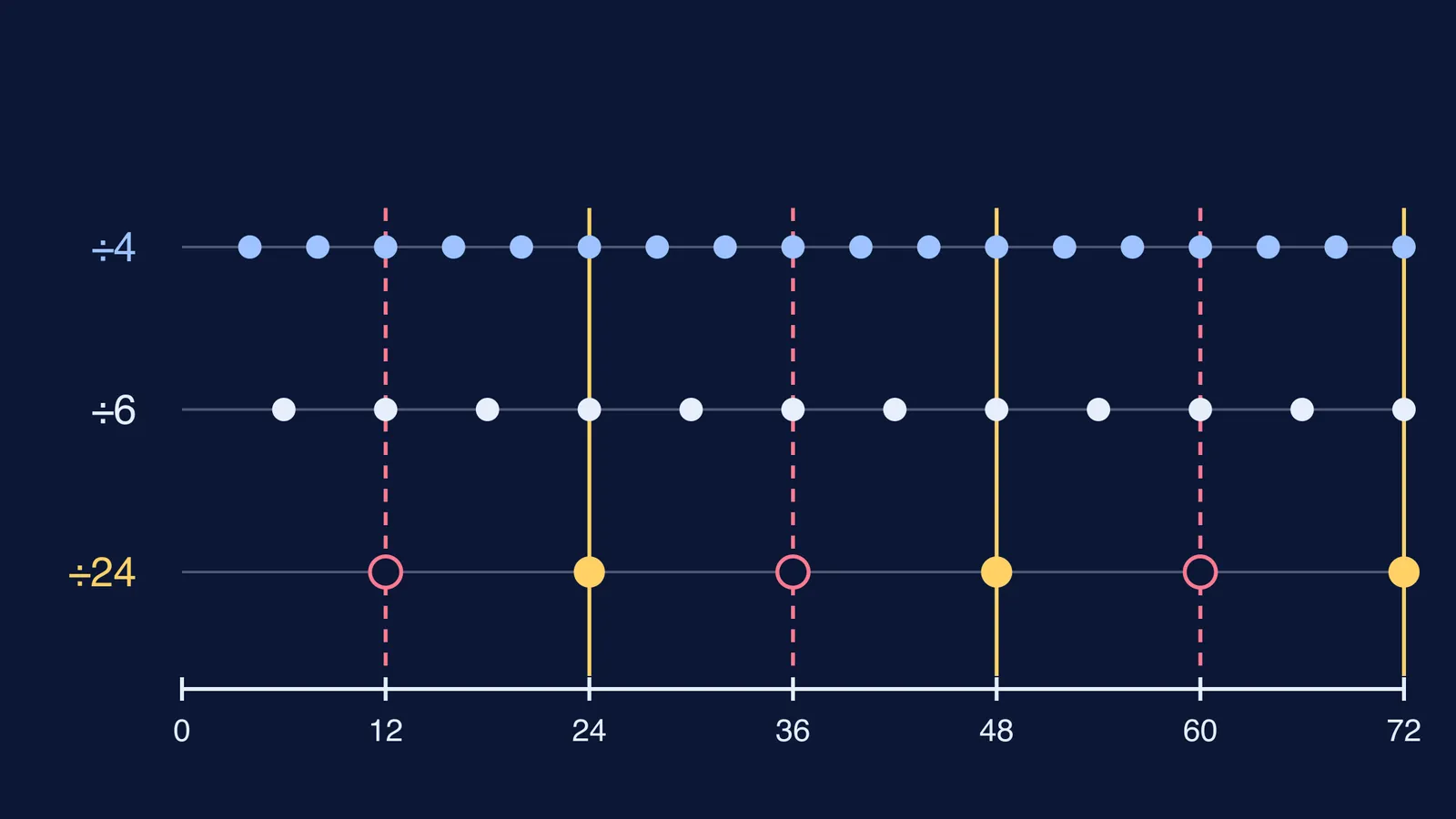
Try 36. It is divisible by 4 (36 ÷ 4 = 9) and by 6 (36 ÷ 6 = 6), but 36 ÷ 24 = 1.5. The diagram at the top shows the pattern: 12, 36 and 60 appear in both the 4 row and the 6 row but are missing from the 24 row.
The fix is to split 24 into co-prime pieces: 24 = 8 × 3. The Wikipedia divisibility page states the general rule: "A number is divisible by a given divisor if it is divisible by the highest power of each of its prime factors." Its own example is 36, tested with 4 and 9, and it warns that "checking 3 and 12, or 2 and 18, would not be sufficient" (Wikipedia: Divisibility rule).
Check 9,384 this way. Its last three digits, 384, are 8 × 48, and its digits add to 24. So 9,384 ÷ 24 = 391. For 36, the 8 test fails at once, catching what 4 and 6 missed.
How do you build a test for any composite number?
Write the prime factorisation: 24 = 2³ × 3, 36 = 2² × 3², 60 = 2² × 3 × 5.
Keep each prime with its full power: 24 gives 8 and 3; 36 gives 4 and 9; 60 gives 4, 3 and 5; 72 gives 8 and 9.
Run the test for every piece. The number must pass all of them.
Before you trust a pair, ask: do these two share a factor? If yes, the pair is wrong. Using 2 and 6 for 12 fails on 18; using 3 and 6 for 18 fails on 12.
Can you try it on these?
Is 8,316 divisible by 12? The last two digits, 16, are divisible by 4 and the digit sum is 18. Yes: 8,316 ÷ 12 = 693.
Is 4,140 divisible by 24? It passes the 4 and 6 tests, but 140 ÷ 8 = 17.5. No: 4,140 ÷ 24 = 172.5.
Is 3,672 divisible by 72? 672 = 8 × 84 and the digit sum is 18, a multiple of 9. Yes: 3,672 ÷ 72 = 51.
The same LCM idea is behind counting numbers up to 1000 not divisible by 2, 3 or 5 and finding when bells ring together again. For more on co-primes, see how many numbers below n are coprime to n.
If co-prime factors still feel shaky, the Fermi Concept Library covers every concept in mathematics, each with its own lesson and its place in the map. If you keep picking the wrong pair in practice questions, the Fermi Problem Library has worked problems with a step-by-step solver that explains the reasoning rather than printing an answer.
Next time you see a composite divisor, factorise it first, then test the co-prime pieces.


