On this page
Area is Chapter 7, the last chapter of Ganita Prakash Part II, NCERT's Class 8 maths book (code hegp2, First Edition December 2025), according to the book's prelims. It builds formulas by cutting and rearranging shapes without changing their area. CBSE publishes no separate 2026-27 curriculum for Classes 6 to 8; they follow the NCERT book, and the chapter is assessed by the school. All numbers below are our own.
What does Chapter 7 Area cover in Ganita Prakash?
In the order of the chapter PDF:
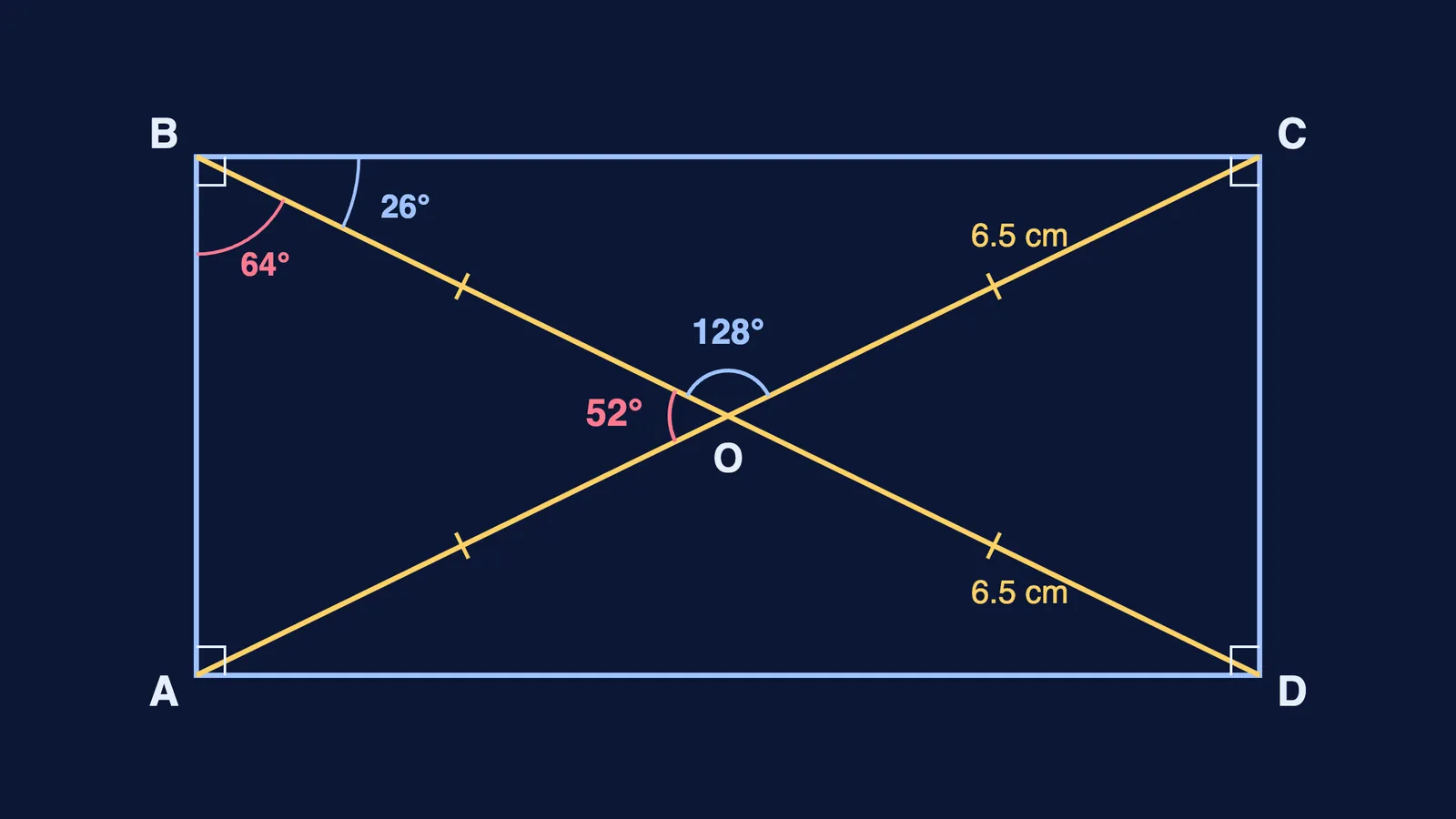
Rectangles. Area counts unit squares, so it is length × width; a diagonal halves it. Perimeter cannot measure area.
Triangles. Area = ½ × base × height, shown with a rectangle drawn around the triangle, and for obtuse cases as a difference of two areas.
Uses. A missing altitude, a line from a vertex to the opposite side's midpoint halving a triangle's area, and a least-perimeter triangle found by mirror reflection.
Any polygon. Cut it into triangles.
Parallelogram, rhombus, trapezium. Each formula comes from dissection: cutting a figure up and rearranging the pieces into one of equal area. Several methods come from the Śulba-Sūtras.
Real-life units. Inches, feet, acres, km² and local units such as bigha, gaj and katha.
How do you find a missing altitude of a triangle?
Any side can be the base, with its own height, and every pair gives the same area. Our example: in triangle ABC, BC = 10 cm, the height from A is 6 cm and AC = 12 cm. Find the altitude from B to AC.
Area = ½ × 10 × 6 = 30 cm².
With AC as base: ½ × 12 × altitude = 30, so the altitude is 5 cm.
Common slip: a height not perpendicular to its base.
How do you find the area of a trapezium? A worked example
A trapezium plot has parallel sides 11 m and 17 m, 8 m apart. The chapter's formula is Area = ½ × height × sum of the parallel sides (NCERT Chapter 7).
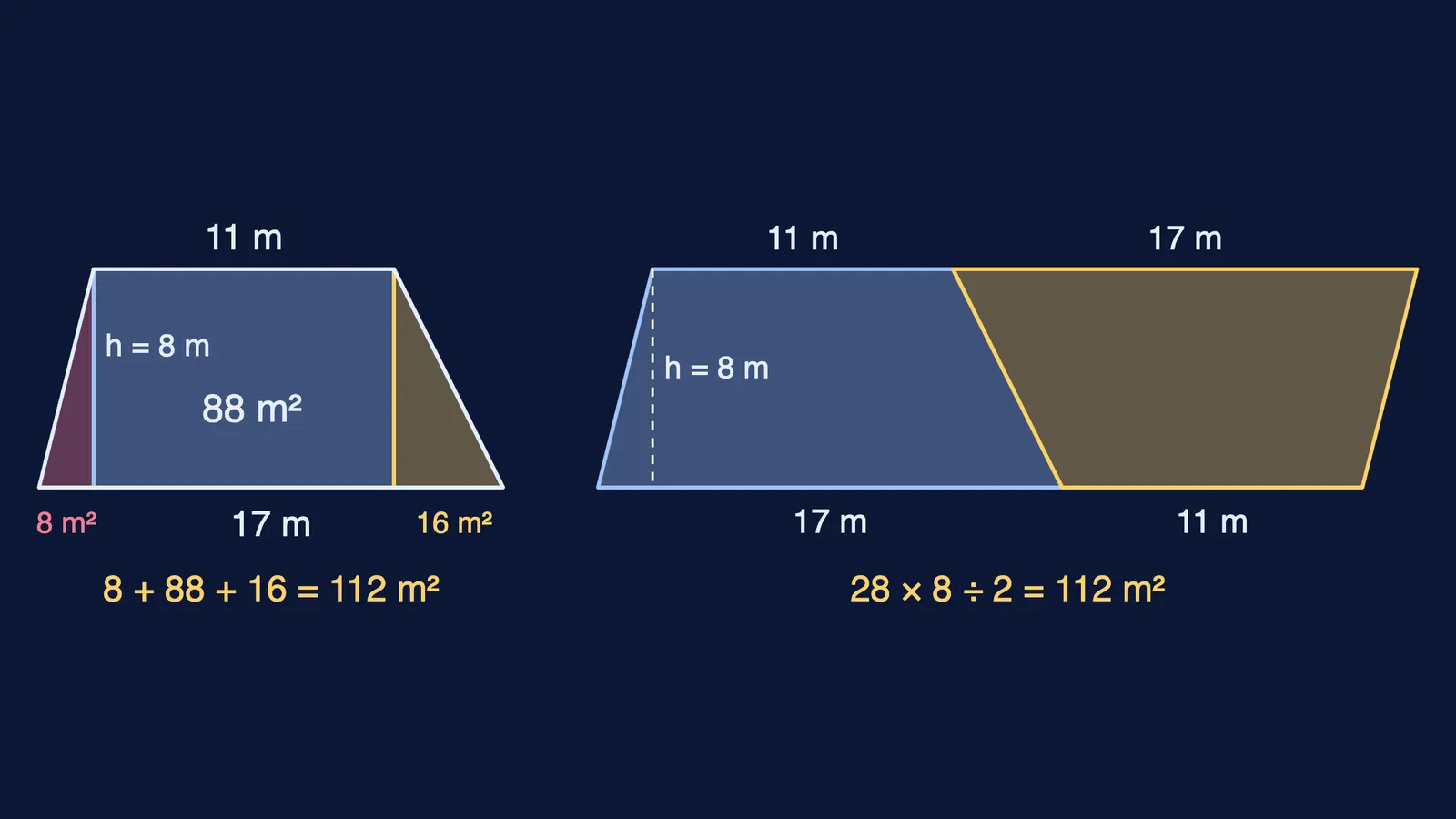
Method 1: formula. ½ × 8 × (11 + 17) = 4 × 28 = 112 m².
Method 2: a rectangle and two triangles (left of the diagram). Drop perpendiculars from the shorter parallel side. Our plot overhangs 2 m on the left and 4 m on the right (2 + 11 + 4 = 17): ½ × 2 × 8 = 8 m², plus 11 × 8 = 88 m², plus ½ × 4 × 8 = 16 m², total 112 m².
Method 3: two copies (right of the diagram). Rotate a second copy and join it to the first along a non-parallel side. Together they form a parallelogram of base 28 m and height 8 m, area 224 m², so one trapezium is 112 m². All three agree.
Why do the parallelogram and rhombus formulas work?
Cut a right triangle off one end of a parallelogram and slide it to the other end: you get a rectangle with the same base and height. So a parallelogram's area is base × height, and any side works as the base with its matching height.
A rhombus is a parallelogram whose diagonals are perpendicular bisectors of each other. A Śulba-Sūtra dissection turns it into a rectangle with sides of one diagonal and half the other, so area = ½ × product of diagonals. For diagonals of 18 cm and 13 cm: ½ × 18 × 13 = 117 cm².
Practice questions on Area (with answers)
Mark values are our suggestion; your school decides how it assesses the chapter.
A parallelogram has base 9.5 cm and height 4 cm. Find its area. (1 mark) Answer: 38 cm².
In triangle PQR, QR = 16 cm, the height from P is 9 cm and PQ = 12 cm. Find the altitude from R to PQ. (2 marks) Answer: area 72 cm², altitude 12 cm.
A rhombus has area 96 cm² and one diagonal of 16 cm. Find the other diagonal and the side. (3 marks) Answer: 12 cm; half-diagonals 8 cm and 6 cm give a side of 10 cm by the Baudhayana-Pythagoras theorem.
A trapezium of area 150 m² has parallel sides 13 m and 17 m. Find its height. (2 marks) Answer: 2 × 150 ÷ 30 = 10 m.
The chapter gives 1 acre = 43,560 ft². How many ft² is half an acre? (1 mark) Answer: 21,780 ft².
How does Area connect to the rest of Ganita Prakash?
The proofs use earlier work: parallelogram and rhombus properties from Quadrilaterals in Part I, and Chapter 2's Baudhayana-Pythagoras theorem in question 3. Our guide to the new Class 8 books lists both parts.
A 30 in × 48 in tabletop is 1,440 in², or 10 ft², since 1 ft² = 144 in². For costing jobs, see perimeter or area: what you pay for. In Class 9, Measuring Space in Ganita Manjari adds Heron's formula and circles.
Unsure which formula fits? Fermi's AI tutor works out what you already know and builds a plan for the session.