

On this page
Every "cost of fencing" or "cost of flooring" question asks the same two things: what are you paying for, a length or a surface, and are your units the same as the rate's? Get those right and the arithmetic is the easy part.
Is fencing cost based on perimeter or area?
Fencing goes around the boundary, so you pay for its length. The perimeter of a shape is the length of its boundary, and for a rectangle with sides a and b it is 2(a + b), according to Wolfram MathWorld; for a square of side a it is 4a.
Flooring and tiling cover the inside, so you pay for the surface. The area of a rectangle is length × width, as the US National Institute of Standards and Technology puts it on its area formulas page.
A quick sorting rule for the words in the question:
Edge jobs (perimeter × ₹ per metre): fencing, wire around a field, skirting along walls, a lace border on a tablecloth, a frame around a photo.
Surface jobs (area × ₹ per m²): flooring, tiling, carpeting, painting a wall, levelling or turfing a lawn, polishing a tabletop.
The units check you: ₹/m × m gives rupees, and ₹/m² × m² gives rupees. If the units in your multiplication do not cancel down to rupees, you have picked the wrong measurement.
How do you calculate the cost of flooring per square metre with mixed units?
Here is one room that needs both kinds of answer.
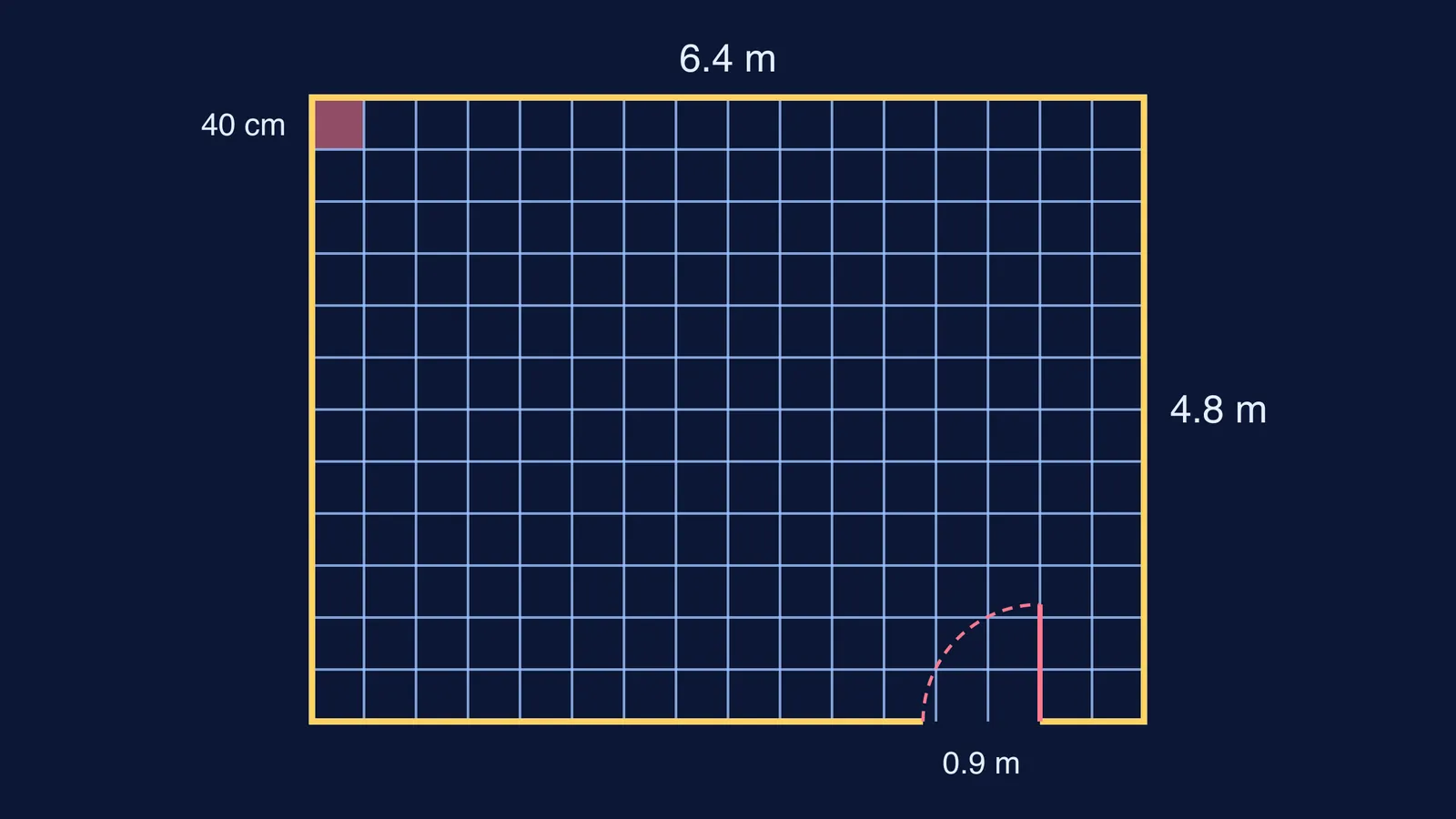
A room is 6 m 40 cm long and 4 m 80 cm wide. Flooring costs ₹650 per m². Square tiles are 40 cm on each side. Wooden skirting along the walls costs ₹120 per metre, and the 90 cm doorway gets no skirting.
Convert to one unit first. Centi means one hundredth, per NIST's list of SI prefixes, so 6 m 40 cm = 6.4 m and 4 m 80 cm = 4.8 m.
Area for the floor. 6.4 × 4.8 = 30.72 m².
Cost of flooring. 30.72 × 650 = ₹19,968.
Number of tiles. Each tile is 0.4 m × 0.4 m = 0.16 m², so 30.72 ÷ 0.16 = 192 tiles. Check it by rows: 6.4 ÷ 0.4 = 16 tiles along, 4.8 ÷ 0.4 = 12 across, and 16 × 12 = 192.
Perimeter for the skirting. 2(6.4 + 4.8) = 22.4 m, minus the 0.9 m doorway = 21.5 m.
Cost of skirting. 21.5 × 120 = ₹2,580.
Count tiles by rows too: when a tile does not divide the length exactly, area ÷ tile area hides that.
Why is 1 m² equal to 10,000 cm² and not 100?
Because area has two lengths in it. One metre is 100 cm, so a 1 m × 1 m square is 100 cm × 100 cm = 10,000 cm². NIST's table of area units builds the same ladder in steps of 100: 100 cm² = 1 dm², and 100 dm² = 1 m².
The same page defines the hectare: a hectare is a special name for 10,000 m², a square 100 m on each side (NIST). That matters when a field is given in hectares and the levelling rate is per m².
For more practice on this one step, our post on converting square metres to square centimetres works through the conversions in both directions.
How do you work backwards from the cost of fencing?
Some questions run the calculation in reverse. Try this one.
A square field is fenced for ₹14,400 at ₹90 per metre. Find the cost of levelling it at ₹12 per m².
Length of fence = 14,400 ÷ 90 = 160 m. That length is the perimeter.
Side = 160 ÷ 4 = 40 m, using the 4a formula above.
Area = 40 × 40 = 1,600 m², or 0.16 hectare.
Cost of levelling = 1,600 × 12 = ₹19,200.
The skill here is noticing that cost ÷ rate gives back the measurement the rate was quoted in: a per-metre rate returns a length, a per-m² rate returns an area.
If the land is not a plain rectangle, split it first; our guide to the area of composite rectilinear figures shows how, and the area of a path around a garden covers the border questions that often come with a cost at the end.
If you keep picking perimeter when the question wanted area, the Fermi Problem Library has worked problems with a step-by-step solver that explains the reasoning rather than printing an answer, so you can see which word in the question decided the method. To revisit the ideas themselves, the Fermi Concept Library gives perimeter, area and units each their own lesson.


