

On this page
An L-shaped room or a U-shaped courtyard is just rectangles stuck together, or a rectangle with a piece taken out. That gives you two ways to find the area, and a built-in check, because both must agree.
How do you find the area of an L-shaped figure?
Area is additive: if you cut a shape into pieces that do not overlap, the areas of the pieces add up to the area of the whole. The US Common Core maths standards put it in one line: find areas of rectilinear figures "by decomposing them into non-overlapping rectangles and adding the areas of the non-overlapping parts" (Common Core State Standards, 3.MD.C.7d). A rectilinear figure is one whose sides all meet at right angles, like every L, T and U shape.
Split and add: cut the shape into rectangles, find each area, add.
Box and subtract: take the smallest rectangle around the shape, then subtract the missing piece or pieces.
Worked example: an L shape
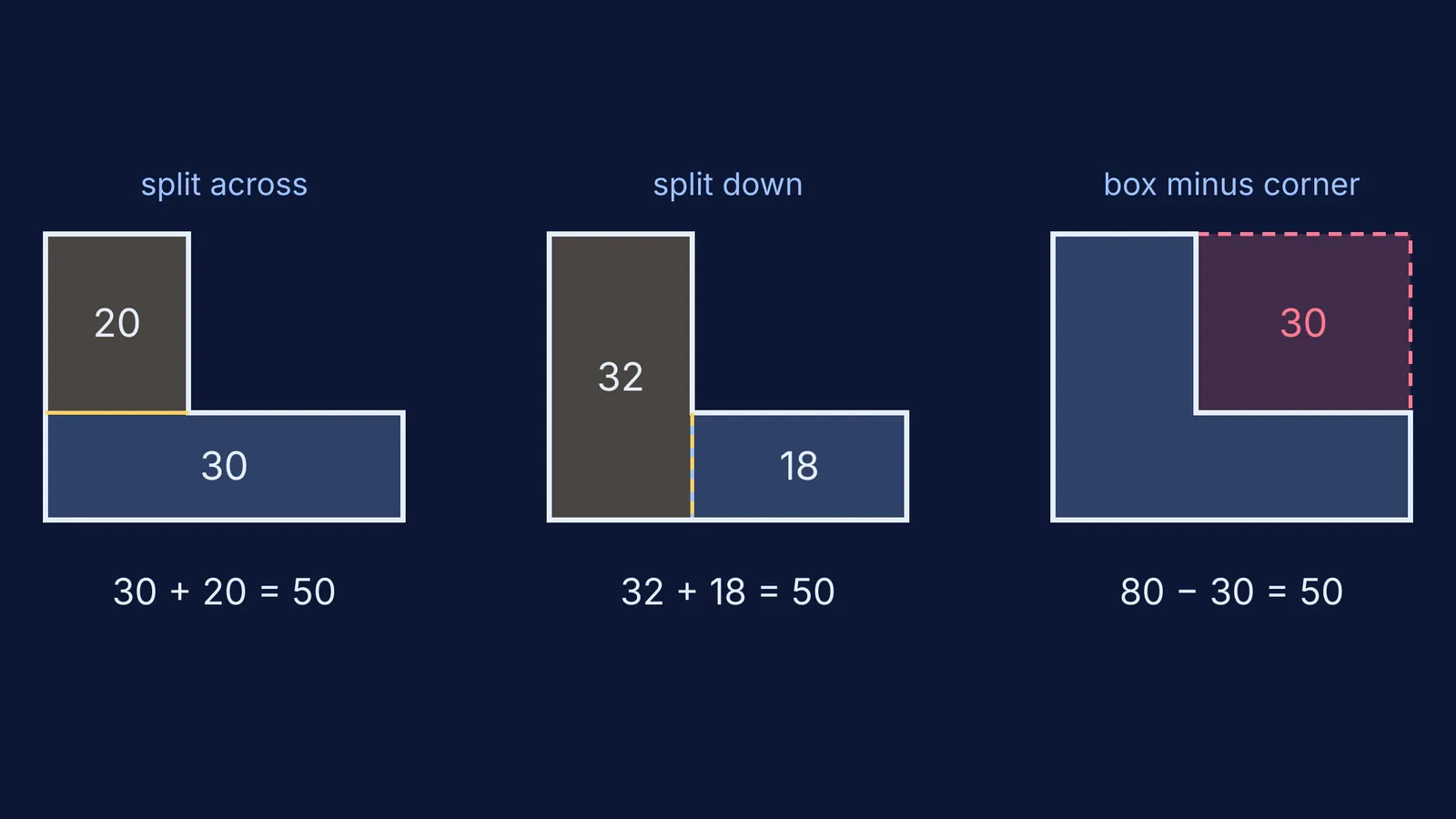
Take an L that is 10 m along the bottom and 8 m tall, with a bottom strip 3 m tall and an upright arm 4 m wide.
Split horizontally along the top of the strip: the strip is 10 × 3 = 30 m² and the arm is 4 × (8 − 3) = 4 × 5 = 20 m². Total: 50 m².
Split vertically instead: the left column is 4 × 8 = 32 m² and the right foot is (10 − 4) × 3 = 6 × 3 = 18 m². Total: 50 m².
Box and subtract: the surrounding rectangle is 10 × 8 = 80 m². The missing corner is 6 m wide and 5 m tall, so 30 m². 80 − 30 = 50 m².
Three routes, one answer. If one had given 54, you would know something was wrong.
How do you find the area of T and U shapes?
T shape. A bar 9 cm wide and 2 cm tall sits centred on a stem 3 cm wide and 5 cm tall. Split: 9 × 2 = 18 and 3 × 5 = 15, so 33 cm². Box: the outer rectangle is 9 × 7 = 63 cm². There are two empty corners, each (9 − 3) ÷ 2 = 3 cm wide and 5 cm tall, so 2 × 15 = 30 cm². 63 − 30 = 33 cm².
U shape. An 8 m by 6 m rectangle has a notch 4 m wide and 4 m deep cut from the top, which leaves a base 2 m tall and two arms 2 m wide. Box: 48 − 16 = 32 m². Split: the base is 8 × 2 = 16 m² and each arm is 2 × 4 = 8 m², so 16 + 8 + 8 = 32 m².
For a U, box-and-subtract is usually shorter; for an L, splitting often is. Solve with the faster method, check with the other. Subtraction is also the heart of border questions, as in our walk-through on finding the area of a path around a garden.
Why check with a second method?
Redoing the same method often repeats the same slip; a different method exposes it as a mismatch.
In a 2007 experiment, Bethany Rittle-Johnson and Jon Star had 70 seventh-grade students study worked examples of equation solving, either comparing two methods side by side or studying them one at a time (Journal of Educational Psychology, doi:10.1037/0022-0663.99.3.561). According to a Harvard Graduate School of Education summary, the comparison group got better at solving equations, including unfamiliar ones, and at producing more than one solution to a problem. Both groups improved similarly on conceptual knowledge, and the study was about algebra, not area. Still, the habit it trains, comparing two methods, is the one you use here.
What mistakes do students make with composite areas?
Overlapping pieces. Taking 10 × 3 and 4 × 8 for the L above counts the 4 × 3 corner twice and gives 62 m². Pieces must not overlap.
Using the full side for a part. The L's upright arm is 5 m tall, not 8 m.
Wrong units. An area in m, not m², means something slipped. If sides mix cm and m, convert first; our guide to converting m² to cm² shows why the factor is 10,000 and not 100.
For more figures to practise on, the Fermi Problem Library has worked problems with a step-by-step solver that explains the reasoning rather than printing an answer, so you can see which split went wrong.
A two-minute routine for exams
Label every side, including hidden ones.
Solve with the faster method.
Check with the other method.
If they disagree, check hidden sides first, then overlap.
Write the answer in square units.
The same split-and-check idea extends to trapezium and rhombus areas.


