

On this page
What makes a shape a trapezium or a rhombus?
Before applying any area formulas, it helps to identify the exact properties of these quadrilaterals.
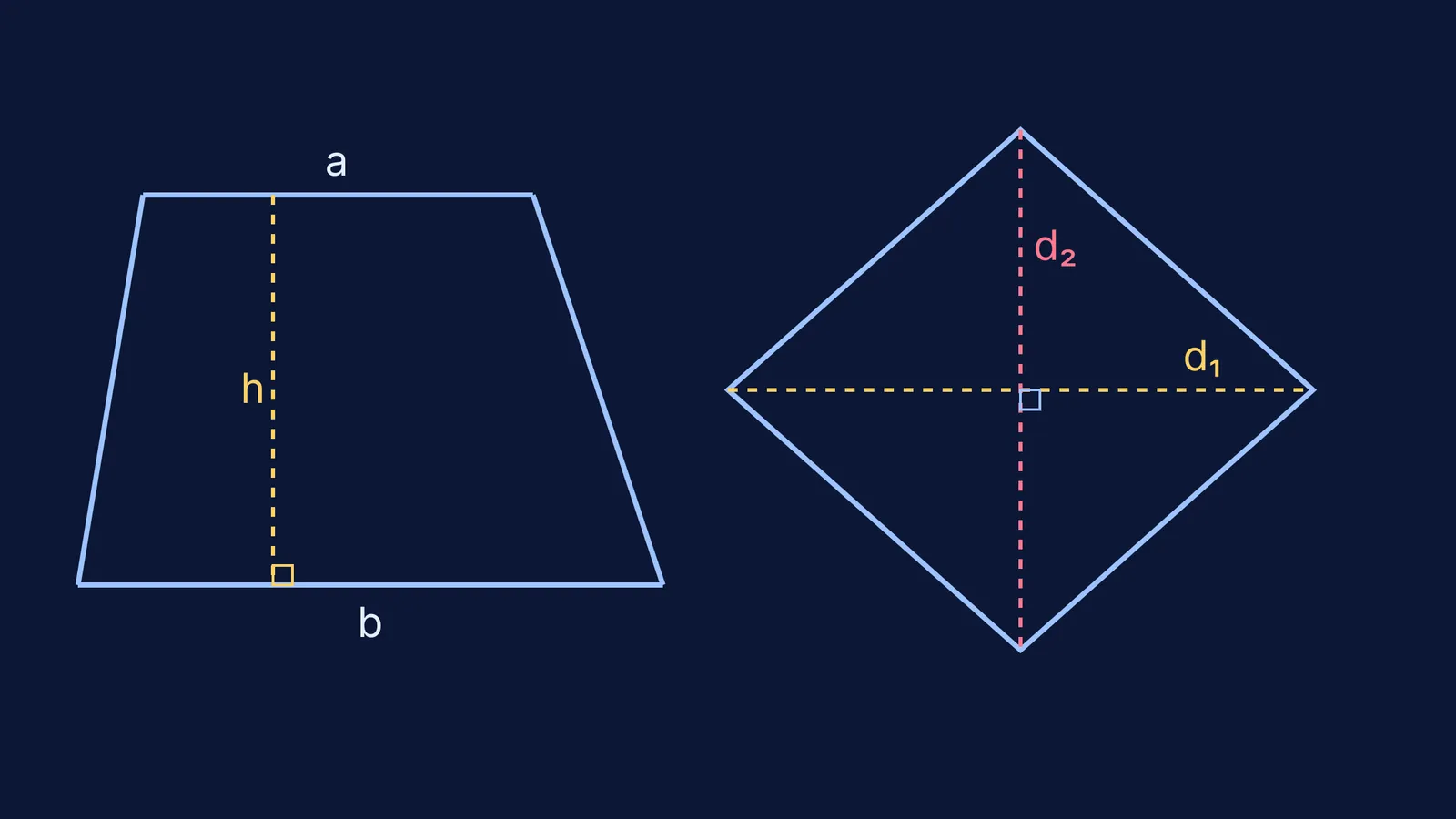
A trapezium (often called a trapezoid in American English) is a four-sided shape with exactly one pair of parallel sides. These parallel sides are known as the bases. The non-parallel sides are called the legs. A special case is the isosceles trapezium, where the two non-parallel legs are equal in length, giving the shape a vertical line of symmetry.
A rhombus, on the other hand, is a quadrilateral where all four sides are equal in length. Because opposite sides are parallel, every rhombus is also a parallelogram. The diagonals of a rhombus have a unique property: they bisect each other at exactly 90 degrees. This perpendicular bisection is the key to understanding its area formula.
What is the formula for the area of a trapezium?
The area of a trapezium is half the sum of the parallel sides multiplied by the height (BYJU'S). You will usually see this written as A = ½(a + b)h.
In this formula, the letters *a* and *b* represent the lengths of the two parallel sides, while *h* is the perpendicular height between them. You cannot use the length of the slanted legs for the height.
Why does this work? If you duplicate a trapezium, flip the copy upside down, and place it next to the original, the two shapes join to form a large parallelogram. The base of this new parallelogram is the sum of the two parallel sides (a + b), and its height remains *h*. Because the parallelogram is made of two identical trapeziums, the area of one trapezium is exactly half of the parallelogram's area.
You can also prove this by drawing a diagonal line across the trapezium, which splits it into two triangles. One triangle has a base of *a* and a height of *h*, yielding an area of ½ah. The other has a base of *b* and the same height *h*, yielding ½bh. Adding them together gives ½ah + ½bh, which factorises neatly into ½(a + b)h.
How do you calculate the area of a rhombus?
The area of a rhombus is half the product of its two diagonals (BYJU'S). This formula is written as A = ½d₁d₂, where d₁ and d₂ are the lengths of the diagonals.
Because the diagonals of a rhombus always meet at a 90° angle, they cut the shape into four identical right-angled triangles. The base of each small triangle is ½d₁, and its height is ½d₂. The area of one of those small triangles is ½ × (½d₁) × (½d₂) = ⅛d₁d₂. If you multiply that area by four (for the four triangles), you get ½d₁d₂.
Since a rhombus is a specific type of parallelogram with four equal sides, you can also use the standard base × height formula. If a question gives you a side length and the perpendicular height rather than the diagonals, simply multiply the base by the height.
How do you find a missing side or diagonal?
Examiners rarely ask you just to calculate the area by plugging in three numbers. Instead, they will often provide the area and ask you to find a missing dimension, requiring a bit of algebra.
Suppose you know a trapezium has an area of 50 cm², a height of 5 cm, and a top base of 8 cm. To find the bottom base (*b*), substitute what you know into A = ½(a + b)h:
50 = ½(8 + b) × 5
100 = (8 + b) × 5
20 = 8 + b
b = 12 cm
If you get stuck manipulating the algebra, the Fermi Problem Library has a step-by-step solver that explains the reasoning for finding missing geometric values rather than just printing an answer. This helps you build the skills to move terms across the equals sign confidently.
What is a good routine for geometry exam questions?
When tackling area problems in your maths exam, a reliable routine prevents silly errors.
Draw it out: Sketch the shape and label the known sides, diagonals, or heights. Visualising the geometry often reveals the path to the solution.
Write the formula: State ½(a + b)h or ½d₁d₂ before plugging any numbers in. This earns method marks in many marking schemes.
Check the units: Make sure all lengths are in the same unit.
Solve step-by-step: Carry out the algebra one step at a time, keeping your equals signs aligned.
Mastering these basic formulas also builds a foundation for more advanced coordinate geometry, such as finding the area of a triangle using determinants. Once you are comfortable with linear equations, you can apply the same algebraic rules to quadratic word problems in Class 10.


