

On this page
Calculating the area of a path around a rectangular garden is a core mensuration skill. Whether a pathway surrounds a lawn, borders the inside edge of a park, or crosses directly through the centre, the calculation relies on one geometric principle: outer rectangle minus inner rectangle.
How do you find the area of a path around a rectangular garden?
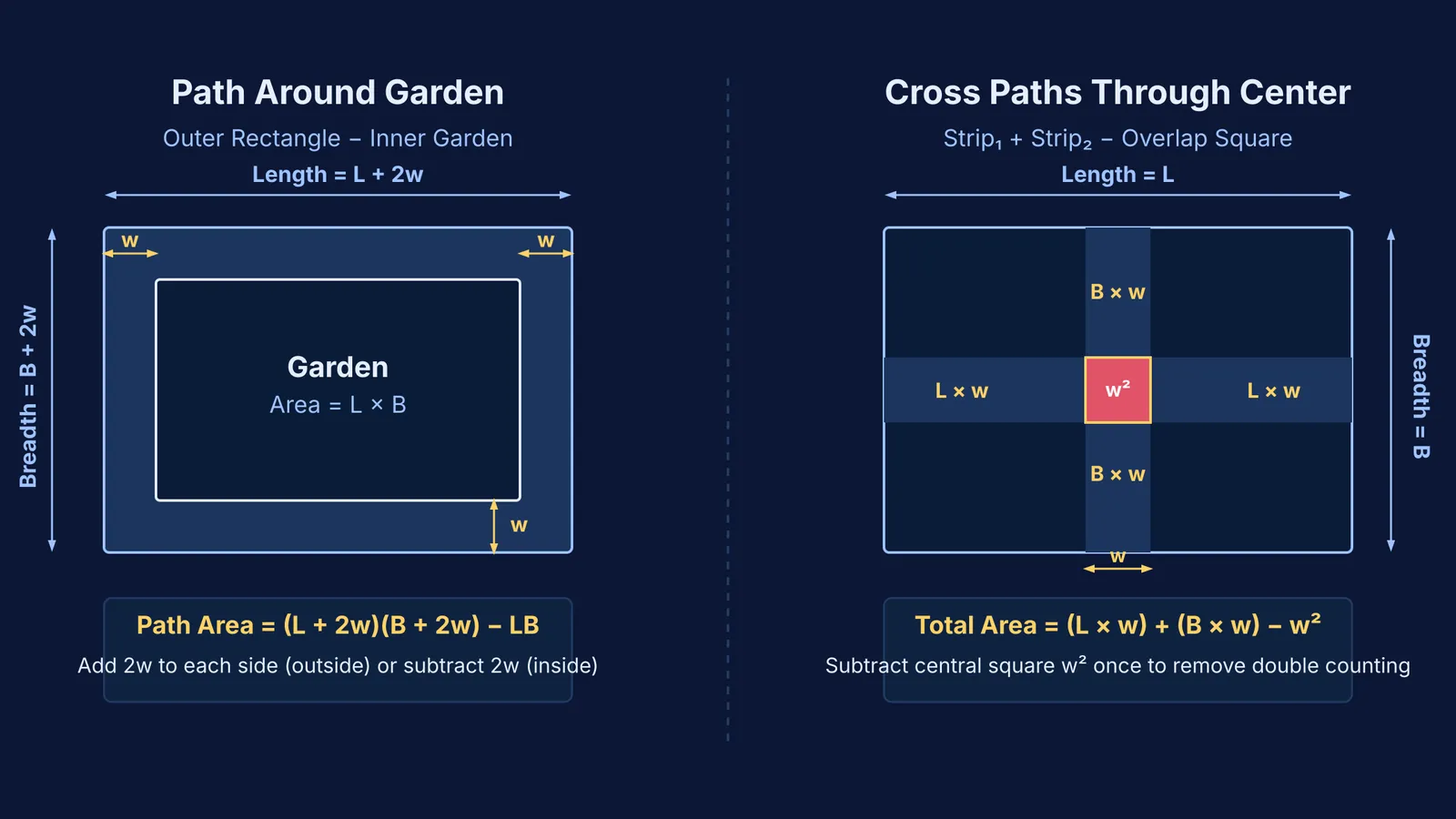
When a path of uniform width w surrounds the exterior of a rectangular garden, the outer boundary forms a larger rectangle. Because the path runs along both sides of each dimension, it extends the length by w on the left and w on the right, and extends the breadth by w at the top and w at the bottom.
Inner garden area: Area(inner) = L × B.
Outer dimensions: length = L + 2w, breadth = B + 2w.
Outer area: Area(outer) = (L + 2w) × (B + 2w).
Path area: Area(outer) − Area(inner).
Under the standard geometric area framework, a benchmark problem features a 90 m by 75 m garden with a 5 m wide exterior path. The inner area is 90 m × 75 m = 6,750 m². The outer dimensions become 100 m and 85 m, producing an outer area of 8,500 m². Subtracting the garden gives 8,500 m² − 6,750 m² = 1,750 m² for the path.
What changes when the path is built inside the boundary?
When a path runs along the inside border of a plot, the given boundary is the outer rectangle. The path encloses a smaller inner lawn. The method remains outer minus inner, but you subtract the pathway width from both opposite edges of each axis: inner length is L − 2w and inner breadth is B − 2w.
In exercises aligned with CBSE Academic mensuration standards, consider a 60 m by 40 m plot with an interior 3 m wide pathway. The outer area is 2,400 m². The inner rectangle measures 54 m by 34 m, giving an inner area of 1,836 m². The path area is 2,400 m² − 1,836 m² = 564 m².
How do you calculate cross paths running through the middle?
When two paths cut through the centre of a rectangular park parallel to its sides, they intersect at right angles. Finding their total area relies on the principle of inclusion-exclusion. Adding the two rectangular path strips directly double-counts the square where they cross, so you must subtract that common central area once.
Horizontal path: Area = L × w.
Vertical path: Area = B × w.
Overlap square: Area = w × w = w².
Total path area: (L × w) + (B × w) − w².
A classic problem features a 700 m by 300 m park with two 10 m wide crossroads. The horizontal road is 7,000 m², the vertical road is 3,000 m², and the central square is 100 m². The total road area is 7,000 m² + 3,000 m² − 100 m² = 9,900 m², which equals 0.99 hectares using 1 hectare = 10,000 m².
Why do students double-count corners and overlap squares?
Spatial errors often stem from memorizing formulas without visualizing shapes. Research by France M. Machaba in *Pythagoras* showed that secondary learners frequently confuse boundary perimeters with surface areas when solving composite figures. Students often add the path width only once or split borders into four separate strips, accidentally counting corner squares twice.
The outer-minus-inner framework prevents corner duplication by treating the border as the difference between two whole rectangles. The Fermi Problem Library has worked problems with a step-by-step solver that explains the reasoning rather than printing an answer, helping students master spatial decomposition.
How can you avoid common mensuration exam traps?
Examiners frequently combine boundary calculations with secondary tasks like turfing costs or unit conversions. To maintain accuracy under exam conditions:
Sketch first: Draw nested rectangles or crossroads with labeled dimensions before calculating.
Check orientation: Confirm if the path runs outside (+2w) or inside (−2w).
Subtract overlaps: Remove w² for crossroads to prevent double counting.
Unify units: Convert all dimensions to metres before multiplying.
Convert land units: Use 1 hectare = 10,000 m² as specified in CBSE Academic exam problems.
Mastering these boundary problems connects to perimeter and area in Class 6 and prepares you for Class 8 mensuration. These spatial setups also reappear in Class 10 quadratic word problems involving borders. The Fermi Concept Library covers every concept in mathematics, each with its own lesson and its place in the map, linking geometric boundaries to algebraic problem solving.


