On this page
Chapter 6 of NCERT's new Class 8 book, Exploring Society: India and Beyond, Part 1 (code hees1, First Edition July 2025, reprinted March 2026), explains who makes India's laws and who carries them out. CBSE publishes no separate 2026-27 curriculum for Classes 6 to 8; these classes follow the NCERT book, so this chapter is assessed by the school.
What does Chapter 6 of Exploring Society Class 8 cover?
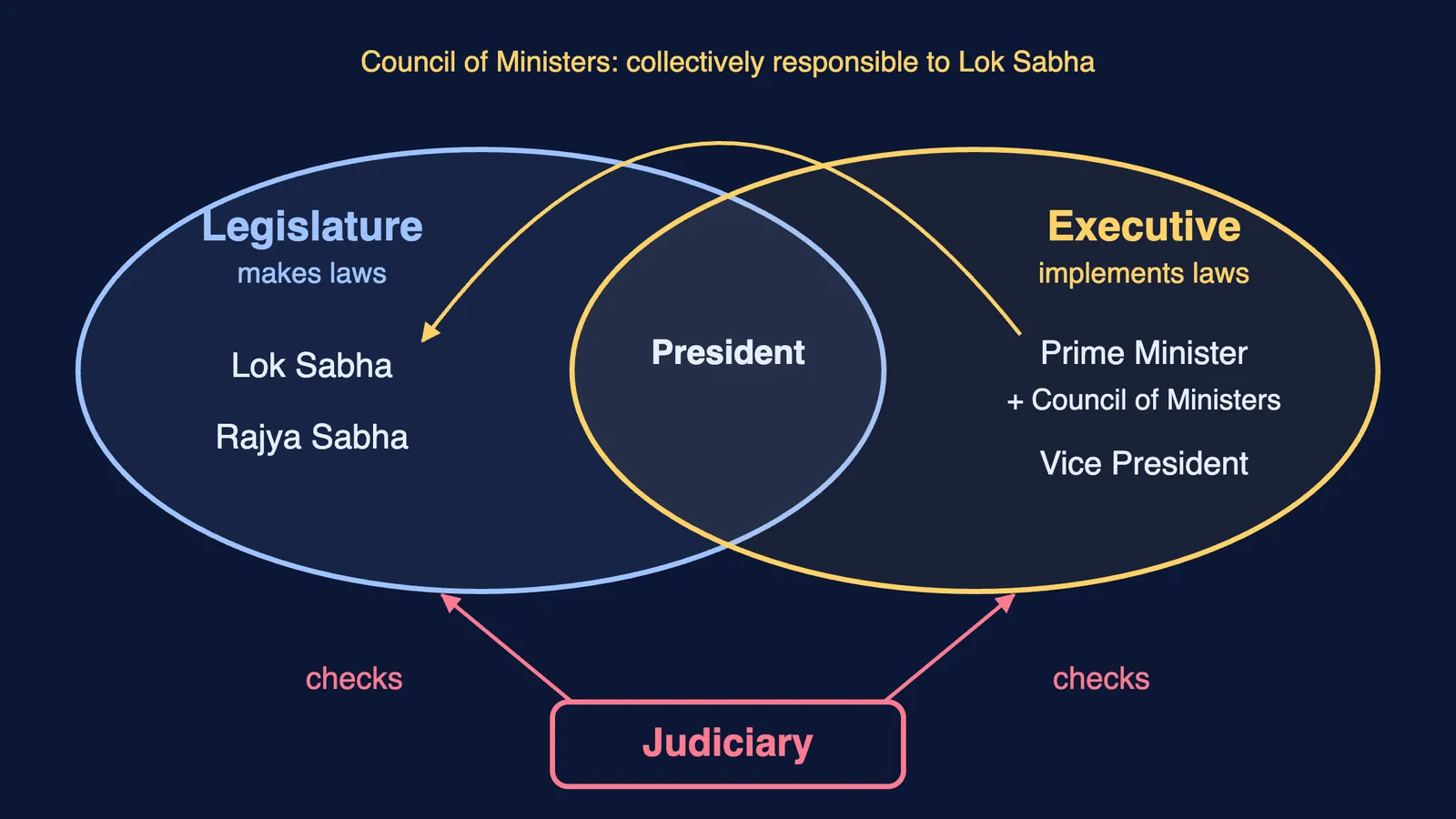
In the chapter, Parliament has three parts: the President, the Lok Sabha (House of the People) and the Rajya Sabha (Council of States). Two houses make it bicameral. Voters elect Lok Sabha members directly, while Rajya Sabha members are chosen indirectly by the electoral college from Chapter 5. The Speaker runs the Lok Sabha; the Vice President chairs the Rajya Sabha.
The book sorts Parliament's work under four heads:
Constitutional functions, such as electing the President and Vice President and amending the Constitution.
Lawmaking, turning bills into acts.
Executive accountability, for example through Question Hour, typically the first hour of a session.
Financial accountability, by approving and watching spending through the annual budget.
What is the difference between legislature and executive?
The legislature makes laws and watches the executive, which puts laws into action. In the chapter, the Union Executive has three parts: the President, the Vice President, and a Council of Ministers that the Prime Minister leads.
The President is Head of State and the executive's head in name, with discretionary powers in specific circumstances, such as a crisis when no party has a clear Lok Sabha majority.
The Prime Minister holds real (de facto) executive power. The President appoints whoever leads the Lok Sabha's majority party or coalition.
Ministers come from both houses but are collectively responsible to the Lok Sabha.
Civil servants are permanent officials who carry out policies under ministers.
On moral responsibility, the book recalls 1956, when Lal Bahadur Shastri, then Railway Minister, quit after a train accident though he was not blamed for it.
Courts check that laws and executive actions stay within the Constitution.
How does a bill become an act? A worked example
A bill is a draft law. The book traces the Right to Education (RTE) Act: the 86th Amendment in 2002 added Article 21A for children aged 6 to 14, a bill went to the Rajya Sabha six years later, and in August 2009 it passed the Lok Sabha and got the President's assent.
Try the steps on our own made-up bill: a "Village Library Bill" introduced in the Lok Sabha.
Introduction and reading: introduced in the Lok Sabha (either House is allowed), then read.
Standing Committee: it may be referred to one; not every bill is.
Consideration: taken up for consideration and passing; clause-by-clause discussion and amendments voted.
Vote on the bill: the Lok Sabha passes it.
Other House: the process is repeated in the Rajya Sabha.
Assent and Gazette: presidential assent, then Gazette notification.
If it were a Money Bill (taxes or borrowing), it could start only in the Lok Sabha, with the President's prior recommendation.
How are the Union and state governments organised?
The states mirror the Union. The Governor, appointed by the President, is the nominal head; the Chief Minister holds real executive power, and the state's ministers are collectively responsible to the Vidhan Sabha. Six states have a second house, the Vidhan Parishad: Karnataka, Maharashtra, Andhra Pradesh, Telangana, Bihar and Uttar Pradesh. The rest are unicameral, as the chapter lists.
Three lists divide subjects. Parliament makes laws on the Union List, states on the State List, and both on the Concurrent List. If the Union legislates on a concurrent subject, states must follow it; RTE applies across India though education is concurrent.
The chapter ends on challenges such as absences and disruptions; its table shows 677 sittings for the 1st Lok Sabha and 356 for the 13th.
How does Chapter 6 connect to the rest of the book?
Chapter 6 closes Theme D, Governance and Democracy, in Part 1, straight after Chapter 5 on universal franchise and elections. The older book covered similar ground in why we need a Parliament, and our Class 8 judiciary guide adds more on courts. In Class 9 the story continues with governance and public policy.
Practice questions (mark values are our suggestion):
What does "bicameral" mean? Name the two houses of Parliament. (1 mark)
Who is the nominal head and who is the de facto head of the Union Executive? (2 marks)
Give two ways Parliament holds ministers accountable. (2 marks)
A bill on school transport is passed by the Rajya Sabha. List the remaining steps before it becomes law. (3 marks)
Compare the Union and a state government on constitutional head, executive head and lower house. (5 marks)
Not sure which part to revise first? Fermi's AI tutor works out what you already know and builds a plan for the session.