

On this page
This Class 8 judiciary guide covers what courts do, judicial independence, the three levels of courts, civil versus criminal law, and Public Interest Litigation (PIL). It follows the older NCERT chapter Judiciary (Social and Political Life III). NCERT's newer book, Exploring Society: India and Beyond (Vol II), has a chapter titled The Role of Judiciary in our Society, which NCERT said in February 2026 it would rewrite for 2026-27, so check which book your school uses.
What does the judiciary do?
India has the rule of law: laws apply equally to all persons, and fixed procedures must be followed when a law is broken, says the NCERT chapter. Courts do three jobs:
Dispute resolution: between citizens, citizens and the government, two states, or the centre and a state.
Judicial review: the judiciary can strike down a law passed by Parliament if it believes the law violates the basic structure of the Constitution.
Enforcing Fundamental Rights: any citizen can approach a High Court or the Supreme Court if they believe their Fundamental Rights have been violated.
If the Fundamental Rights feel hazy, revise the features of the Indian Constitution for Class 8 first.
What is an independent judiciary?
An independent judiciary means the legislature and the executive cannot interfere in the work of the courts, one aspect of the separation of powers, according to the NCERT chapter. High Court and Supreme Court judges are appointed with very little interference from the other branches and are very difficult to remove.
Under Article 124(4) of the Constitution, a Supreme Court judge can be removed only by an order of the President, after each House of Parliament supports it by a majority of its total membership and two-thirds of members present and voting, on the ground of proved misbehaviour or incapacity.
What are the three levels of courts in India?
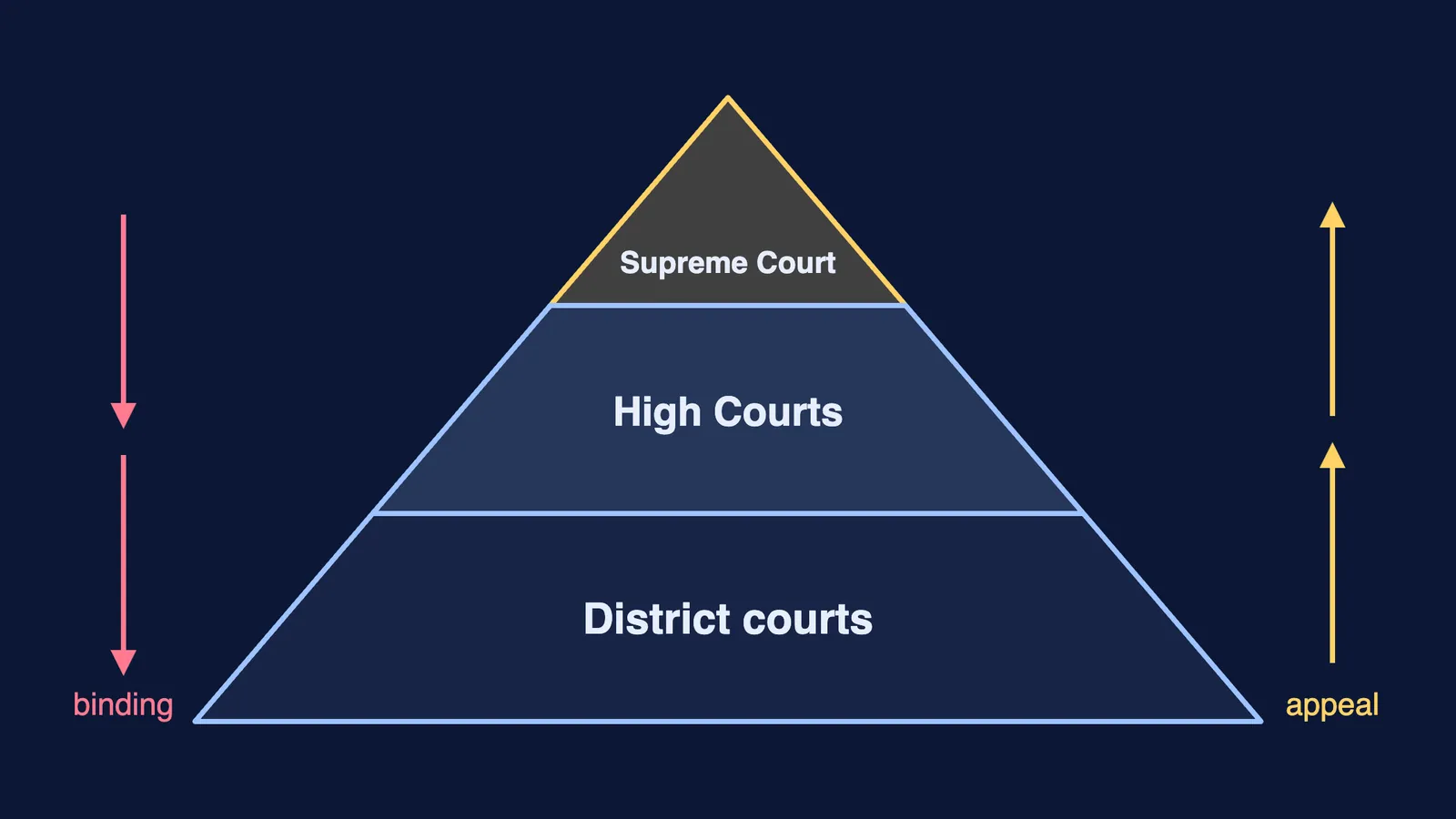
The NCERT chapter describes a pyramid:
District or subordinate courts, usually at district or tehsil level, are the courts most people deal with; one common name is the Trial Court.
High Courts are the highest court in each state, though some states share one; the book counts 25, the first set up in Calcutta, Bombay and Madras in 1862.
The Supreme Court in New Delhi, presided over by the Chief Justice of India, was established on 26 January 1950, and its decisions bind every other court.
In this integrated system, a person who thinks a lower court's judgment was unjust can appeal to a higher one: the appellate system.
Worked example: one case, three courts. The book traces State (Delhi Administration) vs Laxman Kumar and Others (1985), about Sudha Goel's death:
Trial Court: convicted Laxman, his mother and his brother-in-law and sentenced all three to death.
High Court (appeal filed in November 1983): decided the fire was an accident and acquitted all three.
Supreme Court (1985): found Laxman and his mother guilty, acquitted the brother-in-law for lack of evidence, and sent the two to prison for life.
What is the difference between civil and criminal law?
The NCERT chapter gives three tests:
What went wrong? Criminal law covers acts defined as offences, like theft or murder; civil law covers harm to someone's rights, like land, rent or divorce disputes.
How does it start? Criminal: usually an FIR with the police. Civil: a petition filed in court by the affected party.
What can the court do? Criminal: jail and a fine. Civil: the specific relief asked for, such as ordering a flat vacated and rent paid.
Try it: boys harassing girls on the way to school is criminal; a tenant forced out by a landlord is civil. The Bhopal case in our Law and social justice Class 8 guide makes a good third case.
What is PIL, and why was it introduced?
Public Interest Litigation, devised by the Supreme Court in the early 1980s to widen access to justice, lets any person or organisation approach a High Court or the Supreme Court on behalf of people whose rights are violated, explains the NCERT chapter. Because cases cost poor families too much money and time, even a letter or telegram to the court could be treated as a PIL.
After the 2001 drought in Rajasthan and Orissa, the People's Union for Civil Liberties filed a PIL arguing that the Right to Life in Article 21 includes the Right to Food; the Supreme Court ordered steps including mid-day meals. In Olga Tellis vs Bombay Municipal Corporation (1985), the court held that the Right to Livelihood is part of the Right to Life.
How should you revise the judiciary chapter?
Draw the pyramid and fill in the Laxman Kumar verdicts.
Write the two reasons for independence and the removal rule.
Sort a few news stories as civil or criminal.
Explain PIL aloud in three sentences with the mid-day meal example.
If maths or science is also piling up, Fermi's AI tutor can work out what you already know and build a plan for the session. Curious about the bench? Read how to become a judge after an LLB in India.


