

On this page
The Class 8 civics chapter Law and Social Justice makes one argument: a law protects people only when the government enforces it. It is Chapter 8 in the 2024-25 reprint of NCERT's Social and Political Life III, free on the NCERT textbook site. Here are its big ideas, one law that has changed since printing, and a method for long answers.
What is the chapter Law and Social Justice about?
The NCERT chapter says markets tend to exploit people, whether as workers, consumers or producers, so the government makes laws to keep unfair practices to a minimum. Making a law is half the job; the government must also enforce it, by inspecting work sites and punishing those who break it.
Many of these laws rest on Fundamental Rights, such as the Right against Exploitation, which says no one can be forced to work for low wages or under bondage. For a refresher, see the features of the Indian Constitution for Class 8; consumer rights in Class 10 covers the laws that protect buyers.
Why do we need a law on minimum wages?
Workers who badly need a job have little bargaining power, so employers can underpay them. A minimum wage law says the employer must pay not less than a fixed amount, revised upwards every few years, as the NCERT chapter explains.
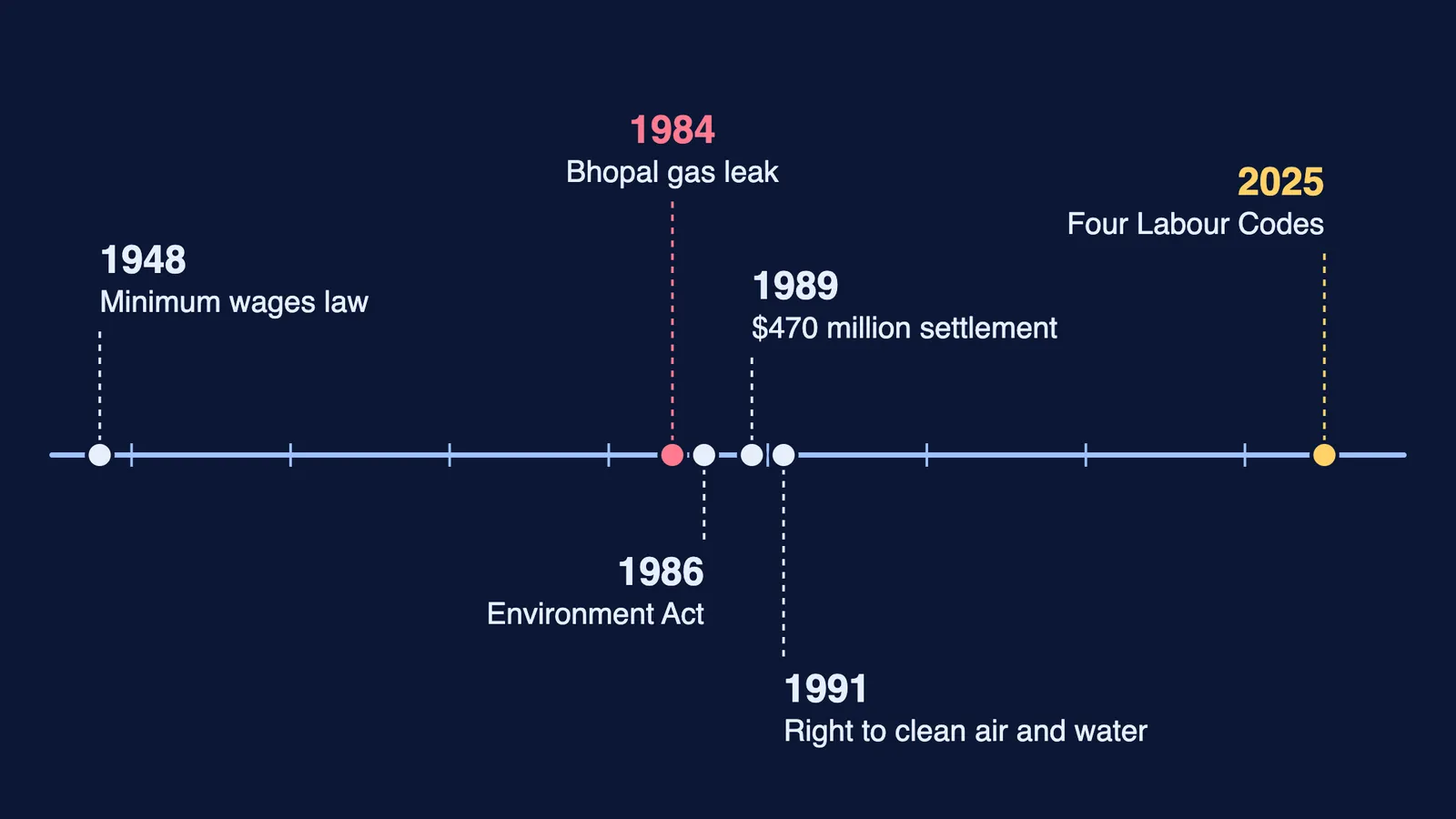
The law has moved on since the book was printed. Four Labour Codes came into effect from 21 November 2025, according to the Press Information Bureau. A PIB backgrounder says the Code on Wages, 2019 brings together four older laws, including the Minimum Wages Act, 1948, and gives all employees a statutory right to a minimum wage. The old Act covered only "scheduled employments", about 30% of workers by PIB's estimate. Workplace safety laws such as the Factories Act, 1948 are now part of the Occupational Safety, Health and Working Conditions Code, 2020.
What happened in the Bhopal gas tragedy?
At midnight on 2 December 1984, methyl isocyanate (MIC), a highly poisonous gas, began leaking from Union Carbide's pesticide plant in Bhopal, according to the NCERT chapter. The book says more than 8,000 people died within three days. Counts differ: a 2005 review in Environmental Health says more than 40 tons of MIC leaked and at least 3,800 people died immediately. For the chemistry, read what gas leaked in Bhopal.
NCERT lists the cost-cutting behind it:
Between 1980 and 1984, the MIC plant's crew was cut from 12 workers to 6.
Safety training was cut from 6 months to 15 days.
The MIC plant's night-shift worker post was abolished.
Bhopal relied on manual gauges and human senses to detect leaks; the company's West Virginia plant had computerised warnings and evacuation plans.
The book adds that the government filed a $3 billion compensation case in 1985 but accepted $470 million in 1989. The Supreme Court's order of 14 February 1989 records that settlement, payable to the Union of India.
How did Bhopal change environmental law in India?
In 1984, NCERT says, India had very few environmental laws and hardly any enforcement, and the existing laws covered only the individual worker, not people hurt by an industrial accident. After Bhopal, new laws held the polluter accountable. The Environment (Protection) Act, 1986 is Act No. 29 of 1986, dated 23 May 1986, as listed on the government's Parivesh environment clearance portal.
In Subhash Kumar vs State of Bihar (1991), the Supreme Court held that the Right to Life under Article 21 includes the right to pollution-free water and air, as the NCERT chapter records. The book adds a twist: when courts ordered polluting industries in Delhi to close or move, many workers lost their jobs.
How do you write a 5-mark answer on this chapter?
Most long questions in the NCERT exercises fit four steps:
Law: what does the law say?
Why: what unfair practice does it stop?
Whom: whose interests does it protect?
Enforced: who must enforce it, and what happened when they did not?
Worked example (Exercise 3): did the Bhopal victims get justice?
Law: safety laws existed, and Article 21 guarantees the Right to Life.
Why: to stop a company cutting safety to save costs.
Whom: workers, and families living near the plant.
Enforced: the book says safety laws were lax and unenforced, and inspectors kept approving the plant's procedures despite repeated leaks. The settlement was $470 million against a $3 billion claim.
Conclusion: largely no. End with the chapter's lesson: weak, poorly enforced laws can cause serious harm.
Then try the book's first exercise: ask two workers near you whether they receive the minimum wage, and run their answers through the four steps.
For your science and maths chapters, Fermi's AI tutor can work out what you already know and build a plan for the session, so you start with a clear next step.


