

On this page
If you are in Class 10 this year, consumer rights reaches you as a project, not as a board-exam chapter. The CBSE Class X Social Science curriculum for 2026-27 lists Chapter 5, Consumer Rights, as "Project Work", and gives 5 internal marks to a project on Consumer Rights or Social Issues or Sustainable Development. So what you need is correct notes and a project that uses them.
What are the six consumer rights?
The Consumer Protection Act, 2019 lists six "consumer rights" in section 2(9) (the Act as published in the Gazette, via PRS India):
Safety: protection against the marketing of goods, products or services that are hazardous to life and property.
Information: about quality, quantity, potency, purity, standard and price.
Choice: access, wherever possible, to a variety of goods and services at competitive prices.
To be heard: your interests get due consideration at the right forum.
Redressal: a remedy against unfair or restrictive trade practices and exploitation.
Consumer awareness.
Your NCERT chapter, Understanding Economic Development Chapter 5, uses the older names from the 1986 Act: choice, information, redressal, representation, safety and consumer education. Use the textbook names, and add one line matching them to the 2019 wording.
Use the chapter's cases as anchors. Reji Mathew, a Class IX student crippled for life by improper anaesthesia during a tonsil operation, is the safety case. Abirami, who left a coaching course after a year, is the choice case: the District Commission ordered the institute to refund ₹28,000. For a real fee dispute, our guide to getting a refund from a coaching centre walks through the steps.
These are legal rights under an Act, unlike the six Fundamental Rights from Class 9 in the Constitution.
What is COPRA and what changed in 2019?
COPRA is the Consumer Protection Act, 1986. India marks 24 December as National Consumers' Day because Parliament enacted COPRA on that day (NCERT). Its replacement, the Consumer Protection Act, 2019, received the President's assent on 9 August 2019 (Gazette text). Three changes to note:
Online shopping is covered: the definition of a consumer includes online transactions, teleshopping, direct selling and multi-level marketing.
Product liability: a complaint can be a product liability claim against the manufacturer, the seller or the service provider.
A parent can complain for a minor: the Act counts a minor's parent or legal guardian as a complainant.
Which consumer court hears which complaint?
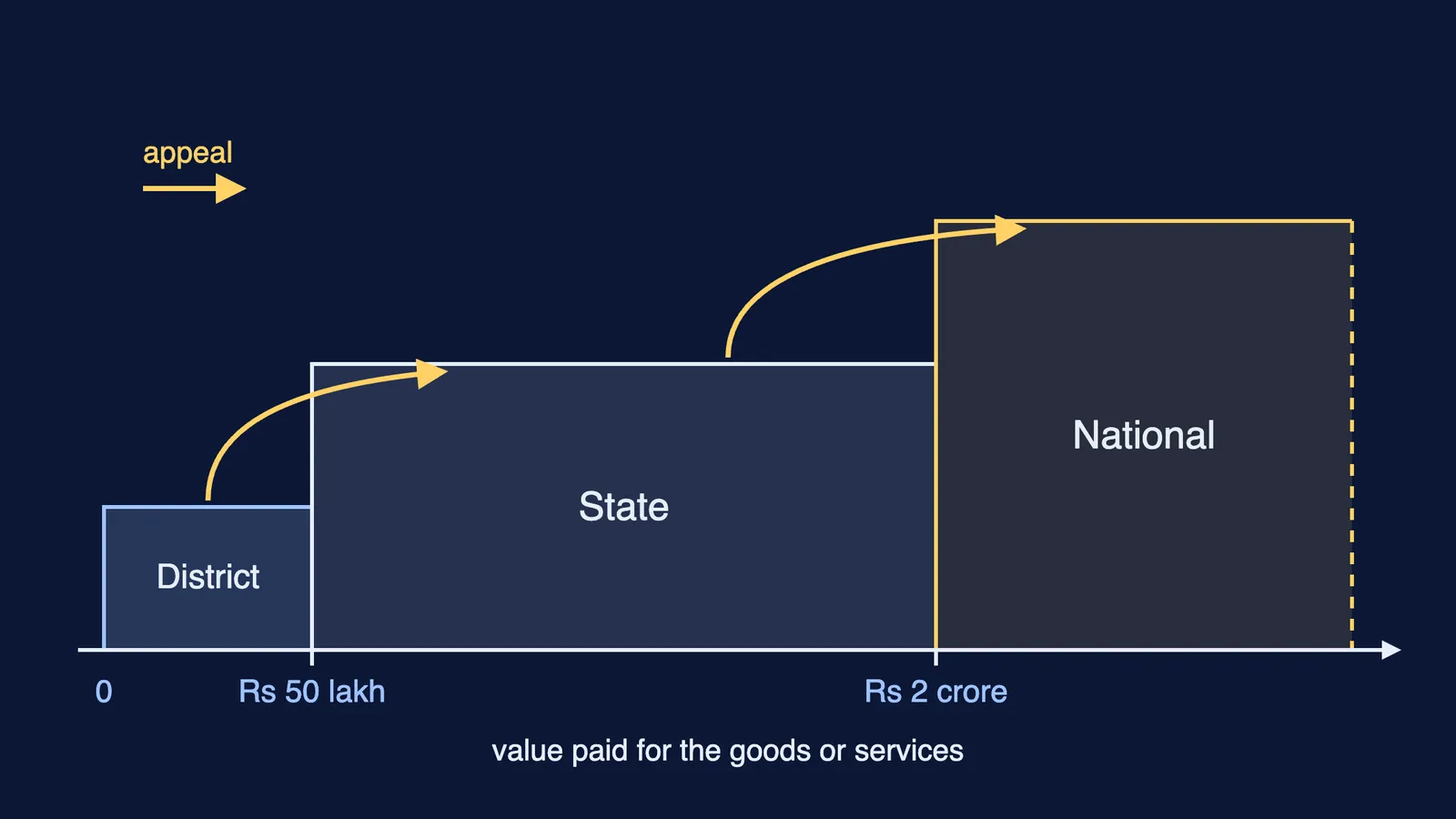
Under the Consumer Protection jurisdiction rules of 2021%20Rules,%202021.pdf), notified on 30 December 2021, which of the three Consumer Disputes Redressal Commissions hears a complaint depends on the value paid for the goods or services:
District Commission: up to ₹50 lakh.
State Commission: more than ₹50 lakh, up to ₹2 crore.
National Commission: more than ₹2 crore.
If a District Commission dismisses a case, you can appeal to the State Commission and then the National Commission (NCERT).
For everyday problems, start with the National Consumer Helpline: call 1915 toll free or message 8800001915 on WhatsApp. Its site also links to e-Jagriti, the consumer affairs ministry's online platform.
How do you make a consumer rights project file?
CBSE's suggested presentation template asks for objectives, evidence such as photos and interview excerpts, references and reflections (CBSE curriculum, Annexure IV). Its rubric for interdisciplinary projects gives 1 mark each to research, collaboration and presentation, and 2 marks to creativity and analysis; ask which rubric your school uses. A plan:
Pick one real purchase at home: a phone, a gas cylinder, an online order.
Read the label: the MRP, batch number, expiry date and any ISI, Agmark or Hallmark mark.
Survey 10 households with the 17-question checklist at the end of the NCERT chapter, and tally Always, Sometimes and Never.
Map each finding to a right: a price above the MRP or a missing expiry date is information; being made to buy a stove with a gas connection is choice.
Write the complaint (template below).
Show the route: shop, then helpline, then the right commission at today's limits.
Reflect on what you would now do differently as a buyer.
A worked example for step 3: if 3 of the 10 households always ask for a bill, write "Only 3 of the 10 households we surveyed always ask for a bill, so most would struggle to prove a complaint." That one sentence links data, a right and a consequence.
For step 5, NCERT asks you to write a letter for Mrs Krishna, whose colour TV stopped working within its six-month warranty. A simple template: "To the President, District Consumer Disputes Redressal Commission. I bought [item] on [date] for ₹[amount]; bill attached. It stopped working on [date], within warranty. I complained to [dealer] on [dates] without remedy. I request a replacement or refund, and compensation."
For the interdisciplinary project on globalisation, our Lifelines of National Economy notes and map list cover the geography half. And for the science and maths side of your Class 10 list, Fermi's AI tutor can work out what you already know and build a plan for the session, so you sit down to a clear next step.


