

On this page
The NCERT Class 8 civics book, Social and Political Life III, once titled this chapter 'Why do we need a Parliament?'. The 2024-25 NCERT edition calls it 'Parliament and the Making of Laws'. The answer is the same in both: Parliament lets citizens take part in decisions and keep control of the government.
Why do we need a Parliament in a democracy?
The chapter starts from one idea: 'The take-off point for a democracy is the idea of consent', meaning the people's approval and participation (NCERT, Chapter 3). Citizens of a country as large as India cannot all meet to decide things, so they elect representatives who meet in Parliament. Under universal adult franchise, every adult citizen has the right to vote.
The chapter describes three jobs for an elected Parliament:
It selects the national government.
It controls, guides and informs the government.
It makes laws.
What are the Lok Sabha and Rajya Sabha?
Under Article 79 of the Constitution, Parliament consists of the President and two Houses: the Council of States (Rajya Sabha) and the House of the People (Lok Sabha).
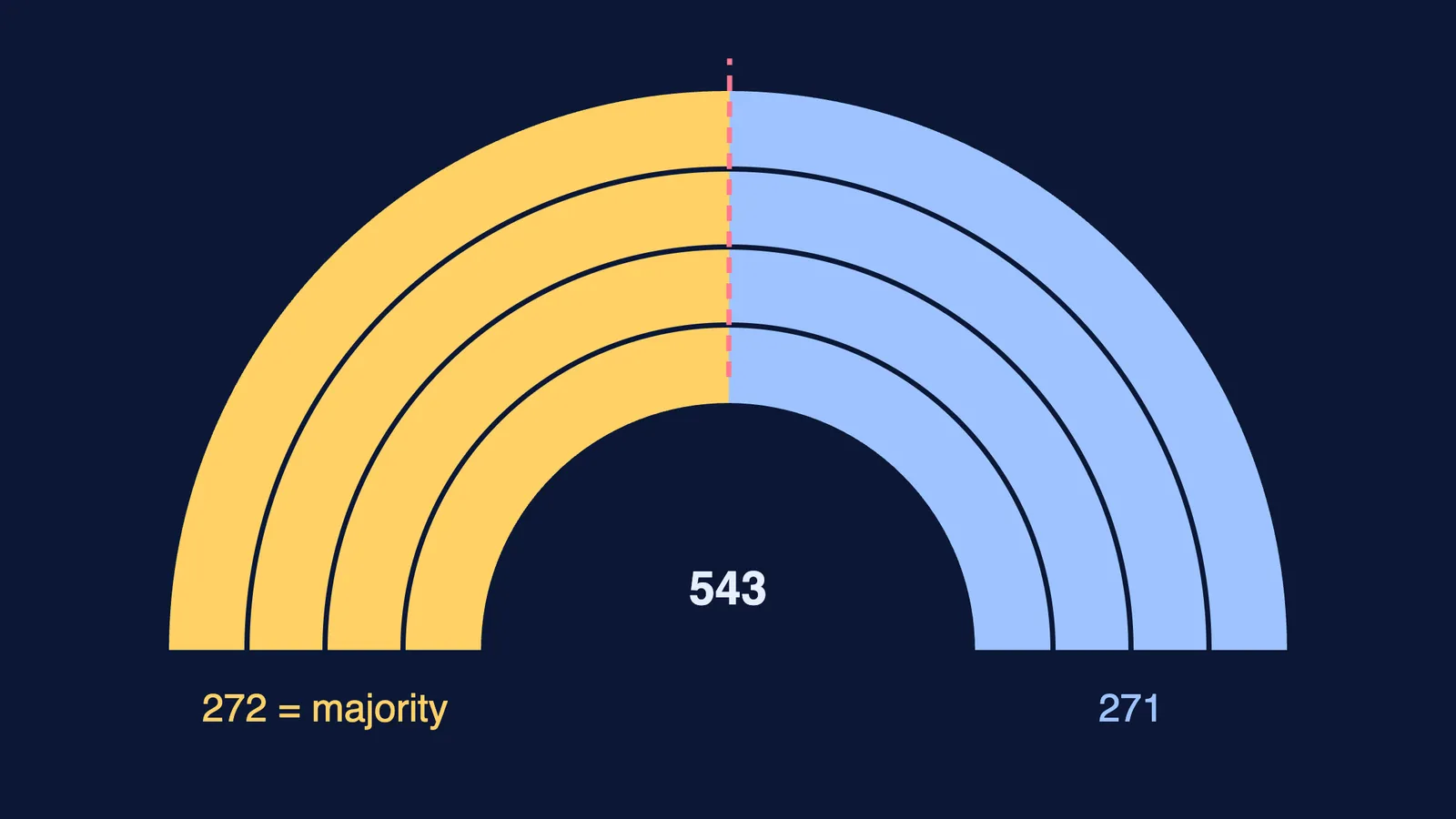
The Lok Sabha has 543 members elected directly by voters, one per constituency, and is presided over by the Speaker (NCERT). Unless dissolved sooner, it continues for five years from the date appointed for its first meeting (Article 83).
The Rajya Sabha represents the states. The Constitution allows up to 238 representatives of the states and Union territories, plus 12 members nominated by the President (Article 80); each state's members are elected by the elected members of its Legislative Assembly. The NCERT chapter gives 233 elected seats. The Rajya Sabha is never dissolved: about one-third of its members retire every second year (Article 83).
The Rajya Sabha reviews and can alter laws that start in the Lok Sabha. A Money Bill, though, cannot be introduced in the Rajya Sabha, which may only return it with recommendations within fourteen days (Article 109).
How is a government formed after Lok Sabha elections?
With 543 elected seats, a party needs at least 272 MPs to form the government (NCERT). Work through an imaginary result:
Party A wins 240 seats, Party B 190, Party C 30, Party D 25, and others 58. Total: 543.
Party A is the largest but is 32 seats short of 272.
A plus C makes 270, still short. A plus C plus D makes 295, a majority.
These three form a coalition government. Everyone outside it is the Opposition, and the largest of those parties is called the Opposition party.
NCERT gives a real case: in the 2009 Lok Sabha election the Congress won 206 seats, short of a majority, and formed the United Progressive Alliance with its allies.
The President appoints the Prime Minister, and the Council of Ministers is collectively responsible to the House of the People (Article 75). So a government needs the Lok Sabha's support for as long as it governs, not just on counting day.
How does Parliament question the government?
Generally, the first hour of a Lok Sabha sitting, 11:00 to 12:00, is set aside for questions (Lok Sabha). In Question Hour, MPs ask ministers for information, and the government learns about its shortcomings and what people think. The NCERT chapter reprints a real one: a question answered on 15 December 2017 asking the Ministry of Women and Child Development whether it planned to bring schemes for children together.
Parliament's approval is also crucial in all matters dealing with money, and Opposition parties point out weak policies and build support for their own. Laws can begin with citizens too: the chapter shows how groups raised the issue of domestic violence until it became the Protection of Women from Domestic Violence Act 2005.
How should you answer this question in the exam?
Use this five-point frame for a long answer, with one example per point:
Consent: in a democracy, people rule through elected representatives.
Government: the Lok Sabha majority (at least 272 of 543 seats, per the NCERT chapter) selects the executive.
Control: Question Hour, approval of money matters and the Opposition keep the government answerable.
Laws: Parliament makes laws and responds to issues people raise, such as domestic violence.
States: the Rajya Sabha gives the states a voice and reviews laws.
For the rules behind all this, read our guide to the features of the Indian Constitution for Class 8. To see how voters fill these seats, read how an Indian election works, and for what comes next, who decides what in our institutions.
If science chapters are the harder half of your Class 8 year, Fermi's AI tutor can work out what you already know and build a plan for the session, so you start revision with a clear next step.


