On this page
Chapter 6 of NCERT's Ganita Prakash, Part II for Grade 7 (book code gegp2, First Edition October 2025) has two halves: exact figures drawn with only an unmarked ruler and a compass, then tiling. CBSE's 2026-27 curriculum page lists syllabi for Classes 9 to 12 only, so Class 7 follows the NCERT book and the chapter is assessed by the school.
What does Constructions and Tilings cover in Class 7?
Each idea leans on the one before it:
Perpendicular bisector. Two points each equally far from X and Y, one on each side, fix the line that halves XY at a right angle. Congruent triangles prove it.
90° at a point O on a line. Mark X and Y equally far from O; O already lies on the bisector.
Śulba-Sūtras. A rope method for the perpendicular bisector from the Kātyāyana-Śulbasūtra; the Śulba-Sūtras are Vedic-period texts on fire altars, and a stretched rope does the compass's job.
Bisecting and copying angles, both by the SSS condition, and then a parallel line drawn through equal corresponding angles.
Arches and regular hexagons. Six equilateral triangles fit around a point because 6 × 60° = 360°, giving a hexagon with 120° angles. A 60° angle comes from an equilateral triangle; bisecting gives 30°, then 15°.
Tiling. Tangrams, grids covered by 2 × 1 tiles, then the whole plane tiled by squares, equilateral triangles or regular hexagons. The book mentions Escher (1898–1972), a tiling found in 2023, and hexagonal bee-hive cells.
Congruence comes from Chapter 1, 'Geometric Twins', so our guide to writing a congruence proof step by step helps if the "why" parts feel shaky.
How do you construct a perpendicular bisector? A worked example
Take XY = 8.6 cm. Half of it is 4.3 cm, so the arc radius must be more than 4.3 cm for the arcs to meet. Choose 6.2 cm.
With radius 6.2 cm, draw an arc above XY from X, then from Y. Name their crossing A.
Keeping the same radius, draw arcs below XY from X, then from Y. Name their crossing B.
Join AB: it is the perpendicular bisector. It meets XY at O; check that OX = 4.3 cm and the angle at O is 90°.
In right triangle AOX, OA = √(6.2² − 4.3²) = √19.95 ≈ 4.47 cm, so AB ≈ 8.93 cm. If your drawing is far off, an arc slipped. With a 4 cm radius the arcs never meet.
How do you know a grid cannot be tiled with 2 × 1 tiles?
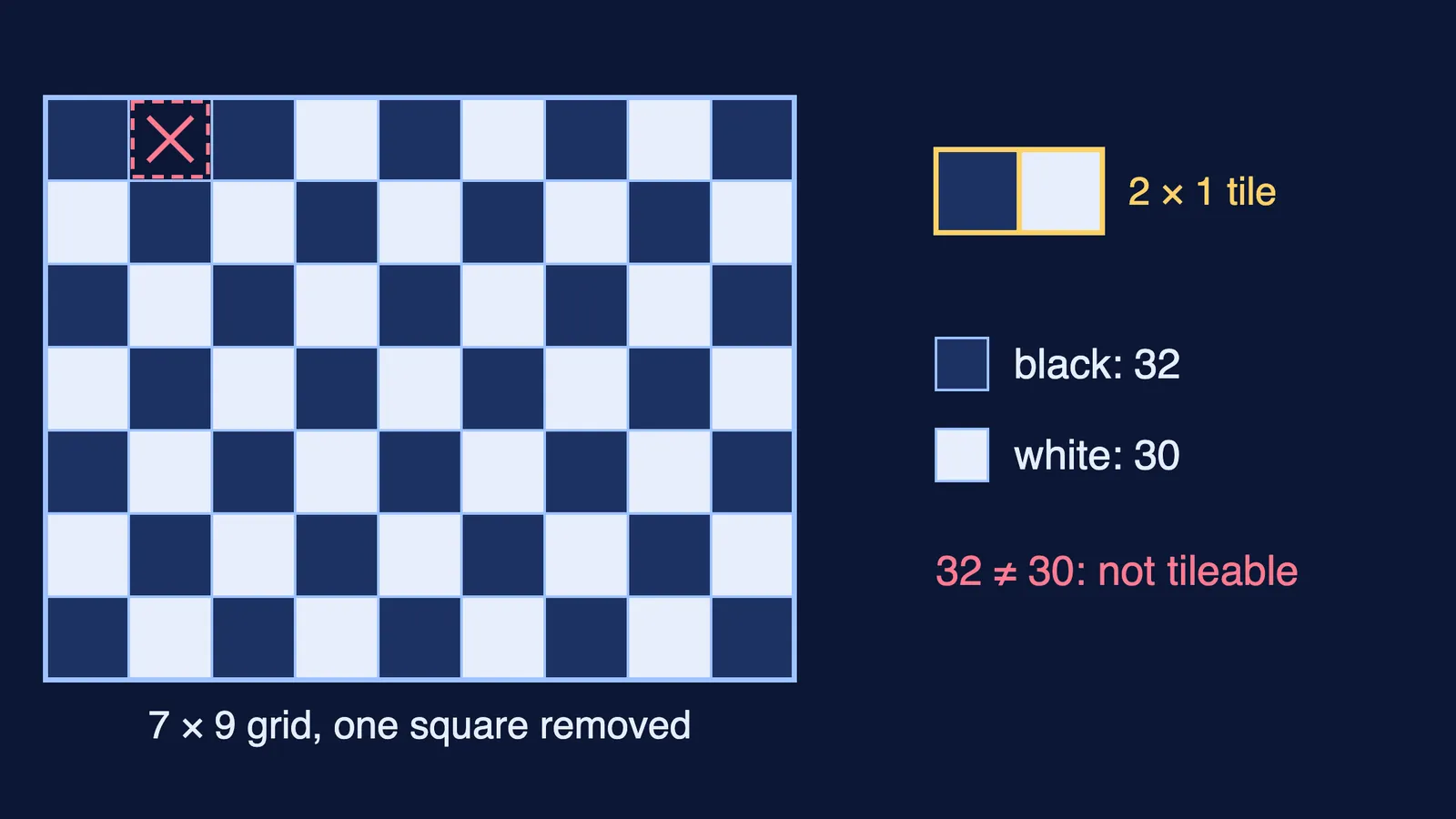
Each tile covers two unit squares, so an odd number of squares can never be tiled. An even count is not enough, though. The book's trick: colour the grid black and white so neighbours always differ. Every tile then covers one black and one white square, so a tileable region needs equal numbers of each.
Worked example (the image above). A 7 × 9 grid has 63 squares. The corners share a colour; call it black. Rows 1, 3, 5 and 7 have 5 black squares each and rows 2, 4 and 6 have 4, so there are 20 + 12 = 32 black and 31 white.
Remove a corner: 31 black, 31 white. A tiling exists (we checked by computer).
Remove the square beside a corner (white): 32 black, 30 white. No arrangement of tiles can work.
Our post on which shapes tessellate takes plane tiling further, to why only three regular polygons work.
Practice questions
Marks are our suggestion; your school sets the real pattern.
Can a 6 × 9 grid be tiled with 2 × 1 tiles? How many tiles? (2 marks)
A 9 × 5 grid is coloured with black corners. Count each colour. Which colour must a removed square be for the rest to be tileable? (3 marks)
Describe how to construct 75° with a ruler and compass. (3 marks)
Angles of 85°, 110° and 65° meet at a point. Will a 95° angle fill the rest? (2 marks)
XY = 7.4 cm. Arcs of radius 3.5 cm from X and Y do not meet. Why not, and what is the smallest whole-centimetre radius that works? (2 marks)
Answers. (1) Yes: 6 rows is even, so each column takes 3 vertical tiles; 27 tiles. (2) 23 black, 22 white; the removed square must be black. (3) Construct 90° and a 60° angle inside it; bisect the 30° gap to get 15°; 60° + 15° = 75°. (4) No: the gap is 360° − 260° = 100°, leaving 5° uncovered. (5) The radius must be more than half of XY, which is 3.7 cm; 3.5 cm is too short, so 4 cm is the smallest whole-centimetre radius.
How does this chapter connect to the rest of maths?
Congruence explains why every construction works, and the 360° around a point decides which shapes tile. In Class 9, the Ganita Manjari quadrilaterals chapter keeps the same habit of proving a figure's properties instead of trusting a drawing.
Not sure which construction step keeps going wrong? Fermi's AI tutor works out what you already know and builds a plan for the session.