On this page
Quadrilaterals is Chapter 12 of Ganita Manjari Part II, the new NCERT Class 9 maths book for 2026-27, first published in August 2026 (NCERT contents and imprint page). It runs from page 51 to page 84 (chapter PDF). This guide covers the new book, not the older NCERT textbook.
What does Class 9 Quadrilaterals cover in Ganita Manjari?
The chapter starts by asking what exactly counts as a quadrilateral. Its definition: four distinct points in a plane, joined in order by four segments, where every point other than the four vertices lies on exactly one segment (NCERT chapter). That rules out figures whose sides cross.
A quadrilateral is convex when all its internal angles are less than 180°, or equivalently when its diagonals intersect (NCERT chapter). After that come four tests for a parallelogram, the Midpoint Theorem and its converse, the centroid of a triangle, Varignon's theorem and a tiling of the plane with any 4-gon.
For marks, the CBSE 2026-27 Class IX curriculum places "4-gons (Quadrilaterals)" in Unit IV Geometry, worth 25 of the 80 theory marks and shared with Euclid's geometry, lines and angles, triangles and circles. Its outcomes include finding the fourth vertex of a parallelogram from coordinates.
How do you prove a quadrilateral is a parallelogram?
A parallelogram is defined by both pairs of opposite sides being parallel. The chapter proves that each of these four conditions is also enough on its own (NCERT chapter):
Both pairs of opposite sides are equal.
Both pairs of opposite angles are equal.
The diagonals bisect each other.
One pair of opposite sides is both equal and parallel.
The first three are converses of Class 8 properties, each proved separately. Our guide to propositions and their converses in Class 9 explains why a true statement does not make its converse true.
Worked example (our numbers). Take A(1, 2), B(7, 4), C(9, 9) and D(3, 7).
Midpoint of AC = ((1 + 9)/2, (2 + 9)/2) = (5, 5.5).
Midpoint of BD = ((7 + 3)/2, (4 + 7)/2) = (5, 5.5).
The diagonals share a midpoint, so they bisect each other and ABCD is a parallelogram by test 3.
Reverse it to find a missing vertex. Given only A, B and C, the shared midpoint forces D = A + C − B = (1 + 9 − 7, 2 + 9 − 4) = (3, 7), which matches.
What is the Midpoint Theorem in Class 9?
The Midpoint Theorem says the segment joining the midpoints of two sides of a triangle is parallel to the third side and half its length (NCERT chapter). Its converse in the book: a line through the midpoint of one side, parallel to a second side, bisects the third side.
Our example: in a triangle with BC = 14 cm, the segment joining the midpoints of AB and AC is parallel to BC and measures 14 ÷ 2 = 7 cm.
Two results follow:
Centroid. The three medians of a triangle meet at one point that divides each median in the ratio 2:1, the longer part towards the vertex (NCERT chapter). For a median of 12 cm, that point is 8 cm from the vertex and 4 cm from the midpoint.
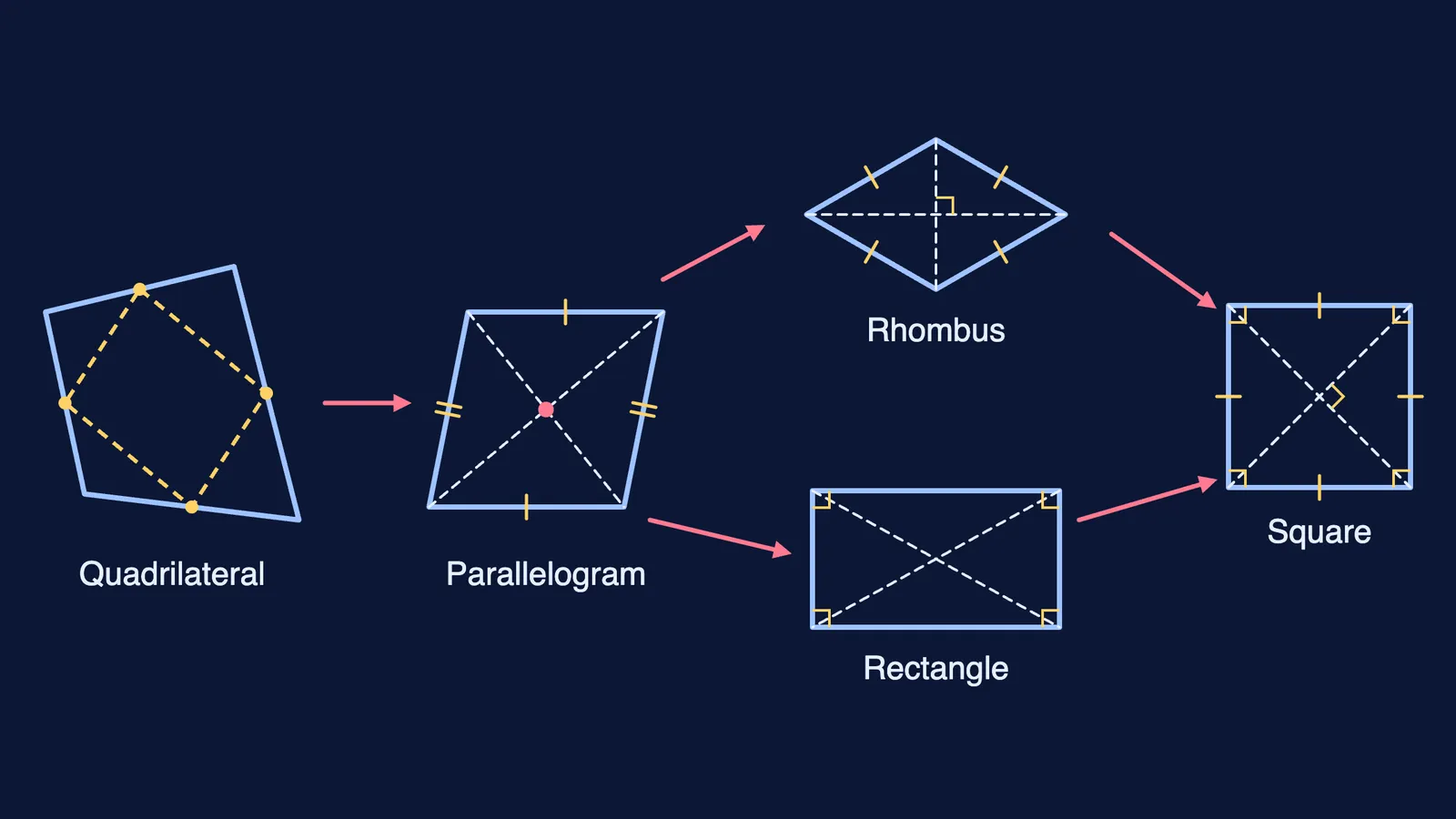
Varignon's theorem. Joining the midpoints of the four sides of any quadrilateral gives a parallelogram (NCERT chapter). Each side is half a diagonal, so a quadrilateral with diagonals of 10 cm and 6 cm gives a parallelogram with sides 5 cm and 3 cm and perimeter 16 cm. See why the midpoints of any quadrilateral form a parallelogram for the full argument.
Can any quadrilateral tile the plane?
Yes. The chapter shows that copies of any 4-gon, even an irregular or non-convex one, can cover a floor with no gaps or overlaps (NCERT chapter). The key fact is that the four angles add up to 360°, so four copies can meet at a point using each angle once. One method rotates a copy by 180° about the midpoint of each edge; cut paper copies and try it.
Which mistakes cost marks, and how should you revise?
Calling a shape with crossing sides a quadrilateral. Check the definition first.
Using a converse that the chapter has not proved. Each converse needs its own proof.
Writing the 2:1 ratio the wrong way round. The longer part touches the vertex.
Skipping reasons. Name the congruence test or theorem at each step.
A one-week plan: day 1, redraw the family tree above with one property per shape; days 2 to 4, prove each parallelogram test from memory; days 5 and 6, invent coordinate examples and check them; day 7, attempt the end-of-chapter exercises without the book. For the properties of each special shape side by side, see our table of parallelogram, rhombus, rectangle, square and kite properties.
When a proof keeps going wrong at the same step, the Fermi Problem Library has worked problems with a step-by-step solver that explains the reasoning rather than printing an answer.