On this page
Propositions and their Converses is Chapter 9, the opening chapter of the new 2026-27 NCERT Class 9 maths book Ganita Manjari Part II, first published in August 2026 (NCERT contents and imprint page). It is only seven pages long (chapter PDF), but its habit matters everywhere: before using a statement, check which way it works.
What is a proposition and what is its converse?
A proposition is a statement that is either true or false, as the Ganita Manjari chapter defines it. "Mumbai is in Maharashtra" is one; "Close the door" is not.
Most propositions in this chapter have the shape "if X, then Y". The converse swaps the two parts: "if Y, then X". The book also writes "if X then Y" as "X implies Y", and points out that "Y when X" says the same thing (NCERT chapter).
Our own example:
Proposition: If you live in Chennai, then you live in Tamil Nadu. (True.)
Converse: If you live in Tamil Nadu, then you live in Chennai. (False: someone in Madurai lives in Tamil Nadu but not in Chennai.)
The Madurai resident is a counterexample: a case where the "if" part holds but the "then" part fails.
Is the converse of a true statement always true?
No. The chapter summary lists every combination: a proposition can be true while its converse is false, both can be true, or both can be false. One of each, all our own:
True, converse false: If a whole number ends in 0, then it is divisible by 5. The converse fails for 35, which is divisible by 5 but ends in 5.
Both true: If a triangle is equilateral, then each of its angles is 60°. Its converse is also true.
Both false: If a number is prime, then it is odd. That fails for 2. The converse, "if a number is odd, then it is prime", fails for 9.
When both are true, the two conditions imply each other, but each direction needs its own proof. The chapter, for instance, guides you through a separate proof of the converse of the Baudhāyana–Pythagoras theorem.
Worked example: does a quadrilateral with equal diagonals have to be a rectangle?
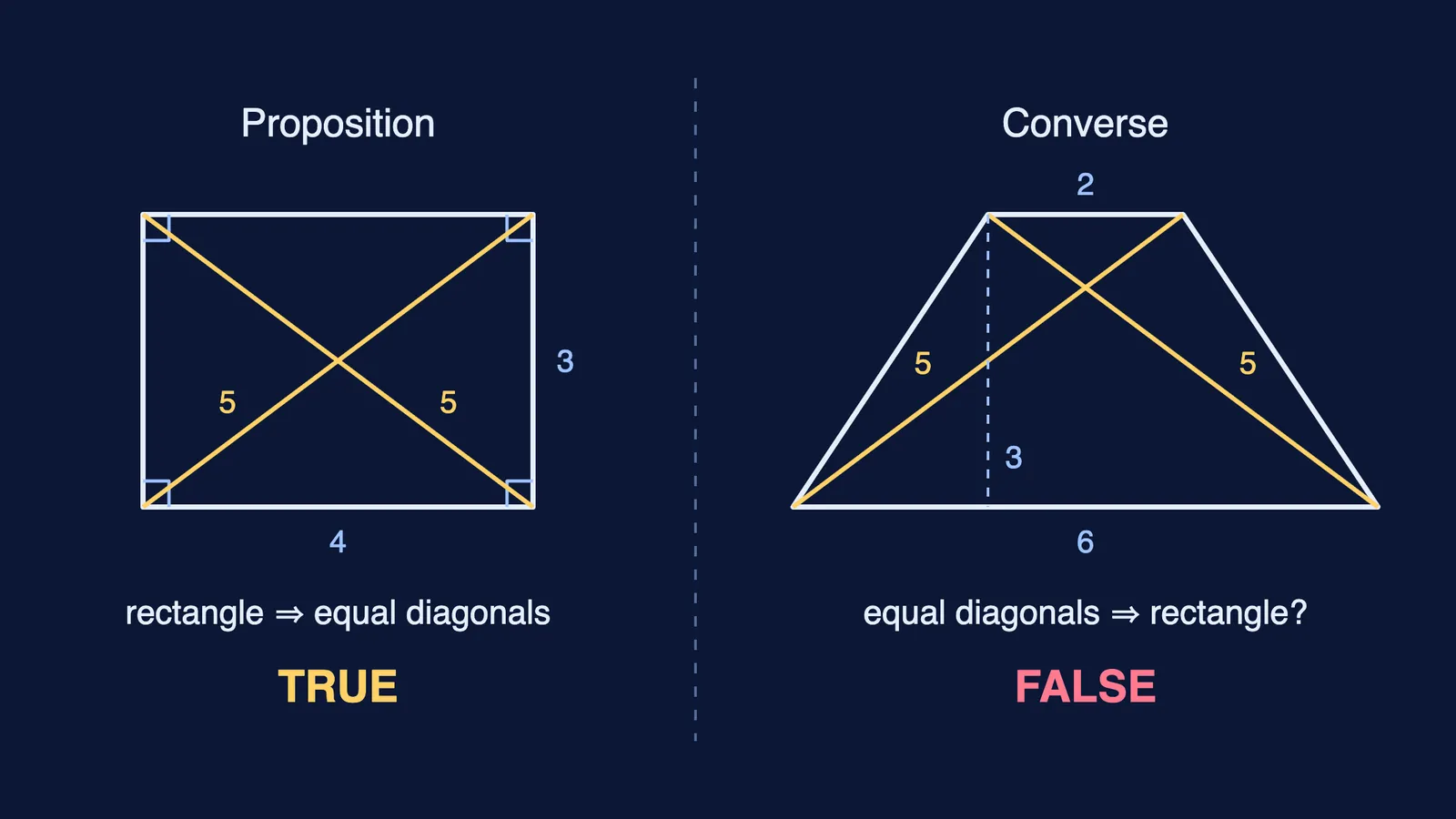
Take the proposition: if a quadrilateral is a rectangle, then its diagonals are equal.
In rectangle ABCD, compare triangles ABC and BAD.
They share side AB. BC equals AD, since opposite sides of a rectangle are equal. The angles at B and A are both 90°.
By the SAS congruence rule, the triangles are congruent, so diagonal AC equals diagonal BD. The proposition is true.
Converse: if a quadrilateral has equal diagonals, then it is a rectangle. Try to break it.
Draw a trapezium with corners at (0, 0), (6, 0), (4, 3) and (2, 3). Its parallel sides are 6 and 2 units long.
The diagonal from (0, 0) to (4, 3) is √(16 + 9) = 5; from (6, 0) to (2, 3) it is also √(16 + 9) = 5.
Equal diagonals, unequal parallel sides: not a rectangle. The converse is false, and this trapezium is the counterexample.
To prove, you reason for every rectangle; to disprove, one shape is enough.
What mistakes do students make with converses?
Assuming the converse comes free. A true statement tells you nothing about its converse.
Picking a counterexample that misses the "if" part. To disprove "if a number is divisible by 5, it ends in 0", you need a number that is divisible by 5 and does not end in 0, such as 25.
Swapping the setup along with the condition. In "for a quadrilateral ABCD, if it is a rectangle, then its diagonals are equal", keep "for a quadrilateral ABCD" and swap only the condition and conclusion.
Missing a hidden "if". Rewrite "a number is even when it ends in 4" as "if a number ends in 4, then it is even" before forming the converse.
If your proofs keep stalling at the same step, the Fermi Problem Library has worked problems with a step-by-step solver that explains the reasoning rather than printing an answer. See also how to test a claimed property with a counterexample and why 1 is not a prime number.
How is this chapter assessed in CBSE Class 9 for 2026-27?
The CBSE Class IX Mathematics curriculum for 2026-27 places propositions and their converse inside the Triangles: Congruence Theorems topic of Unit IV, Geometry. That Geometry unit carries 25 of the 80 marks in the written paper, and the paper is 3 hours long, with a further 20 marks of internal assessment (CBSE curriculum). The chapter has no separate marks of its own.
Its learning outcomes ask you to identify the converse of a given proposition and use counterexamples to show some converses are false (CBSE curriculum). For each statement you meet:
Rewrite it in "if X, then Y" form.
Write its converse.
Decide true or false for each, with a short proof or one counterexample.
Try it on "if a number ends in 5, then it is odd".