

On this page
Ask a Class 10 classroom whether 1 is prime and you may well get a split vote. It feels like it should be: 1 is divisible only by 1 and itself. But mathematicians keep 1 out of the primes on purpose, and the reason is one of the most useful facts in school maths.
What is the definition of a prime number?
The standard definition, as given by the Prime Pages FAQ on the number one, is: "An integer greater than one is called a prime number if its only positive divisors (factors) are one and itself."
Put another way, a prime has exactly two different positive divisors. 2 has two (1 and 2). 13 has two (1 and 13). 1 has only one divisor, itself, so it does not qualify. So why write the definition that way?
Why is 1 not a prime number?
Because letting 1 in would break unique prime factorisation. The NCERT Class 10 textbook states the Fundamental Theorem of Arithmetic as: "Every composite number can be expressed (factorised) as a product of primes, and this factorisation is unique, apart from the order in which the prime factors occur."
The same NCERT chapter factorises 32760 as 2³ × 3² × 5 × 7 × 13. That is the only way to write 32760 as a product of primes. Now suppose 1 were prime. Then putting one, two or a hundred extra 1s in front would give new prime factorisations, without end. "Unique" would no longer be true.
You could patch the theorem by adding "except for 1". Chris Caldwell and Yeng Xiong note in their survey of the primality of one, published in the Journal of Integer Sequences in 2012, that people who counted 1 as prime did exactly that. They also stress that whether 1 is prime "is a matter of definition, so a matter of choice, context and tradition, not a matter of proof." The modern choice saves you from writing "except 1" in theorem after theorem.
Is 1 prime or composite?
Neither. The Prime Pages glossary defines a composite as a positive integer that can be written as a product of two smaller positive integers, neither of which is one. 1 cannot be split that way, so it is not composite either.
The same glossary sorts positive integers into three groups: the unit {1}, the primes {2, 3, 5, 7, 11, ...}, and the composites {4, 6, 8, 9, 10, ...}. In higher maths, 1 is called a "unit", a number with a multiplicative inverse, and the Prime Pages FAQ treats units and primes as separate kinds of number.
Was 1 ever considered a prime number?
Sometimes, but less often than people think. Caldwell and Xiong's history of the smallest prime finds that Euclid did not count the unit as a number at all, so it could not be prime. One started to be treated as an ordinary number after Simon Stevin's work on decimals in 1585, and some writers then called it prime. After Gauss stated and proved the Fundamental Theorem of Arithmetic in 1801, the modern definition that excludes 1 slowly won out. As the authors put it in their introduction: "There does not appear to be any period of time during which most mathematicians defined one to be a prime."
How can you check this for yourself?
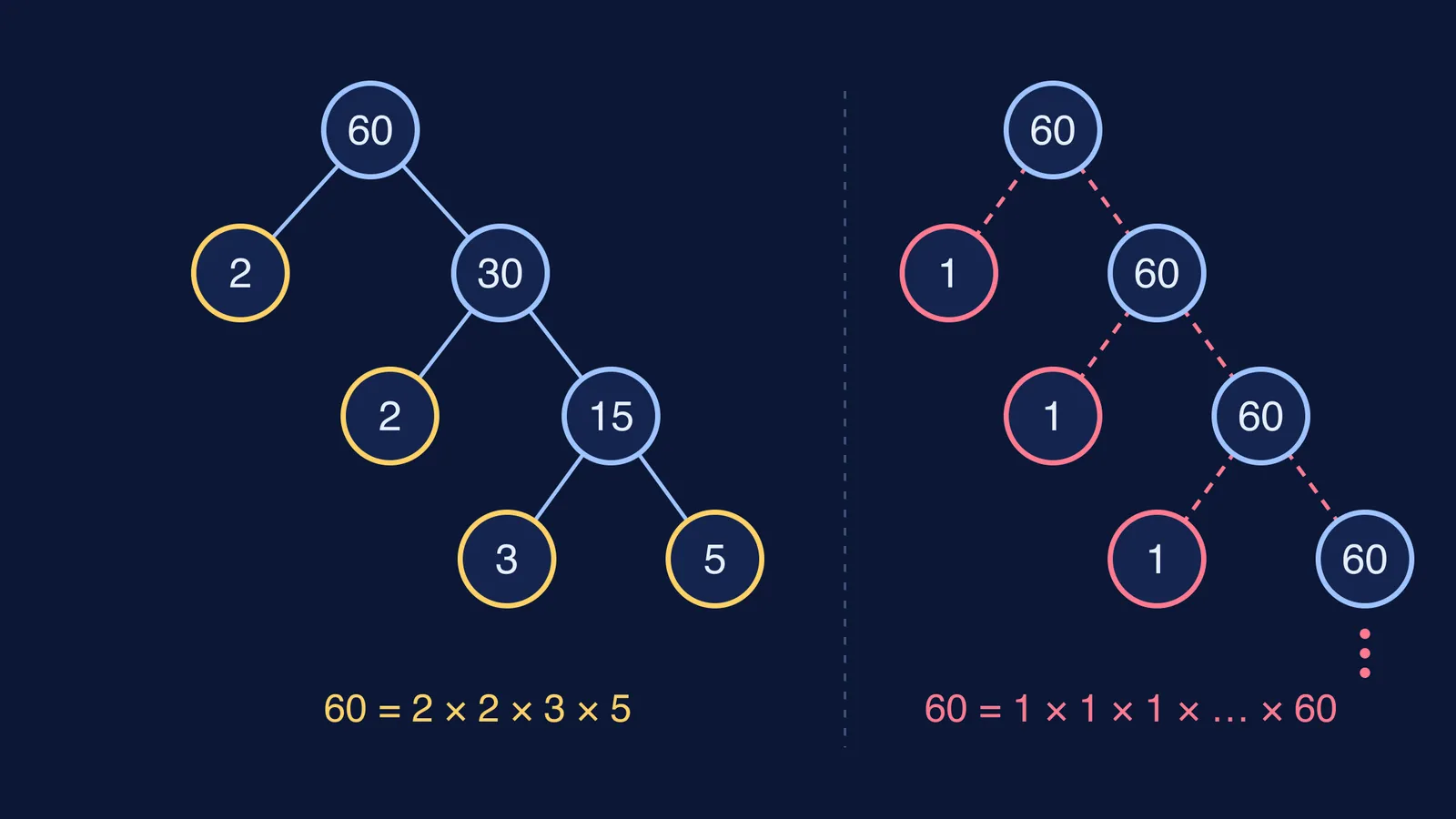
Try it with 60, the number in the diagram above.
Split 60 as 6 × 10. Then 6 = 2 × 3 and 10 = 2 × 5. You end with 2 × 2 × 3 × 5.
Start again with 4 × 15. Then 4 = 2 × 2 and 15 = 3 × 5. Same four primes.
Now pretend 1 is prime. 60 = 1 × 60 is a legal first split, and so is 1 × 1 × 60. The tree never has to stop.
Every honest path gives 2 × 2 × 3 × 5, which is exactly what uniqueness promises. Our post on why every factor tree ends with the same primes walks through more trees like this.
Here is a quick check you can run on any whole number n:
Count its positive divisors.
One divisor: n is 1, which is neither prime nor composite.
Exactly two divisors: n is prime.
More than two divisors: n is composite.
For larger numbers, where listing every divisor is slow, see our guide on how to check whether a number is prime. Unique factorisation is also what makes HCF, LCM and irrationality proofs work; see where the Fundamental Theorem of Arithmetic is used.
If units, primes and composites still feel slippery, the Fermi Concept Library gives each idea in mathematics its own lesson and its place in the map. To practise, the Fermi Problem Library has worked problems with a step-by-step solver that explains the reasoning rather than printing an answer.


