

On this page
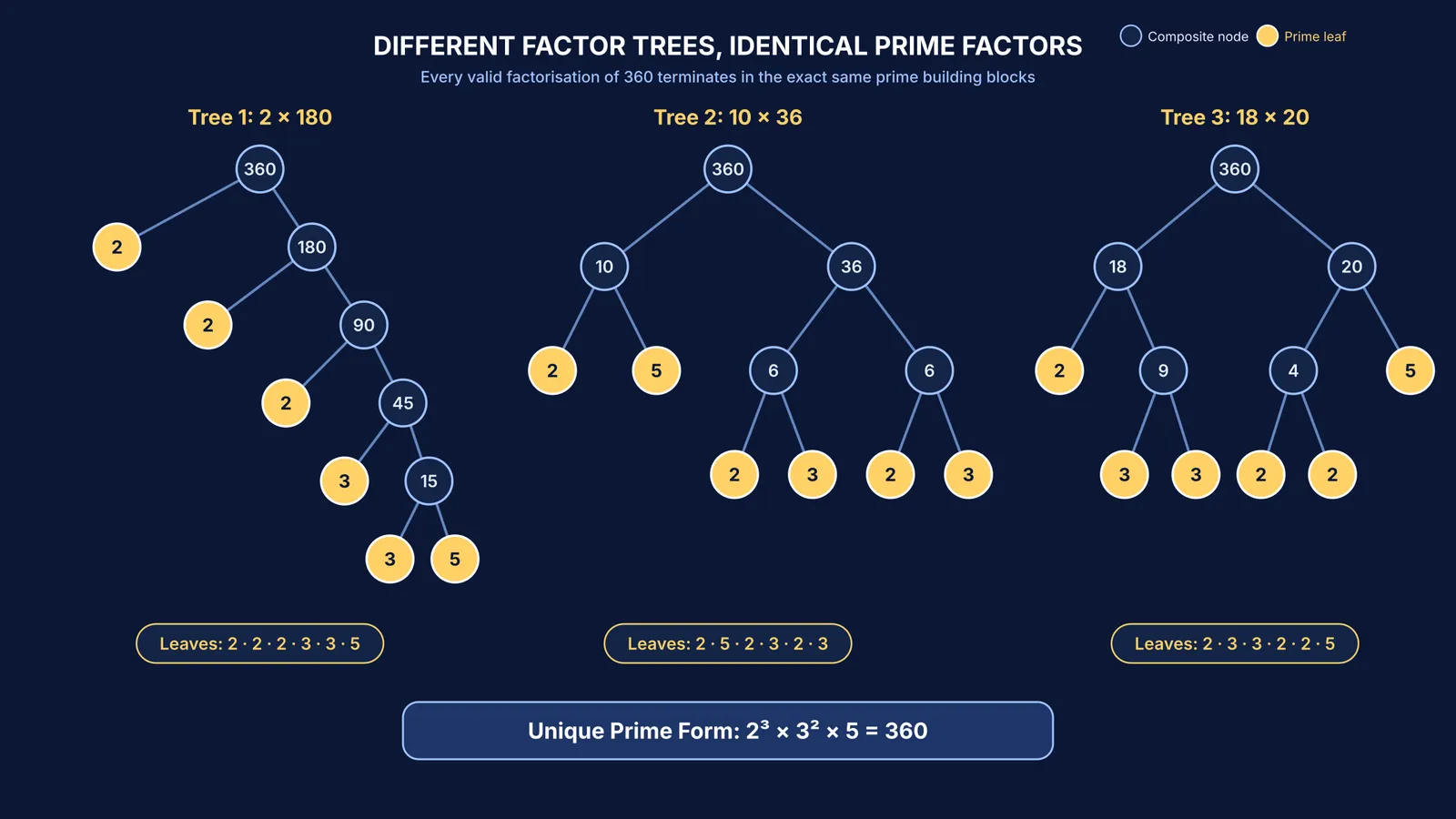
Suppose you ask three students to write the prime factorisation of 360 using a factor tree. The first student notices that 360 is even and immediately branches it into 2 and 180. The second student spots the zero and branches 360 into 10 and 36. A third student starts with 18 and 20.
At first glance, their diagrams look entirely unrelated. One tree forms a tall, narrow spine cascading down the page; another spreads into two balanced clusters; the third branches into squat limbs. Yet when each student finishes breaking down every composite branch until only prime numbers remain, every tree terminates in the exact same collection of leaves: three 2s, two 3s, and one 5.
This visual surprise is one of the most reassuring moments in school mathematics. Students first encounter this when moving from elementary divisibility to prime numbers, as explored in our guide to prime numbers and divisibility rules. But why does the initial split never alter the final destination?
What happens when you split 360 in different ways?
To see this invariance in action, follow the branches of 360 across three distinct starting factorisations:
The sequential branch (2 × 180): Peel off 2, leaving 180. Split 180 into 2 × 90, then 90 into 2 × 45. Next, split 45 into 3 × 15, and 15 into 3 × 5. Collecting the prime leaves yields 2, 2, 2, 3, 3, 5.
The base-10 branch (10 × 36): Split 10 into 2 × 5. Split 36 into 6 × 6, then split each 6 into 2 × 3. Collecting all the prime leaves yields 2, 5, 2, 3, 2, 3, which orders to 2, 2, 2, 3, 3, 5.
The balanced branch (18 × 20): Split 18 into 2 × 9 (giving 2, 3, 3) and 20 into 4 × 5 (giving 2, 2, 5). Reordering the leaves yields 2, 2, 2, 3, 3, 5.
Every valid tree resolves to 2³ × 3² × 5 = 360. As documented on Wolfram MathWorld's Fundamental Theorem of Arithmetic, every integer greater than 1 has a unique prime factorisation up to factor order. This unvarying signature is also what allows students to calculate the total number of divisors from prime exponents.
Why do all factor trees produce identical prime leaves?
The permanence of prime factors is an iron law of arithmetic. Around 300 BCE, Euclid proved in Book IX, Proposition 14 of the *Elements* that the least number measured by a set of primes cannot be measured by any other prime. Euclid’s proof depended on Book VII, Proposition 30: if a prime divides a product of two integers, it must divide at least one of them, as recorded in the Clark University Elements archive.
In 1801, Carl Friedrich Gauss published *Disquisitiones Arithmeticae*. In Article 16, Gauss noted that while mathematicians had long assumed prime factorisation was unique, none had proved it rigorously. Gauss provided that proof, showing that composite integers resolve into primes in only one way.
When you draw a factor tree, you are not creating factors; you are merely unpacking bundles. Splitting 360 into 10 × 36 gathers the bundle (2 × 5) on the left and (2² × 3²) on the right. Because prime numbers cannot be broken down further, peeling each bundle down eventually releases the identical prime building blocks.
When an idea is easier to see than to read, visual models turn formal proofs into tangible intuition. The Fermi Simulation Lab provides interactive simulations for ideas that are easier to see than to read, helping learners manipulate variables and observe mathematical invariants in real time.
How does predicting the outcome change how students learn?
In 1992, Richard White and Richard Gunstone introduced the Predict-Observe-Explain (POE) model in *Probing Understanding*, archived in the ERIC database. Rather than demonstrating a rule passively, POE requires students to commit to a prediction before observing the outcome.
When students are asked whether splitting 360 into 18 × 20 will produce different primes than 2 × 180, many intuitively guess yes. When their own pencil work reveals identical primes at every leaf, the resulting surprise creates cognitive conflict that anchors the concept permanently.
Active engagement is backed by extensive educational evidence. A meta-analysis of 225 STEM studies in the Proceedings of the National Academy of Sciences (Freeman et al., 2014) showed that active learning raised exam scores by 6% and cut failure rates by 35.5% compared to traditional lecturing. Moving from static rules to active exploration, as discussed in our look at simulations and static diagrams, helps students understand why patterns hold.
For students working through multi-step arithmetic and algebra, the Fermi Problem Library offers worked problems with a step-by-step solver that explains the reasoning rather than printing an answer.
How can you test prime uniqueness at home or in class?
You can run this brief prediction activity with paper and pencil:
Choose a composite number: Numbers like 72, 120, or 360 work best because they offer multiple factor pairs.
Commit to a prediction: Ask the learner whether starting with an even or odd factor pair changes the prime leaves.
Draw two contrasting trees: On the left, peel off 2s repeatedly. On the right, split the number into two composite halves.
Circle the prime leaves: Circle every leaf that cannot be split further, sort them in ascending order, and write the prime-power form.
Testing multiple factor trees directly shows learners that arithmetic is not a set of arbitrary rules, but an interconnected system built on unbreakable foundations.


