

On this page
The fundamental theorem of arithmetic is a cornerstone of Class 10 mathematics. It underpins how we break numbers apart, compare them, and prove their mathematical properties.
What does the fundamental theorem of arithmetic state?
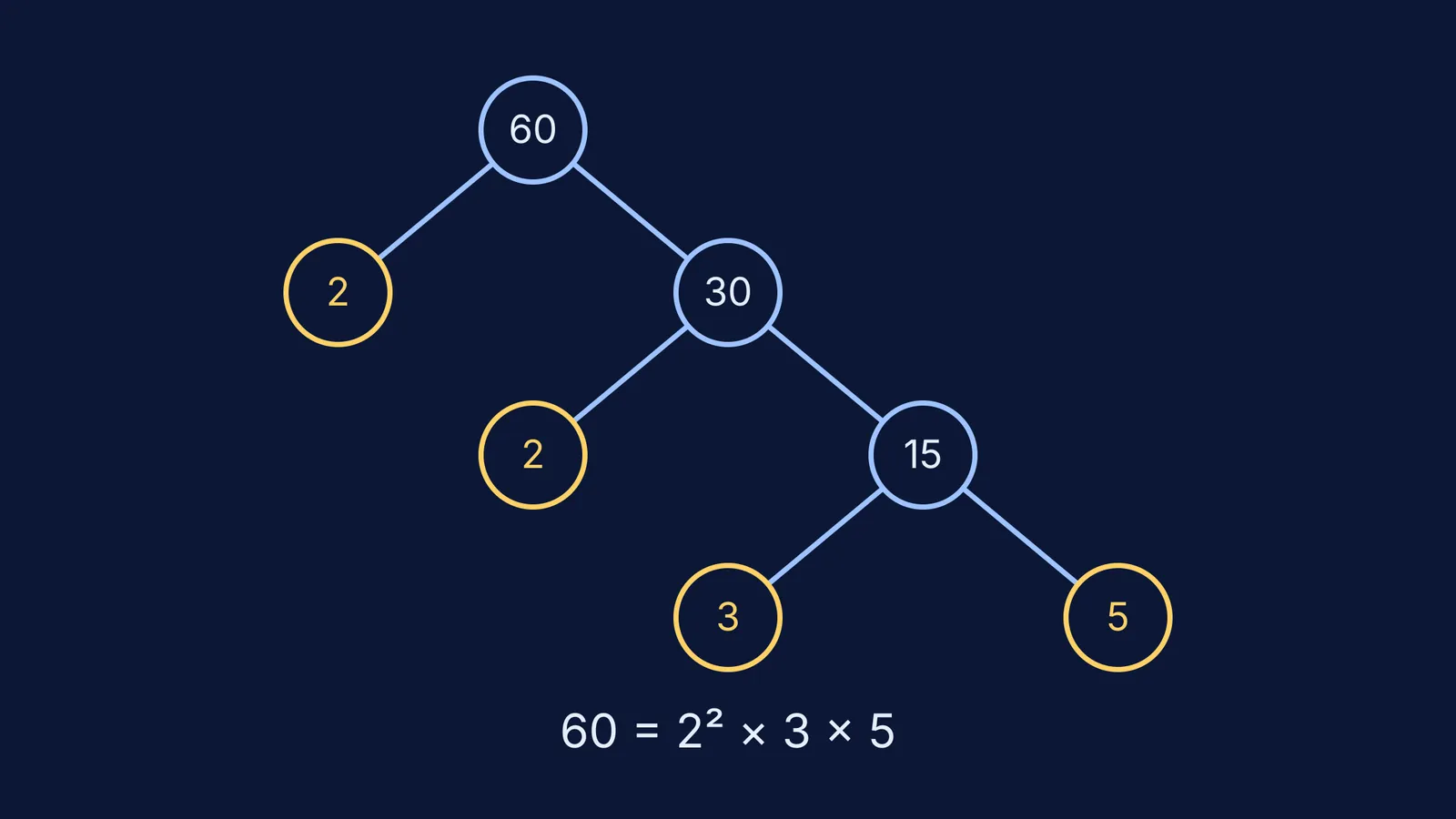
The fundamental theorem of arithmetic guarantees that every integer greater than 1 has exactly one unique prime factorisation (ignoring the order of the factors). This foundational property was first rigorously proved for its uniqueness part by Carl Friedrich Gauss in his 1801 work, *Disquisitiones Arithmeticae*.
For example, 60 will always break down into 2 × 2 × 3 × 5. You can write it as 2² × 3 × 5, but no matter how you divide it—whether you start with 6 × 10 or 4 × 15—you will always arrive at the exact same set of prime numbers. This is why prime numbers are often called the "building blocks" of mathematics.
This idea is more than just a calculation tool; it is a way to look at numbers conceptually. Engaging actively with these concepts, rather than passively listening to lectures or memorising steps, is critical. A meta-analysis of 225 studies found that active learning reduces failure rates in university math and science courses from 32% to 21%. Writing out your own prime factor trees and testing the uniqueness yourself is a proven way to make the concept stick.
How do you prove why 6ⁿ never ends in 0?
One of the most common Class 10 exam questions asks you to prove why a number like 6ⁿ (where n is a natural number) can never end with the digit 0.
The fundamental theorem of arithmetic provides a foolproof way to answer this. For any number to end in the digit 0, it must be exactly divisible by 10. Because 10 is the product of 2 and 5, any number ending in zero must have both 2 and 5 in its prime factorisation.
Let us look at the prime factorisation of 6: 6 = 2 × 3
Since 6 only has prime factors of 2 and 3, any power of 6 (like 6ⁿ) will only ever be a product of 2s and 3s. By the uniqueness guaranteed by the fundamental theorem, the prime factor 5 will never suddenly appear. Without a 5 to pair with a 2, the product can never be a multiple of 10. Thus, you can confidently state that 6ⁿ can never end with the digit 0.
How do you find HCF and LCM from prime powers?
The fundamental theorem of arithmetic also provides a reliable, mechanical method to find the Highest Common Factor (HCF) and Least Common Multiple (LCM) of two or more numbers.
Find the prime factorisation of each number, writing them out using exponents.
For the HCF: Identify the prime factors that are common to all numbers. Take the smallest power of each common prime factor and multiply them together.
For the LCM: Identify all the prime factors involved across the numbers. Take the highest power of every prime factor and multiply them.
For example, let us find the HCF and LCM of 36 and 60. First, find their prime factorisations:
36 = 2² × 3²
60 = 2² × 3¹ × 5¹
The common prime factors are 2 and 3. The smallest power of 2 is 2², and the smallest power of 3 is 3¹. Therefore, the HCF is 2² × 3¹ = 12.
For the LCM, take the highest power of all primes present (which are 2, 3, and 5): 2² × 3² × 5¹ = 4 × 9 × 5 = 180.
A useful property to remember, which you can use to check your work in an exam, is that for any two positive integers *a* and *b*, HCF(*a*, *b*) × LCM(*a*, *b*) = *a* × *b*. In our example, 12 × 180 = 2160, and 36 × 60 = 2160.
How can Fermi help you practice?
When you hit a wall while working on Class 10 quadratic word problems or prime factorisations, you need a clear next step instead of a blank page. Whether you are working on prime factors or finding the area of a triangle using determinants, Fermi's AI tutor holds a line of reasoning across a whole session, notices where a student is stuck, and decides whether to explain, ask, or show.
Try the Fermi Problem Library for worked problems with a step-by-step solver that explains the reasoning rather than printing an answer.


