On this page
If you join the midpoints of the four sides of any quadrilateral, in order, you get a parallelogram. Here is the proof using only the midpoint theorem, a check on real coordinates, and what happens when the outer shape is a rhombus or a rectangle.
What is the midpoint theorem?
The midpoint theorem says that the segment joining the midpoints of two sides of a triangle is parallel to the third side and half its length (Midpoint theorem, Wikipedia). If you want practice using it on triangles first, try our step-by-step midpoint theorem problems.
Why do the midpoints of a quadrilateral's sides form a parallelogram?
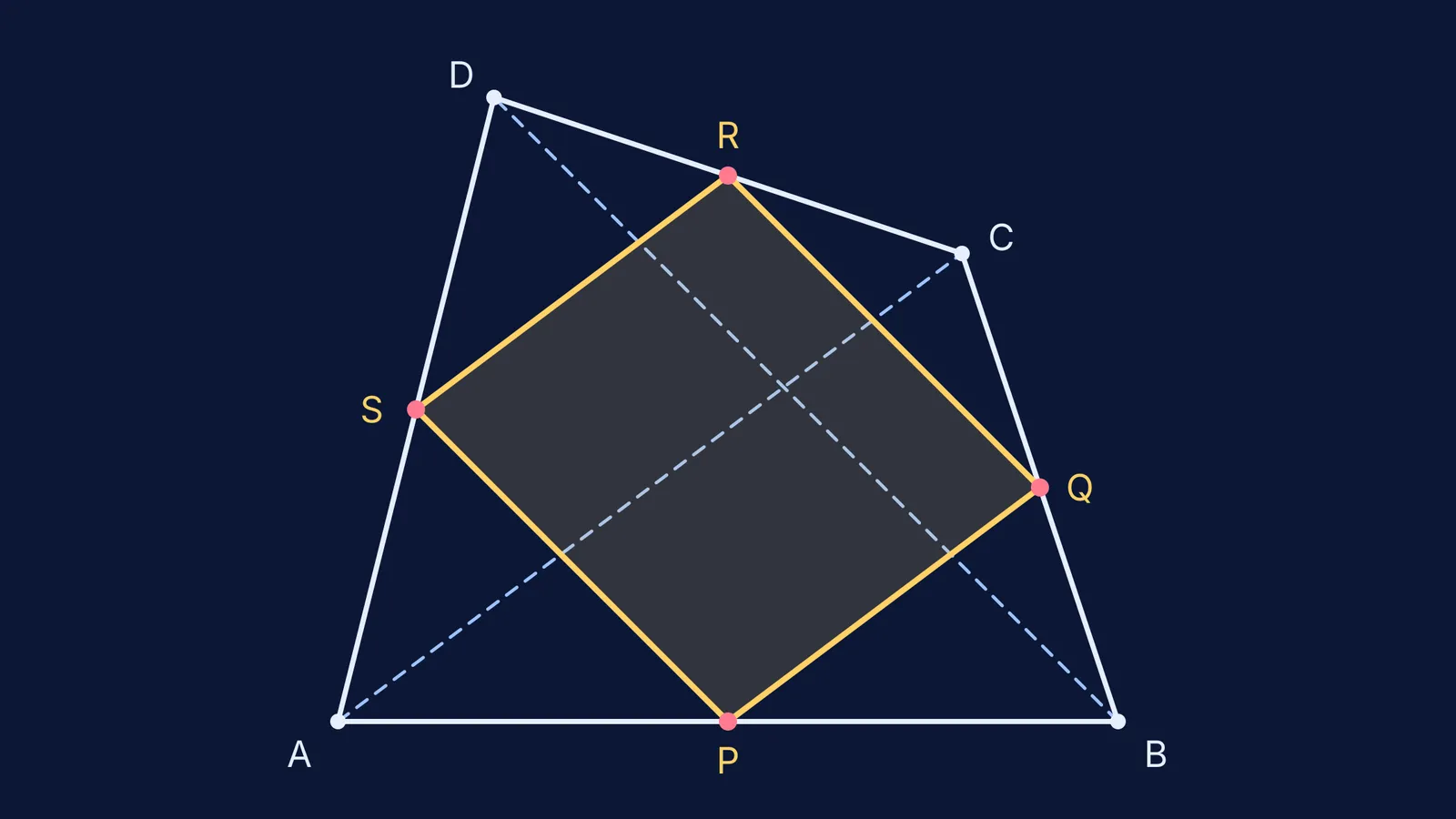
Take any quadrilateral ABCD. Let P, Q, R and S be the midpoints of AB, BC, CD and DA. Draw the diagonal AC, which splits ABCD into two triangles.
In triangle ABC, P and Q are the midpoints of AB and BC. By the midpoint theorem, PQ ∥ AC and PQ = ½AC.
In triangle ADC, S and R are the midpoints of AD and DC. By the midpoint theorem, SR ∥ AC and SR = ½AC.
From steps 1 and 2, PQ ∥ SR and PQ = SR.
A quadrilateral with one pair of opposite sides both equal and parallel is a parallelogram. So PQRS is a parallelogram.
One pair is enough. The other diagonal BD gives QR ∥ BD, PS ∥ BD and QR = PS = ½BD. The special cases depend on this second pair.
The result is called Varignon's theorem, after the French mathematician Pierre Varignon, whose proof was published posthumously in 1731 (Varignon's theorem, Wikipedia). The same article notes that the inner parallelogram's perimeter equals the sum of the two diagonals, and that its area is half the quadrilateral's (for a crossed quadrilateral, only if its area is taken as the difference of its two triangles). MathWorld puts the key fact for convex quadrilaterals: each side is parallel to one of the original diagonals and half as long.
Does it work with real numbers?
Try it on coordinates you can check by hand: A(0, 0), B(10, 0), C(8, 6), D(2, 8).
Midpoints: P(5, 0), Q(9, 3), R(5, 7), S(1, 4).
PQ is a step of (4, 3), and so is SR, from (1, 4) to (5, 7). Same direction, same length: 5.
Diagonal AC is a step of (8, 6), length 10. PQ is exactly half of it.
QR is a step of (−4, 4), and so is PS, each of length 4√2. Diagonal BD is (−8, 8), length 8√2.
Perimeter of PQRS: 2(5 + 4√2) = 10 + 8√2, which is AC + BD.
Area by the shoelace formula: ABCD is 56 square units and PQRS is 28. Half, as expected.
This is the figure at the top of this post. Checking a proof on numbers is a good habit: you find your slip before the examiner does.
What happens if ABCD is a rhombus or a rectangle?
Since the sides of PQRS copy the diagonals of ABCD at half length, the inner shape depends on the diagonals, not the sides. The inner parallelogram is a rhombus if and only if the two diagonals are equal, and a rectangle if and only if they are perpendicular (Varignon's theorem, Wikipedia).
ABCD is a rhombus. Its diagonals are perpendicular (here is why the diagonals of a rhombus are perpendicular). Since PQ ∥ AC and QR ∥ BD, angle PQR equals the angle between the diagonals, 90°. A parallelogram with one right angle is a rectangle.
ABCD is a rectangle. Its diagonals are equal, AC = BD. Then PQ = ½AC = ½BD = QR. A parallelogram with two adjacent sides equal is a rhombus.
ABCD is a square. Its diagonals are equal and perpendicular, so PQRS is both a rectangle and a rhombus: a square.
ABCD is any other parallelogram. Its diagonals are usually neither equal nor perpendicular, so PQRS stays a plain parallelogram.
The diagonal rule also handles other shapes. A kite has perpendicular diagonals, so its midpoints form a rectangle. An isosceles trapezium has equal diagonals, so its midpoints form a rhombus.
How should you write this proof in an exam?
Name the midpoints, then say which diagonal you are drawing and why: it makes two triangles.
Name the theorem each time you use it: "by the midpoint theorem in triangle ABC".
Prove one pair of opposite sides equal and parallel, then state the parallelogram test you used.
For the rhombus or rectangle version, prove the parallelogram first, then add the one extra fact: a right angle, or two equal adjacent sides.
If you keep losing a step between "parallel" and "parallelogram", the Fermi Problem Library has worked problems with a step-by-step solver that explains the reasoning rather than printing an answer. For a refresher on the parallelogram tests, see our Class 9 guide to quadrilaterals and the mid-point theorem, or the Fermi Concept Library, where each concept has its own lesson.
Try it tonight: draw a lopsided quadrilateral, mark its diagonals, and predict the inner shape before you join the midpoints.