

On this page
What are the properties of a rhombus?
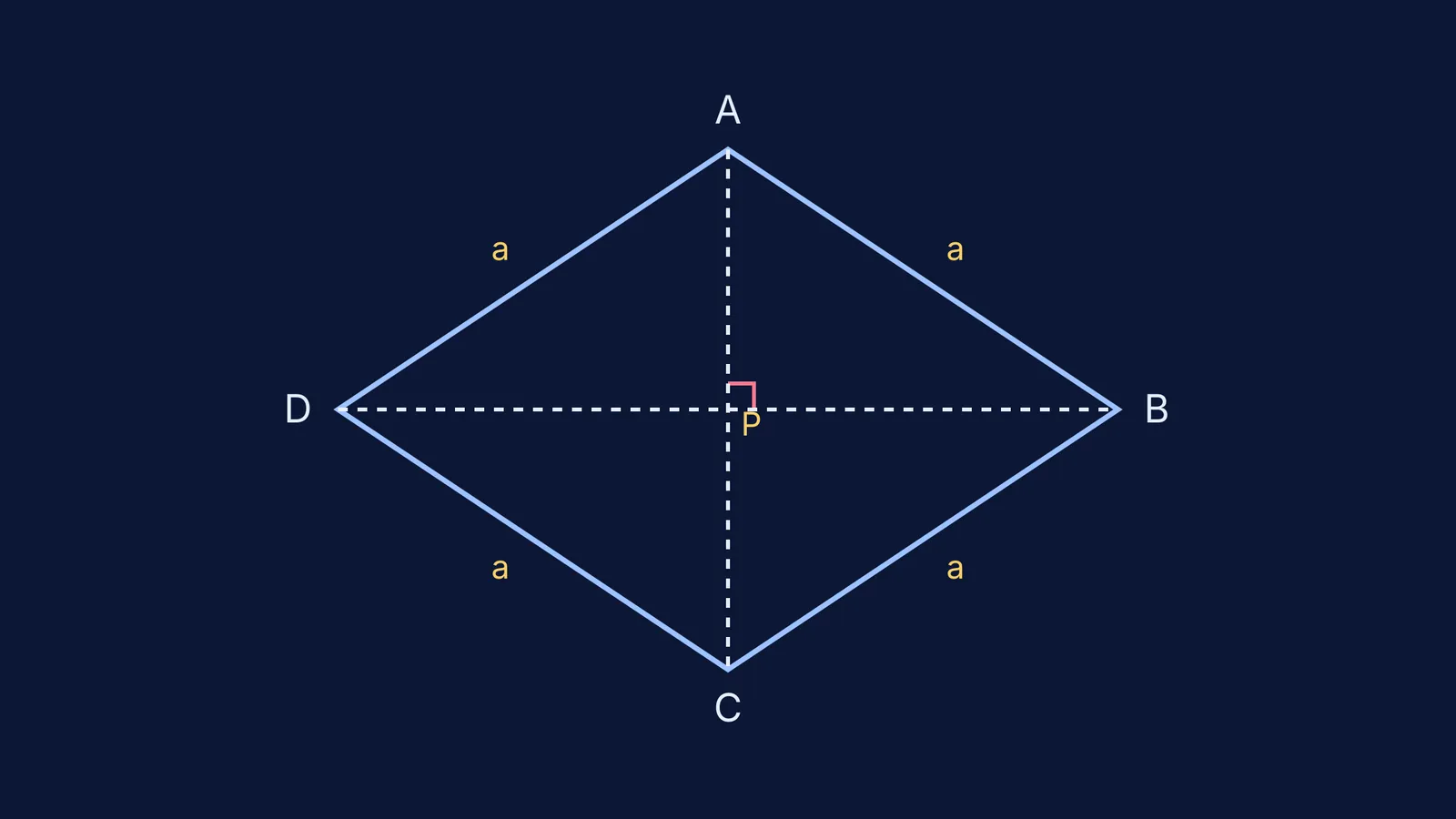
In geometry, a rhombus is a type of quadrilateral where all four sides have equal length. Because opposite sides are parallel, every rhombus is also a special kind of parallelogram. According to Wikipedia, a rhombus is an orthodiagonal quadrilateral, which means its diagonals always intersect at an angle of 90°.
Along with meeting at a right angle, the diagonals of a rhombus have a few other defining properties. First, they bisect each other, meaning they cut each other exactly in half. Second, each diagonal bisects the interior angles of the rhombus at the vertices it connects. Finally, the diagonals act as lines of symmetry for the shape.
How do you prove diagonals of a rhombus are perpendicular?
You can prove that the diagonals of a rhombus are perpendicular by using the Side-Side-Side (SSS) congruence rule for triangles. Here is the step-by-step framework to follow when writing this proof in a maths exam.
Given: Let ABCD be a rhombus. Its diagonals AC and BD intersect at a point P. Because it is a rhombus, all its sides are equal (AB = BC = CD = DA).
To prove: The angle APB is 90° (and therefore all four angles at the intersection P are 90°).
Proof:
Since a rhombus is a type of parallelogram, its diagonals bisect each other. This means AP = PC and BP = PD.
Now, look at the two adjacent triangles formed at the centre: triangle APB and triangle CPB.
In triangle APB and triangle CPB:
AB = BC (Sides of a rhombus are equal)
BP = BP (Common side shared by both triangles)
AP = PC (Diagonals of a parallelogram bisect each other)
By the SSS (Side-Side-Side) congruence criterion, triangle APB is congruent to triangle CPB.
Because the triangles are congruent, their corresponding angles are equal. Therefore, angle APB = angle CPB.
The angles APB and CPB lie on the straight line AC, which means they are supplementary. Their sum must be 180°.
Since angle APB + angle CPB = 180° and they are exactly equal, each angle must be exactly 90°.
This concludes the proof. The diagonals AC and BD are perpendicular to each other.
This geometric method is straightforward. However, if your vertices are given as coordinates on a grid, you will need a different approach, much like finding a circle through three given points. You would calculate the slopes of the two diagonals and show that their product is −1.
If you struggle to recall which triangle properties to use during exams, the Fermi Concept Library explains every concept in physics, chemistry, biology, mathematics and computing, each with its own lesson and its place in the map.
How do you find the area of a rhombus using its diagonals?
Because the diagonals of a rhombus meet at exactly 90°, they split the shape into four right-angled triangles. This unique property gives us a very quick way to find the area without needing to know the height of the shape.
The area of a rhombus is exactly half the product of the lengths of its diagonals. If the lengths of the two diagonals are p and q, the area formula is Area = (p × q) / 2.
For example, if a rhombus has diagonals of 10 cm and 8 cm, its area is (10 × 8) / 2 = 40 cm². You can also relate the diagonals to the side length (a) of the rhombus. The sum of the squares of the diagonals equals four times the square of the side length, written as p² + q² = 4a².
This area formula is very useful for flat 2D shapes. If you are solving coordinate geometry problems and need to find the area of the triangles formed by the diagonals, you can calculate the area of a triangle using determinants instead.
When you are stuck on coordinate geometry problems that ask you to prove these relationships, the Fermi Problem Library has worked problems with a step-by-step solver that explains the reasoning rather than printing an answer.


