

On this page
Class 9 geometry introduces students to formal deductive proofs, and the midpoint theorem is one of the biggest milestones in that journey. It bridges the gap between basic triangles and complex quadrilaterals, setting the stage for higher mathematics and competitive exams.
If you or your child are struggling with geometry proofs, you are not alone. According to a 2025 RAND Corporation survey, 49% of middle and high school students report losing interest in their math classes half or more of the time, often because they struggle to see the practical application of abstract concepts. However, mastering core theorems gives students the logical tools to construct strong mathematical arguments and approach complex shapes with confidence.
What is the midpoint theorem for Class 9?
The midpoint theorem provides a direct, unshakeable relationship between the midpoints of a triangle's sides and its base. The NCERT Class 9 Mathematics textbook defines it formally: the line segment joining the mid-points of two sides of a triangle is parallel to the third side and is half of it.
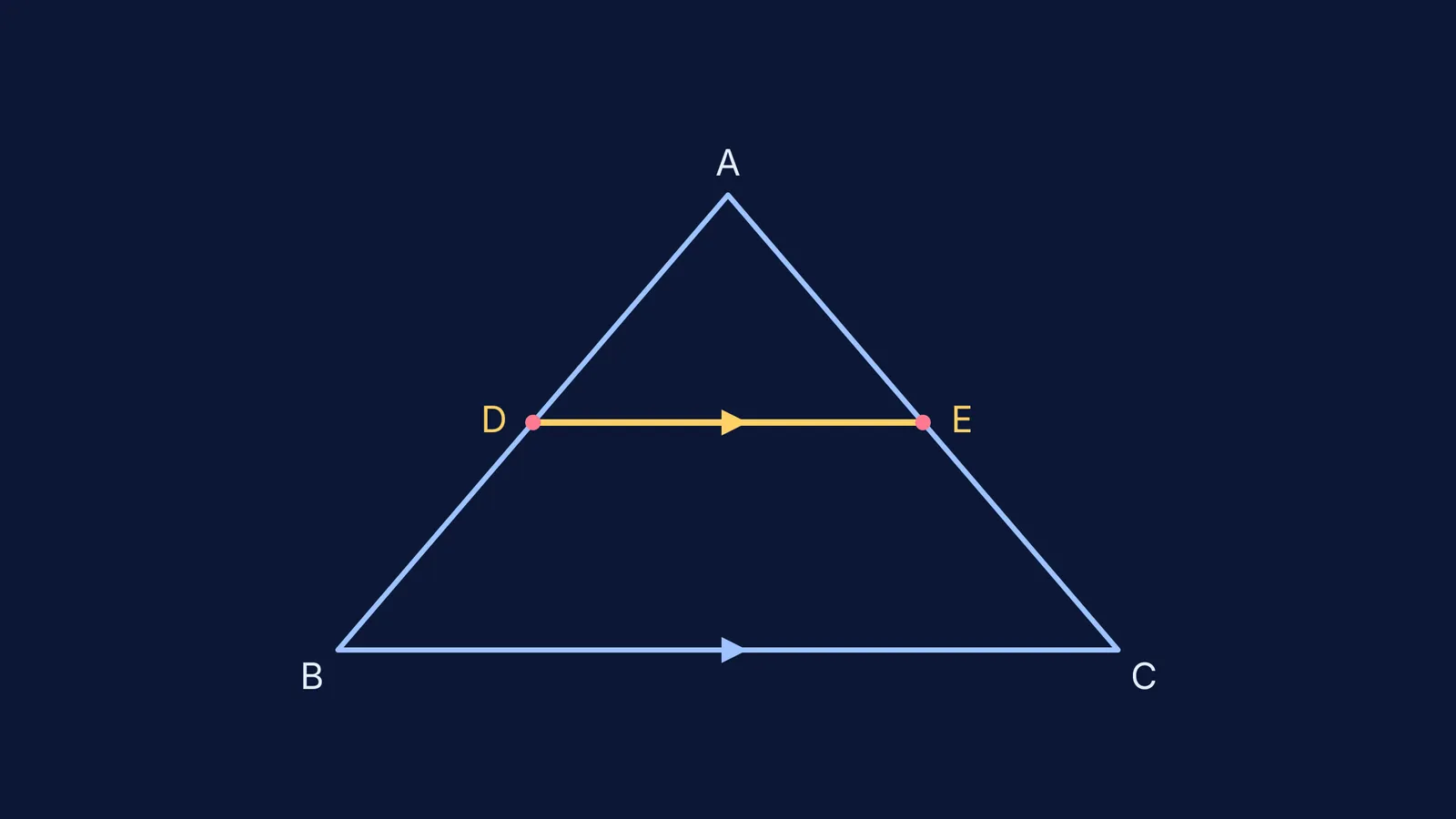
If you draw a triangle ABC, find the exact midpoint of side AB (let's call it D), and the midpoint of side AC (let's call it E), drawing a line between D and E gives you the midsegment. The theorem guarantees two specific mathematical truths:
The line DE is perfectly parallel to the base BC (DE || BC).
The length of DE is exactly half the length of BC (DE = ½ BC).
This rule is powerful because it allows you to prove that shapes formed inside other shapes have specific parallel properties.
What is the converse of the midpoint theorem?
Every powerful theorem in geometry is even more useful when you can run it in reverse. The converse of the midpoint theorem states that the line drawn through the midpoint of one side of a triangle, parallel to another side, bisects the third side.
Imagine you only know one midpoint. If you start at the midpoint D of side AB, and draw a line completely parallel to the base BC, that line will automatically hit side AC at its exact midpoint, E. You do not need a ruler to measure it; the geometry ensures that AE will always equal EC. This reverse logic is frequently tested in Class 9 exams to prove that a specific point perfectly divides a line segment.
How do you solve midpoint theorem problems?
When solving Class 9 geometry problems, the key is to spot hidden triangles inside larger polygons. The most famous application is proving that the midpoints of any quadrilateral form a parallelogram (often called the midpoint quadrilateral). Here is a framework to approach these proofs:
Draw the figure: Never try to solve a geometry problem in your head. Sketch the shape and label all given vertices clearly.
Mark the midpoints: Put clear dots on the midpoints and draw tick marks on the segments to show they are equal.
Draw a diagonal: If you are dealing with a quadrilateral, draw a diagonal line connecting opposite corners. A diagonal splits any quadrilateral into two triangles, instantly giving you a base to apply the midpoint theorem.
Apply the theorem twice: Use the midpoint theorem on the first triangle to show the midsegment is parallel to the diagonal. Then, use it on the second triangle to show its midsegment is also parallel to the same diagonal.
Connect the logic: Since both midsegments are parallel to the same diagonal, they are parallel to each other. If a shape has opposite sides that are parallel, it is a parallelogram.
If you are struggling to build these logical chains, Fermi's AI tutor can work out what you already know and build a plan for the session, so you sit down to a clear next step.
Why does formal geometry feel so hard?
The transition from arithmetic to geometry proofs is notoriously difficult for teenagers. Students are asked to stop calculating raw numbers and start arguing with abstract logic. It requires spatial reasoning and the ability to hold multiple rules in memory at once. If you find calculating the circle through three given points or checking the concurrency of three lines easier than writing a two-column proof, it is because algebra follows a rigid, predictable sequence, while proofs require creative problem-solving and visualization.
When practice problems go wrong, checking an answer key is often not enough to show *why* the reasoning failed or which specific property was missed. The Fermi Problem Library has worked problems with a step-by-step solver that explains the reasoning rather than printing an answer. The AI tutor holds a line of reasoning across a session and notices where a student is stuck, deciding whether to explain, ask or show.


