

On this page
If you remember one thing about a quadrilateral, make it the diagonals. The five special quadrilaterals differ most clearly there.
Everything below follows the NCERT Class 8 Mathematics chapter Understanding Quadrilaterals, which ends with its own summary table.
What are the properties of a parallelogram, rectangle, rhombus, square and kite?
Read each line as sides, then angles, then diagonals.
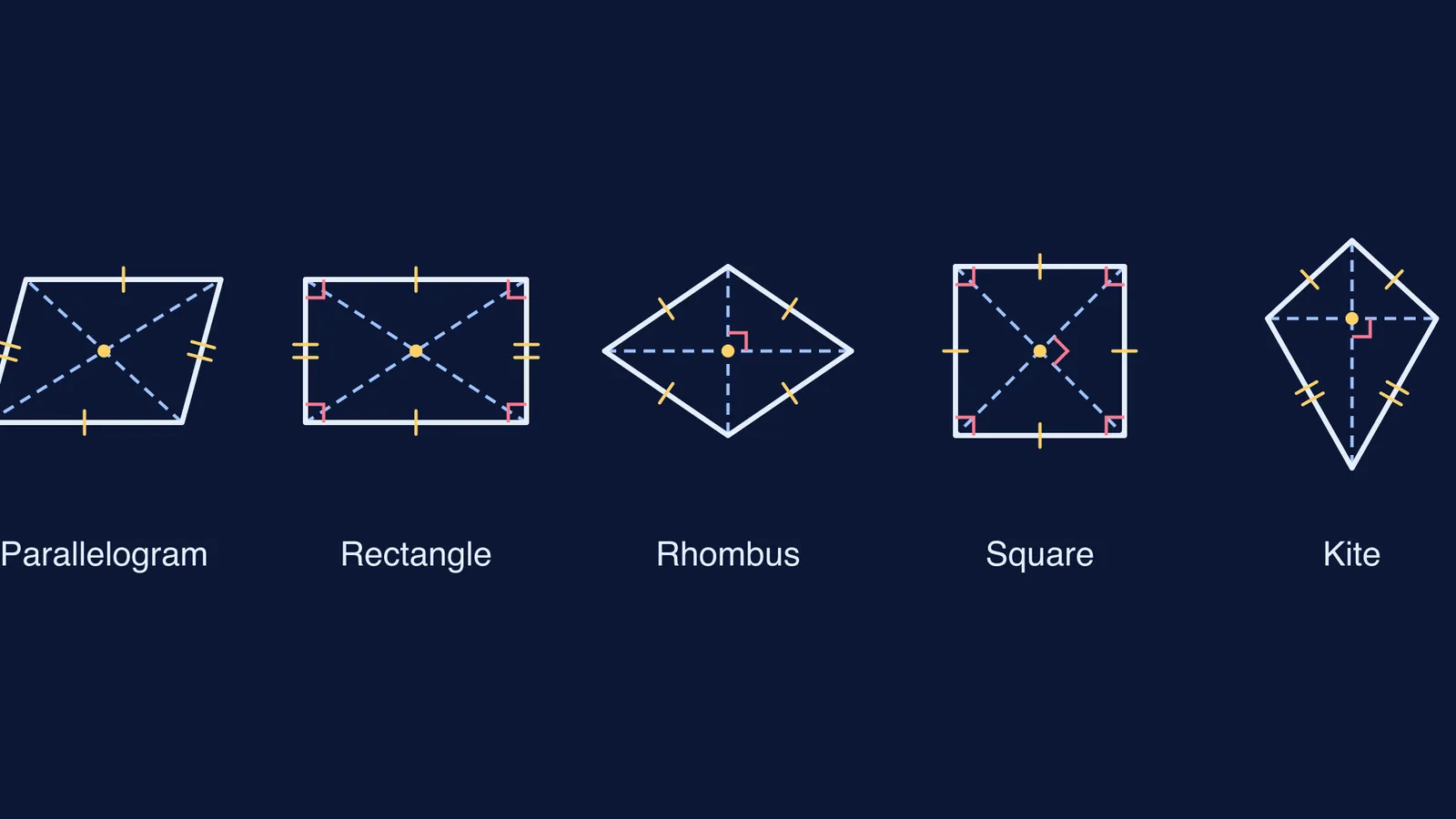
Parallelogram (both pairs of opposite sides parallel): opposite sides equal; opposite angles equal and adjacent angles adding to 180°; diagonals bisect each other but are usually unequal.
Rectangle (a parallelogram with equal angles): opposite sides equal; every angle 90°; diagonals equal and bisecting each other.
Rhombus (a parallelogram with all sides equal): all four sides equal; opposite angles equal; diagonals perpendicular and bisecting each other.
Square (a rectangle with all sides equal): all four sides equal; every angle 90°; diagonals equal, perpendicular and bisecting each other.
Kite (two distinct pairs of equal adjacent sides): two pairs of equal adjacent sides; one pair of opposite angles equal; diagonals perpendicular, with only one of them cut in half.
The NCERT chapter defines it directly: "A parallelogram is a quadrilateral whose opposite sides are parallel" (NCERT Class 8, Chapter 3).
The same chapter states that "the diagonals of a rhombus are perpendicular bisectors of one another" and that "the diagonals of a rectangle are of equal length."
For more on kites, including the area formula, see the properties of a kite: diagonals, angles and formulas.
How do the diagonals tell the shapes apart?
If a question gives you facts about the diagonals, run this test in order.
Do the diagonals bisect each other? If yes, the shape is a parallelogram. Go to step 2.
If they do not, but they are perpendicular and one cuts the other in half, the shape is a kite.
For a parallelogram, ask: are the diagonals equal? Are they perpendicular?
Equal and perpendicular: square. Equal only: rectangle. Perpendicular only: rhombus. Neither: an ordinary parallelogram.
Step 1 rests on why the diagonals of a parallelogram bisect each other, a short proof with congruent triangles.
Which properties are easy to mix up?
Rectangle diagonals are equal, not perpendicular. NCERT says it plainly: "In a rectangle, there is no requirement for the diagonals to be perpendicular to one another" (NCERT Class 8, Chapter 3).
Rhombus diagonals are perpendicular, not equal. They are equal only when the rhombus is a square.
Only one kite diagonal is bisected. The diagonal that runs along the kite's line of symmetry cuts the other one in half, not the other way round.
The kite's equal angles are the pair between unequal sides. In NCERT's figure, angle B equals angle D, but angle A does not equal angle C.
If you keep choosing the wrong property under time pressure, the Fermi Problem Library has worked problems with a step-by-step solver that explains the reasoning rather than printing an answer, so you can see which property each step uses.
How do you use these properties in a problem?
Example 1. ABCD is a rectangle whose diagonals meet at O. OA = 2x + 3 and OB = 4x − 5. Find AC.
A rectangle's diagonals are equal and bisect each other, so their halves are equal: OA = OB. Then 2x + 3 = 4x − 5, so x = 4. OA = 11, and AC = 2 × 11 = 22.
If ABCD were a rhombus, you could not write OA = OB, because a rhombus's diagonals are not equal. Naming the property before you write the equation stops that mistake.
Example 2. A rhombus has diagonals of 24 cm and 10 cm. Find its side.
The diagonals bisect each other at right angles, so they split the rhombus into four right triangles with legs 12 cm and 5 cm. The side is √(12² + 5²) = √169 = 13 cm. For why that right angle is guaranteed, see how to prove the diagonals of a rhombus are perpendicular.
How can you revise this in 10 minutes?
From memory, draw the five shapes with both diagonals dashed in.
Beside each, write sides, angles and diagonals. Check against the list above.
Mark a right angle where the diagonals cross. Three shapes get one: rhombus, square and kite.
Try the NCERT paper-folding check: fold a paper rhombus along both diagonals and test the angle where they meet with a set-square.
Solve one rectangle and one rhombus problem, naming the property before each equation.
If a definition still feels shaky, the Fermi Concept Library covers every concept in mathematics, each with its own lesson and its place in the map.


