

On this page
You walk on tessellations every day: a chessboard, a bathroom floor, a honeycomb. In maths, a tessellation is a tiling: copies of shapes that cover a flat surface with no gaps and no overlaps. Which shapes can do it comes down to one test you can run in your head.
Why do only three regular polygons tessellate?
Each interior angle of a regular polygon with n sides is (n − 2) × 180° ÷ n. That follows from the angle sum, which we derive in why a polygon's angle sum is (n − 2) × 180°.
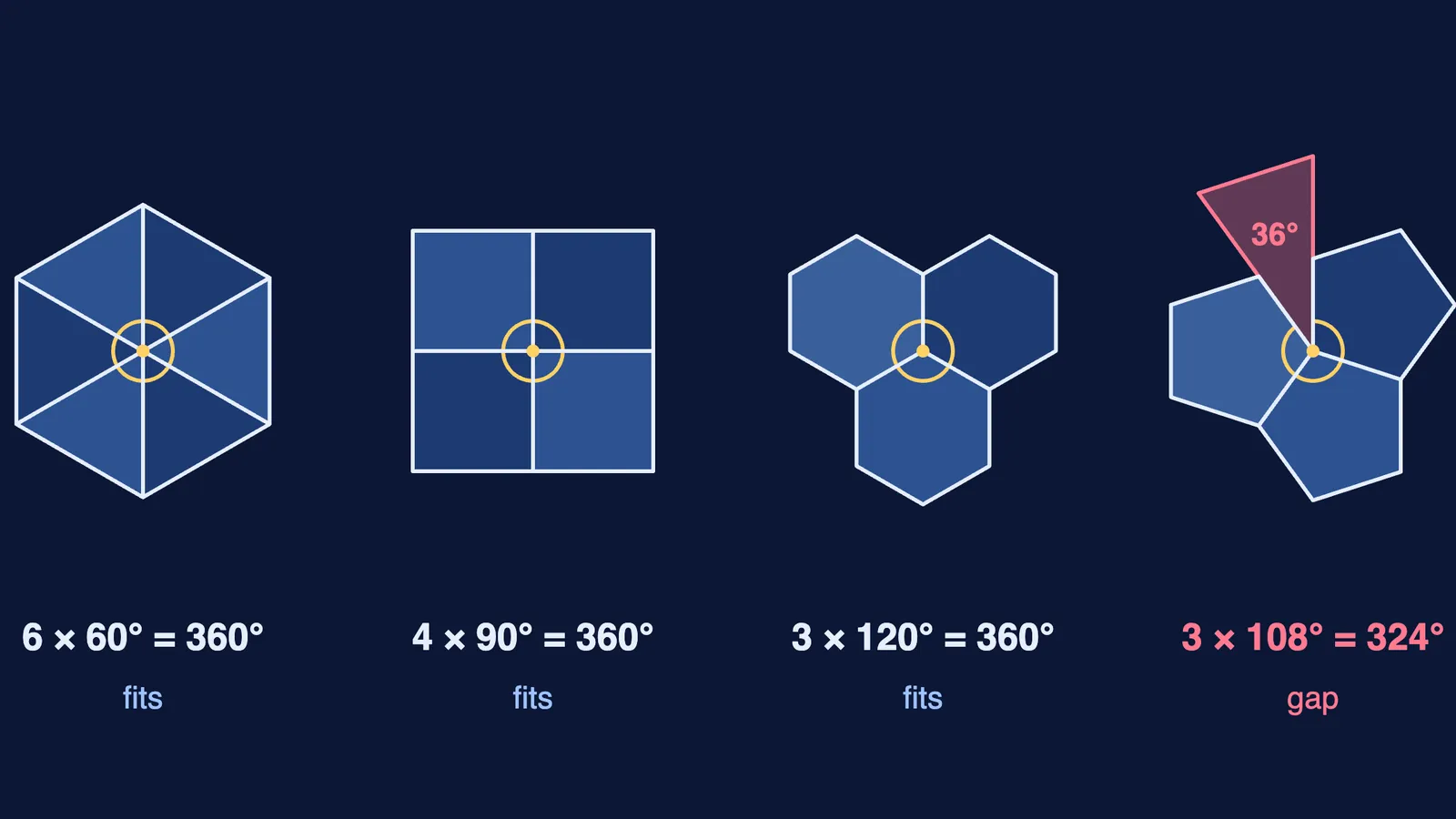
Where tiles meet at a corner, their angles must add to exactly 360°, one full turn. For a single regular shape, 360° divided by its interior angle must be a whole number, and that number must be at least 3, because two flat tiles cannot close a corner.
Run the numbers:
Triangle: 60°, and 360 ÷ 60 = 6. Six triangles meet at every point.
Square: 90°, and 360 ÷ 90 = 4.
Pentagon: 108°, and 360 ÷ 108 is about 3.33. Three leave a 36° gap; four overlap.
Hexagon: 120°, and 360 ÷ 120 = 3.
Heptagon and beyond: every angle is more than 120°, so three tiles overshoot 360° and two fall short.
Wolfram MathWorld reaches the same answer with algebra: with q regular p-gons at each corner, the condition becomes (p − 2)(q − 2) = 4, and its only whole-number solutions mean there are only three regular tessellations, made of the hexagon, square and triangle. The regular pentagon fails because its 108° interior angle is not a divisor of 360°.
Bees build with the hexagon; read why honeycomb cells are hexagons.
Which shapes tessellate if you mix regular polygons?
Allow two or more kinds of regular polygon, with the same polygons in the same order around every corner, and there are eight more tilings, called semiregular or Archimedean. Johannes Kepler gave the first systematic treatment of these tilings in Harmonice Mundi in 1619.
Each is named by listing the polygons round one corner. Check two yourself with the same angle formula:
4.8.8, a square and two octagons: 90° + 135° + 135° = 360°.
3.12.12, a triangle and two 12-gons: 60° + 150° + 150° = 360°.
If the formula still feels like something to memorise rather than understand, the Fermi Concept Library gives every concept in mathematics its own lesson and its place in the map, so you can trace polygon angles back to the triangle.
Which other shapes tile the plane?
Drop the word "regular" and many more shapes work. A 2017 Quanta Magazine report sums up the convex shapes that tile: all triangles, all quadrilaterals, three types of hexagon and 15 families of pentagon.
The pentagon list took a century. Quanta tells the story: Karl Reinhardt found five types in his 1918 doctoral thesis, Marjorie Rice, an amateur with a high-school maths education, found four more, and in 2015 Casey Mann's team at the University of Washington, Bothell used a computer search to find a 15th. In 2017 Michaël Rao's exhaustive computer search found "no more than the already 15 known families". Before peer review, Thomas Hales independently reproduced its key half, Quanta reported.
What are Penrose tiles, and why do they never repeat?
Every tiling so far can be laid out periodically: slide it the right distance and it lands exactly on itself. In a 1974 paper Roger Penrose introduced a set of six tiles that cover the plane but never in a repeating pattern. His best-known pair is the kite, with angles 72°, 72°, 72° and 144°, and the dart, with 36°, 72°, 36° and 216°. Both add to 360°, as every quadrilateral must, so you can check the source with the formula above.
The ratio of the kite's area to the dart's is the golden ratio, about 1.618, according to the same Wikipedia article. For where that number really appears and where it is myth, read the golden ratio: myths and facts. Penrose tilings also helped pave the way for understanding quasicrystals, whose discovery won Dan Shechtman the 2011 Nobel Prize in Chemistry.
Penrose's pair needed two tiles. In 2024 the journal Combinatorial Theory published "An aperiodic monotile" by David Smith, Joseph Samuel Myers, Craig S. Kaplan and Chaim Goodman-Strauss. It describes the "hat", one shape that tiles the plane but only in a pattern that never repeats.
How do you test whether a shape will tessellate?
Use this five-step check on any shape:
Find every corner angle, using (n − 2) × 180° ÷ n for regular polygons.
List the ways those angles can add to exactly 360° at one point.
Check that the edges meeting along each side have equal lengths.
Cut eight to ten paper copies and build outwards from one corner.
If no gap appears after two rings of tiles, look for the repeating block.
Start with the pentagon: cut three, put them round a point, and measure the gap.


