

On this page
The golden ratio has a big reputation: sunflowers, the Parthenon, the perfect face. Some of it is mathematics you can prove; some is a story repeated until it sounds true. Here is which is which, with numbers you can check on a calculator.
What is the golden ratio, exactly?
The golden ratio, written φ (phi), is (1 + √5)/2, which is 1.6180339887... (OEIS A001622).
It is the positive number that satisfies φ = 1 + 1/φ, which rearranges to the quadratic φ² − φ − 1 = 0 (Wolfram MathWorld, regular pentagon). Nothing in the definition mentions beauty.
Where is the golden ratio genuinely true?
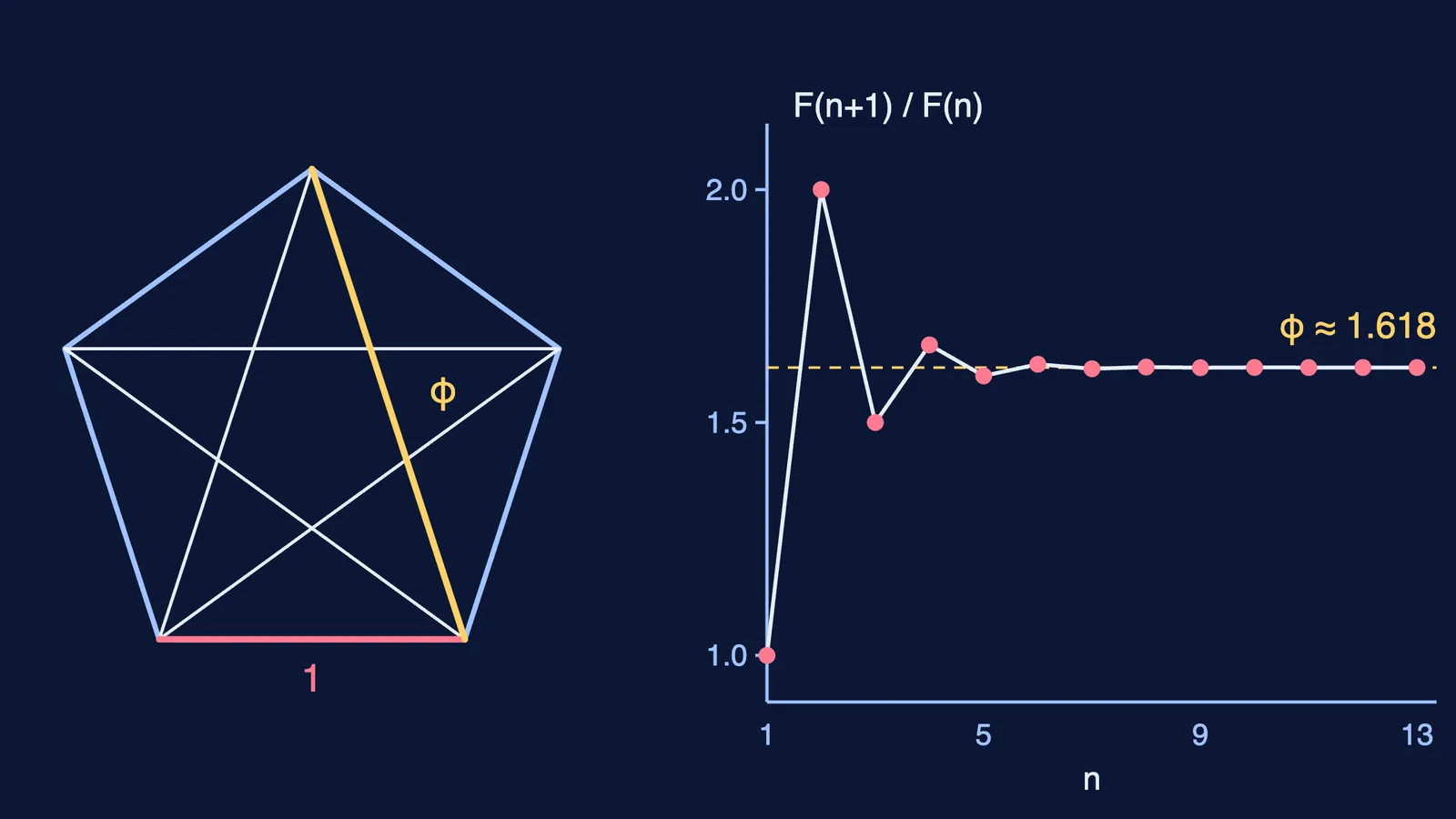
In two places, with proofs. The first is the Fibonacci sequence, where each term is the sum of the two before it: 1, 1, 2, 3, 5, 8, 13, 21, 34, 55, 89, 144. The ratio of consecutive terms tends to φ, a limit first proved by the Scottish mathematician Robert Simson in 1753 (Wolfram MathWorld, golden ratio). Work it out yourself:
2 ÷ 1 = 2
3 ÷ 2 = 1.5
5 ÷ 3 ≈ 1.667
8 ÷ 5 = 1.6
144 ÷ 89 ≈ 1.61798
The ratios zigzag above and below φ and close in on it. Why? If the ratio settles at r, divide F(n+1) = F(n) + F(n−1) by F(n) and you get r = 1 + 1/r, the same equation. Using x² = x + 1 to climb to higher powers is also the trick behind finding α⁵ + β⁵ without solving the quadratic.
The numbers also have an Indian history: Parmanand Singh's 1985 paper in Historia Mathematica traces "the so-called Fibonacci numbers in ancient and medieval India" (Singh, 198590021-7)).
The second is the regular pentagon. Its diagonal divided by its side is exactly φ, which MathWorld derives from similar triangles (Wolfram MathWorld, regular pentagon). Building regular polygons with ruler and compass has its own story: how Gauss built a 17-sided polygon.
Is the golden ratio really in nature?
Often, approximately, and for a reason. Plants add new seeds and leaves one after another, and the spirals they form frequently come in Fibonacci numbers. Physicists S. Douady and Y. Couder reproduced this Fibonacci order in a laboratory experiment and a computer simulation, and explained it as the pattern avoiding periodic arrangements, which pushes it towards the golden mean (Douady and Couder, 1992).
But it is not a law. A citizen-science study collected data on 657 sunflowers; in its most reliable subset, 565 of 768 spiral counts were Fibonacci numbers and a further 67 had a related Fibonacci structure (Swinton and colleagues, 2016). The remaining 136 counts, about one in six, did not fit, and some heads had no definite count at all.
Is the Parthenon built on the golden ratio?
The measurements do not support it. The Parthenon was built and decorated between 447 and 432 BC, and most books on the golden ratio say its front fits precisely into a golden rectangle (Mario Livio, The Golden Ratio, excerpt). As Livio describes, mathematician George Markowsky noted that parts of the building, such as the pedestal edges, fall outside the rectangle usually drawn, and that published dimensions vary between sources (Markowsky, 1992).
Livio uses one architecture book's figures: width 101 ft 3.75 in (1215.75 inches), height 45 ft 1 in (541 inches). 1215.75 ÷ 541 ≈ 2.25, nowhere near 1.618. Markowsky notes that even the 59 ft (708 inch) height of the apex above the pedestal gives about 1.72, which is still not φ. Livio concludes that a golden-ratio design is "far less certain than many books would like us to believe".
Do beautiful faces follow the golden ratio?
The best-known test points elsewhere. In four experiments, Pamela Pallett, Stephen Link and Kang Lee asked people to compare faces with identical features but different spacing. Faces looked most attractive when the eye-to-mouth distance was about 36% of face length and the distance between the eyes about 46% of face width, proportions that match an average face (Pallett, Link and Lee, 2010). Neither is 61.8%, the share 1/φ would give. MathWorld itself warns that golden-ratio claims in art, architecture and anatomy "tend to be greatly exaggerated" (Wolfram MathWorld).
How can you test a golden ratio claim yourself?
Ask four questions of any post, video or textbook box:
What exactly was measured? If the endpoints can shift (steps or column base, chin or jaw), the ratio can be nudged towards 1.6.
What is the ratio to three decimals? 1.6 is not 1.618, and 1.72 is not either.
How many ratios were tried? Measure enough lengths and one pair will land near 1.618 by chance.
Is there a reason? Pentagons and Fibonacci numbers have proofs; plant spirals have a growth model. A building or face needs evidence the ratio was designed or selected.
The same habit settles everyday myths, like whether filling petrol in the morning gets you more fuel.
If quadratics or limits of sequences feel shaky, the Fermi Concept Library gives every concept in mathematics its own lesson and its place in the map.
Keep the proofs, drop the myths, and always do the division yourself.


