On this page
Greek geometers could draw a regular triangle, square, pentagon and 15-gon with only a straightedge and compass, along with any polygon made by doubling those sides (Wolfram MathWorld). For more than 2,000 years after that, nobody added a new prime number of sides to the list (heptadecagon). Then a teenager did.
What did Gauss discover on 30 March 1796?
Carl Friedrich Gauss was born in Brunswick, Germany, on 30 April 1777 (MacTutor biography). On 30 March 1796 he started a mathematical diary, and its first entry, written in Latin, records the principles behind dividing a circle geometrically into seventeen parts: "Principia quibus innititur sectio circuli, ac divisibilitas eiusdem geometrica in septemdecim partes etc." (Gauss's diary).
MacTutor's "on this day" page calls him "the nineteen year old Gauss" (MacTutor, 30 March); strictly, he was a month short of his 19th birthday. The diary grew to 146 entries by 1814, but it was only rediscovered in 1897 and first published by Felix Klein in 1903 (Gauss's diary).
Gauss published the full theory as Section VII of his book Disquisitiones Arithmeticae in the summer of 1801, and MacTutor calls the 17-gon "the most major advance in this field since the time of Greek mathematics" (MacTutor biography). The rest of his career, from number theory to least squares, is in our profile of Carl Friedrich Gauss and his major ideas.
Why can a 17-gon be built but not a 7-gon?
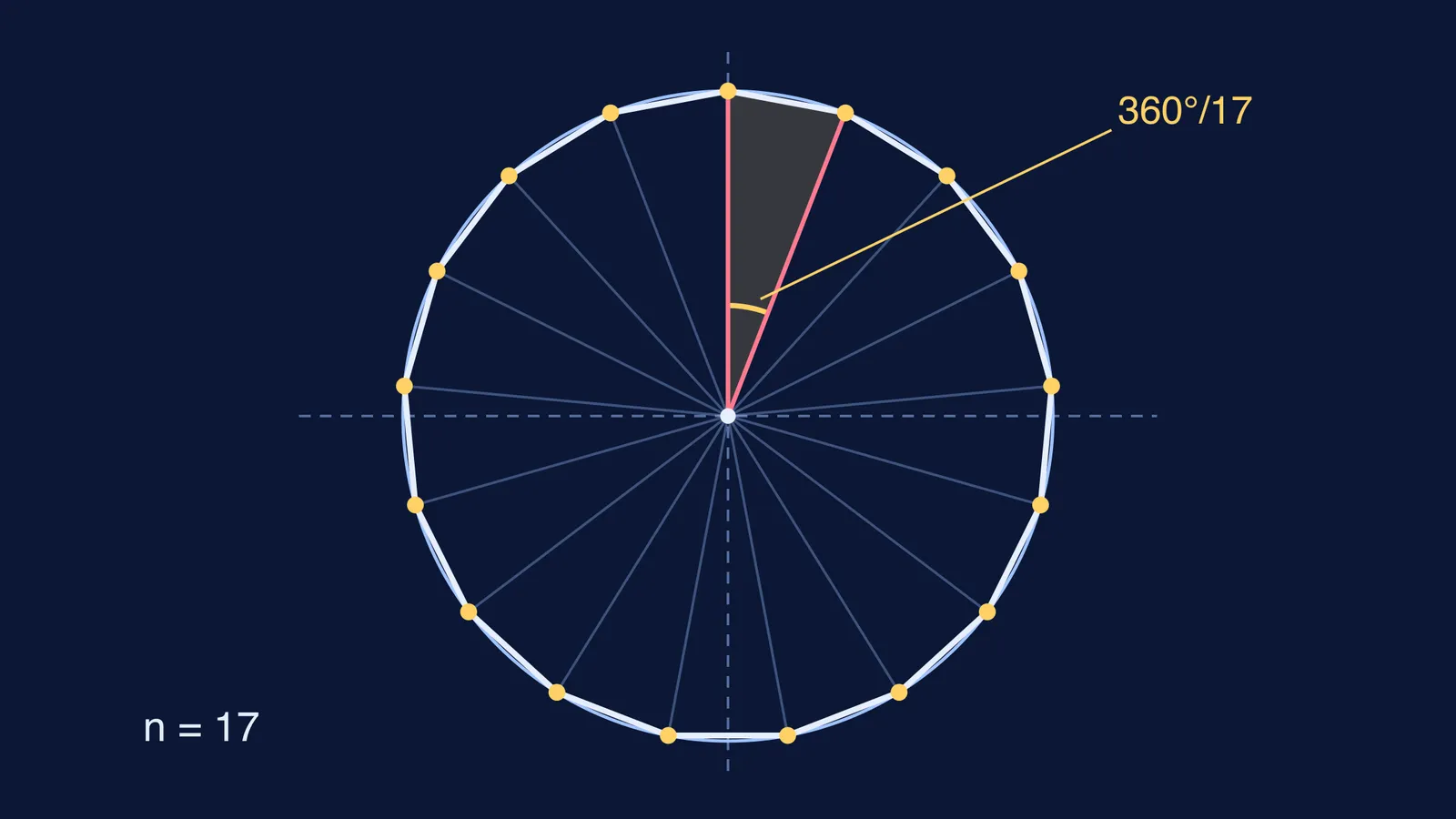
A length can be built with ruler and compass exactly when it can be written using whole numbers, the four arithmetic operations and square roots (constructible numbers). Drawing a regular n-gon in a circle of radius 1 comes down to one number: the cosine of the angle 360°/n at the centre, the gold wedge in the picture above.
Gauss showed that this cosine for the 17-gon needs nothing worse than square roots (heptadecagon):
cos(360°/17) = (1/16)(−1 + √17 + √(34 − 2√17)) + (1/8)√(17 + 3√17 − √(34 − 2√17) − 2√(34 + 2√17))
The deeper reason is that 17 is a Fermat prime, a prime of the form 2^(2^n) + 1 (Wolfram MathWorld). For such a prime, one less than it is a power of 2 (here 16 = 2^4), and that lets the problem be split into a chain of square-root steps. The 7-gon fails because its cosine solves an irreducible cubic equation, and degree 3 is not a power of 2 (constructible numbers).
Which regular polygons can be constructed with ruler and compass?
The Gauss–Wantzel theorem says a regular n-gon is constructible if and only if n is a power of 2 multiplied by distinct Fermat primes (constructible polygons). Gauss proved the condition is enough; Pierre Wantzel proved in 1837 that it is also needed (Wolfram MathWorld). Wantzel used the same algebra to settle older puzzles, which we explain in how Pierre Wantzel proved angle trisection impossible.
Only five Fermat primes are known, 3, 5, 17, 257 and 65537, and the Fermat numbers F5 to F32 have all been shown to be composite (constructible polygons). That gives 31 known constructible polygons with an odd number of sides. Possible is not the same as easy: Johann Gustav Hermes gave the first explicit construction of the 65537-gon in 1894, and spent 10 years on its 200-page manuscript (same source).
Here is a three-step test you can run in your head:
Divide n by 2 until it is odd.
Factor what is left into primes.
The answer is yes only if every prime is one of 3, 5, 17, 257, 65537 and none appears twice.
Worked examples:
60 = 4 × 3 × 5: yes.
51 = 3 × 17: yes.
255 = 3 × 5 × 17: yes.
9 = 3 × 3: no, because 3 repeats.
100 = 4 × 5 × 5: no, because 5 repeats.
7, 11, 13: no, because they are not Fermat primes.
Run the test from 3 to 30 and only 13 values pass: 3, 4, 5, 6, 8, 10, 12, 15, 16, 17, 20, 24 and 30.
How can you practise this at home?
All you need is a compass, a ruler and a calculator:
Draw a circle and step the same radius around it six times to get a regular hexagon.
Bisect each side's arc to get a 12-gon, using the method in how to draw a perpendicular bisector with a compass.
Run the three-step test on every n from 3 to 30 and compare your list with the one above.
Evaluate Gauss's formula one square root at a time and check it against cos(21.18°).
If step 4 raises the question of why square roots are allowed but cube roots are not, the Fermi Concept Library has a lesson for every concept in mathematics, each with its place in the map. For more factorising practice, the Fermi Problem Library has worked problems with a step-by-step solver that explains the reasoning rather than printing an answer.
Next time you draw a hexagon, try n = 17 on paper first. You will see why a single diary entry changed geometry.