On this page
School geometry teaches you to bisect an angle with a compass. Splitting one into three equal parts looks like the next step, and people tried for centuries. In 1837 Pierre Wantzel, then in his early twenties, settled it: with an unmarked ruler and a compass alone, it cannot be done for every angle. Here is what he proved and a 60° example you can check yourself.
What did Pierre Wantzel prove in 1837?
Wantzel's paper, Recherches sur les moyens de reconnaître si un problème de géométrie peut se résoudre avec la règle et le compas, appeared in the Journal de Mathématiques Pures et Appliquées in 1837, on pages 366 to 372 (Numdam archive).
In that paper Wantzel (1814 to 1848) proved that doubling a cube and trisecting an angle cannot be done with ruler and compass, as historian Jesper Lützen summarises in Historia Mathematica (2009). Carl Friedrich Gauss had stated that these problems were impossible but gave no proof; Wantzel was the first to prove it (MacTutor biography of Wantzel).
The rules matter. The ruler has no marks: it only draws the line through two points you already have. The compass only draws a circle with a given centre through a given point. New points come only from where lines and circles cross.
Wantzel's insight was algebraic. Each crossing solves at most a quadratic equation, so every constructible length comes from a chain of square roots. A constructible number therefore satisfies an equation whose degree is a power of 2 (Doubling the cube, Wikipedia).
Why was this a 2,000-year-old problem?
According to a legend passed on by Eratosthenes, an oracle told the people of Delos to build an altar double the size of the existing one to end a plague, which MacTutor places around 430 BC (MacTutor: Doubling the cube). Menaechmus is said to have discovered conic sections while working on it.
The Greeks did trisect angles, just not by the strict rules. Archimedes marked the circle's radius on a ruler and slid it into place (MacTutor: Trisecting an angle). Sliding a marked ruler like this is called a neusis construction (Angle trisection, Wikipedia).
Why can't ruler and compass trisect a 60° angle?
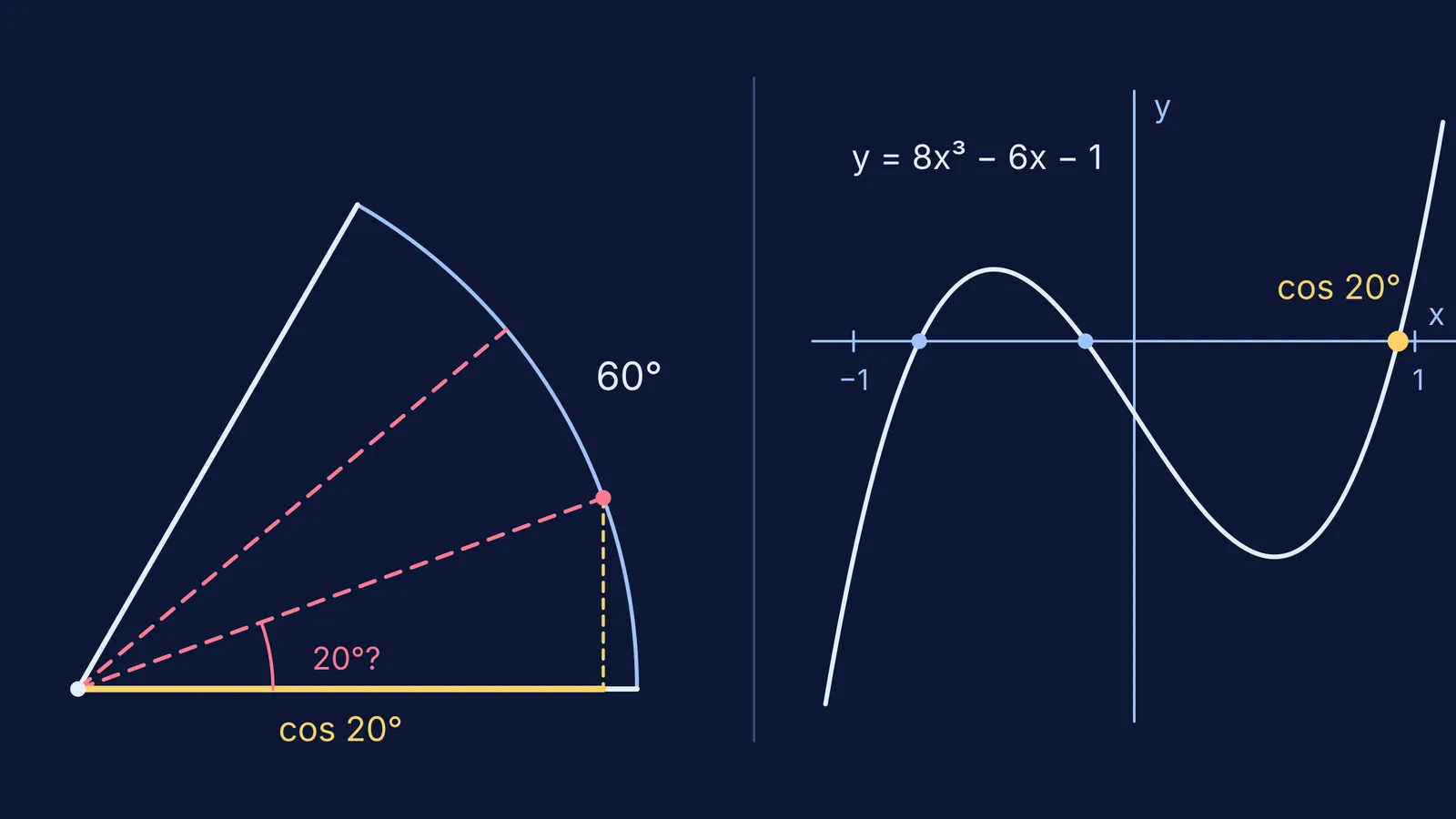
You can draw 60° from an equilateral triangle. Trisecting it means drawing 20°, the same as constructing the length cos 20° on a circle of radius 1. Here is the argument (Angle trisection, Wikipedia):
Use the triple-angle formula: cos 3θ = 4cos³θ − 3cosθ.
Put θ = 20°. Since cos 60° = 1/2, the number c = cos 20° satisfies 8c³ − 6c − 1 = 0.
Substitute y = 2c: y³ − 3y − 1 = 0.
Apply the rational root test. The only possible rational roots are 1 and −1. Check: 1 − 3 − 1 = −3, and −1 + 3 − 1 = 1. Neither is zero.
A cubic with rational coefficients and no rational root cannot be factorised over the rationals, so 2cos 20° needs an equation of degree 3.
Three is not a power of 2, so cos 20° cannot be constructed, and neither can a 20° angle.
Doubling a cube fails the same test. A cube of volume 2 needs side ∛2, a root of x³ − 2 = 0, and none of the candidates ±1 or ±2 works (Doubling the cube, Wikipedia).
If the triple-angle formula or the rational root test feels shaky, the Fermi Concept Library gives every concept in mathematics its own lesson, so you can fill that gap first.
Can any angle be trisected with ruler and compass?
Some can. A right angle is easy, because 30° is constructible: draw 60° and bisect it (Angle trisection, Wikipedia). Wantzel's theorem says ruler and compass cannot trisect every angle, and one counterexample, 60°, is enough.
If a friend shows you a "trisection", run this check:
Does it use a marked ruler, a sliding step or a special curve? Then it breaks the rules.
Is it only close? A protractor reading of 20.0° is not a proof.
Does it claim to work for 60°? Then there is an error; finding it is good practice.
To practise the allowed moves, start with how to draw a perpendicular bisector with a compass, then ask AI to justify each compass and ruler construction step. For the cubic algebra, the Fermi Problem Library has a step-by-step solver that explains the reasoning rather than printing an answer.
Why did Wantzel's proof go unnoticed?
Lützen writes that Wantzel's proof was hardly noticed by his contemporaries and that his name was almost completely forgotten for the following century (Historia Mathematica, 2009). His explanation: at the time, little importance was attached to impossibility results. Wantzel died in 1848, aged 33 (MacTutor biography).
Proving that something cannot be done is a real result. When a problem keeps resisting you, ask what your tools can produce at all, as Wantzel did.
For another ancient problem attacked with patient geometry, read how Archimedes trapped π between 223/71 and 22/7.