On this page
Archimedes of Syracuse, who lived from 287 to 212 BC according to the MacTutor History of Mathematics archive, had no decimals and no calculator. He still pinned π down to within about two thousandths. He built two fences of straight lines, one inside the circle and one outside, and pushed them together until π had almost nowhere left to hide. (He is better known for buoyancy and levers, and the legends around them.)
How did Archimedes estimate pi using polygons?
A polygon drawn inside a circle has a shorter perimeter than the circle, and one drawn around it has a longer perimeter. So the circumference, and with it π, is trapped between two numbers you can work out.
In *Measurement of a Circle*, Archimedes showed that π lies between 3 10/71 and 3 1/7 by inscribing and circumscribing regular polygons with 96 sides (MacTutor). Written as improper fractions, that is 223/71 < π < 22/7 (MacTutor, Pi through the ages).
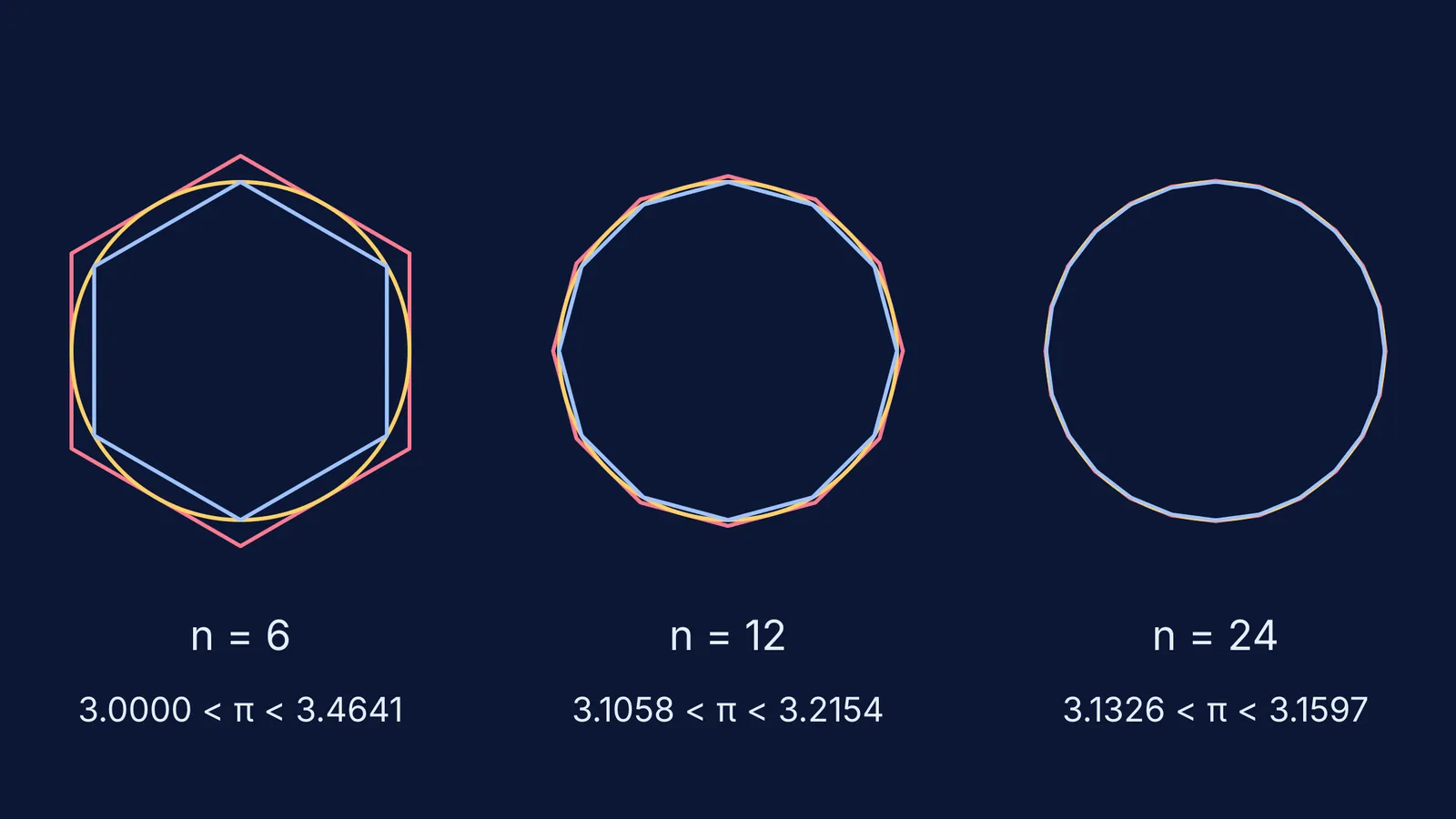
He began with a hexagon and kept halving the angle at the centre, giving polygons with 12, 24, 48 and finally 96 sides, as Burton Rosenberg of the University of Miami sets out in his step-by-step reading of the proof.
Why did Archimedes start with a hexagon?
Because a hexagon inside a circle is easy. Each of its six sides equals the radius, so its perimeter is 6r, which is three diameters. That alone proves π is more than 3.
The hexagon outside the circle is harder, because its size depends on √3, which no fraction equals exactly. Archimedes used 265/153 < √3 < 1351/780 and never explained how he found them (Measurement of a Circle). He then used a doubling rule, which in modern terms is the cotangent half-angle formula, to get each new polygon from the one before (Rosenberg).
Rosenberg notes that Archimedes, estimating every square root by hand, rounded in the safe direction: down for the lower bound, up for the upper. At the end, the inside 96-gon gave π > 6336/2017¼, which is more than 3 10/71, and the outside 96-gon gave π < 22/7.
What do the numbers look like at each doubling?
You can check the squeeze yourself with a calculator. For a circle of radius 1, half the perimeter of an inscribed n-gon is n × sin(180°/n), and of a circumscribed n-gon is n × tan(180°/n), as in Rosenberg's notes. Our values, to four decimal places:
6 sides: 3.0000 < π < 3.4641
12 sides: 3.1058 < π < 3.2154
24 sides: 3.1326 < π < 3.1597
48 sides: 3.1394 < π < 3.1461
96 sides: 3.1410 < π < 3.1427
Watch the gap: 0.4641, then 0.1096, 0.0270, 0.0067 and 0.0017. Each doubling cuts it to roughly a quarter, which fits Rosenberg's modern error bound of less than 2(π/n)². Archimedes' fractions are slightly looser than row 5 because he rounded by hand: 223/71 is about 3.1408 and 22/7 is about 3.1429.
Where is the limit hiding in Archimedes' argument?
The same work opens with a bigger claim. Proposition 1 says the area of any circle equals a right-angled triangle whose two shorter sides are the radius and the circumference (Measurement of a Circle). Work out that triangle's area, ½ × r × 2πr, and you get πr², the formula you learnt in school.
He proved it with the method of exhaustion, a geometric way of closing in on a curved shape with straight-sided ones (same source). Archimedes never wrote about convergence, Rosenberg points out, but the logic is the limit idea you meet in Class 11: the polygons can be made as close to the circle as you like, so the only value that fits all of them is the circle's own. The method goes back to Eudoxus and the method of exhaustion. Centuries later in Kerala, Madhava of Sangamagrama reached π through infinite series instead.
How can you use Archimedes' method when you study?
Three habits carry over to limits, integration and estimation:
Bound before you calculate. Find one quantity you know is too small and one you know is too big. A hexagon inside and a square outside already give 3 < π < 4.
Make the error shrink on purpose. Doubling the sides tightens both bounds at once, the same idea as using thinner strips when you estimate an area under a curve.
Round in the safe direction. In an inequality, every approximation must keep the bound true.
If limits still feel slippery, the Fermi Concept Library gives every concept in mathematics its own lesson and its place in the map. When a bounding problem goes wrong partway, the Fermi Problem Library has worked problems with a step-by-step solver that explains the reasoning rather than printing an answer.
Next time you write πr², remember it began as a squeeze between two 96-sided polygons.