On this page
If you have ever been asked to construct a perpendicular bisector or an angle bisector, you probably learned a strict sequence of steps. First, put the compass point here. Then, draw an arc there. Finally, draw a line through the intersections.
While following these steps will get you a perfectly accurate drawing, it rarely teaches you the geometry behind it. When the exams move past basic drawing and ask you to prove a theorem or find an unknown angle, the step-by-step memorisation stops working.
Here is how you can use a simple compass and straightedge, guided by an AI tutor, to build the logical reasoning you need for advanced geometry.
Why do students struggle with geometry constructions?
The main challenge with geometric constructions is the gap between the physical drawing and the mathematical proof.
When you draw two intersecting arcs to find a midpoint, you are actually relying on the properties of circles and congruent triangles. However, research shows that most students see the drawing as the answer itself, rather than the result of rigid geometric rules. This creates a ceiling on how much they can learn. If you can perform the construction but cannot explain why it works, you will struggle to apply those same rules to complex proofs.
Educators refer to this as being stuck at the lower levels of geometric thought. You can recognise shapes and follow procedures, but you have not yet developed the informal deduction required to understand why those procedures are valid.
Why does physical drawing help you learn?
Despite the rise of dynamic geometry software on tablets and computers, using a physical compass and straightedge remains a remarkably powerful way to learn.
A 2022 study of 50 sixth-graders found that learning geometry through physical compass and straightedge construction, rather than just reading definitions, significantly raised their achievement, motivation, and positive attitudes toward the subject.
The physical act of drawing forces you to think deeply about the properties of the shape you are creating. A compass, for example, is not merely a tool for drawing curves; it is a physical guarantee that every point on an arc is exactly the same distance from the centre. This tangible action builds a mental map that helps you move from basic recognition to formal deduction. If you want to dive deeper into the axioms that make these tools work in the first place, Introduction to Euclid's geometry in Class 9: axioms and postulates covers the foundations.
How can you ask AI to justify each compass and ruler construction step?
You can break the habit of rote memorisation by asking an AI to provide the mathematical justification for each physical step before you execute it on paper.
If you are stuck on a construction, Fermi's AI tutor works out what you already know and builds a plan for the session, writing on a board and checking your understanding as it goes. Rather than just giving you the instructions, you can feed it your intended steps and ask for the underlying logic.
Try using this exact prompt with your AI tutor:
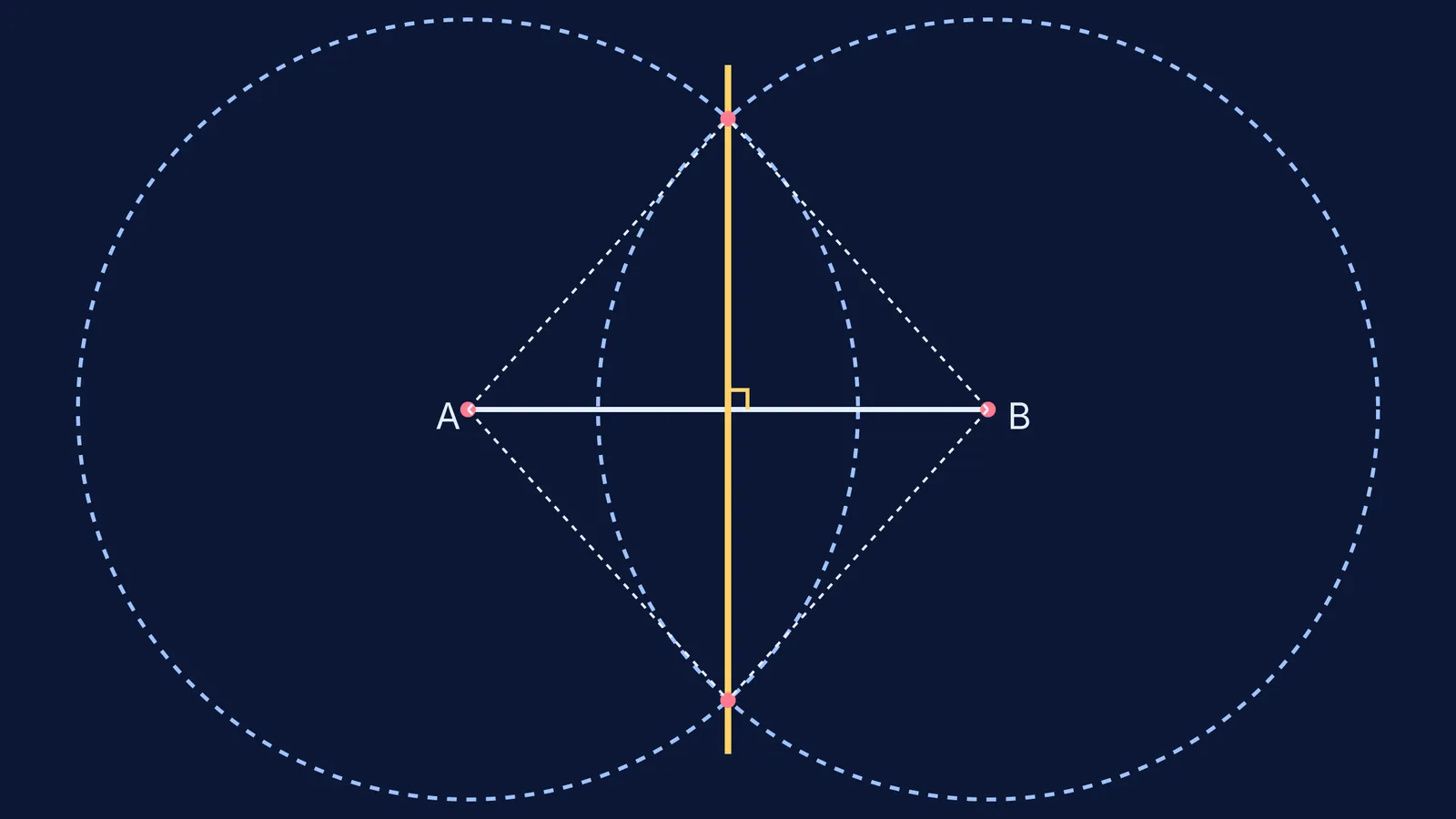
"I need to construct a perpendicular bisector of a line segment AB. My steps are:
Put the compass point on A and draw an arc above and below.
Keep the same width, put the point on B, and draw arcs to cross the first ones.
Draw a line through the two intersections.
Before I draw this, justify mathematically why this works."
The AI will explain that because you kept the compass width exactly the same, the two intersection points are equidistant from both A and B. This creates two isosceles triangles that share a common base, which proves that the line connecting the intersections cuts the original segment exactly in half at a perfect right angle.
What is the best way to check your work?
Once you understand the justification, the final step is to execute the drawing accurately.
Use your compass and straightedge to follow the steps you discussed. Because you now know that the intersection points must form a rhombus with the endpoints of the segment, you will be much more precise with your tool placement. You are no longer just making marks on a page; you are physically building a geometric proof. If your final measurement is slightly off, you can review the geometric properties to see if the error was in your logic or simply a physical slip of the compass point.
For more complex problems where you need to see the reasoning written out clearly, the Fermi Problem Library has worked problems with a step-by-step solver that explains the reasoning rather than printing an answer. This ensures you never have to blindly follow a sequence again. To see how these logical proofs evolved historically, you can read about Euclid's Elements: how proof-based geometry began.