

On this page
Before the 1840s, a wounded soldier faced two terrors: surgery while fully awake, and a broken bone that would not stay still long enough to heal. Russian surgeon Nikolay Pirogov (1810–1881) attacked both, with ether and with plaster.
When did Pirogov first use ether on the battlefield?
The starting gun was fired in Boston. William Morton gave the first public demonstration of ether anaesthesia on a patient named Gilbert Abbott on 16 October 1846, according to Harvard's Countway Library. We tell that story in William Morton and the first public operation under ether.
Pirogov moved fast. The Complete Dictionary of Scientific Biography records that in 1847 he worked out a theory of how anaesthetic acts, tested it on himself before using it on a patient, and was the first to give anaesthetic through the rectum. The same entry says he was "the first to use ether under battle conditions (1847)."
A 2022 Leiden University doctoral thesis by I. F. Hendriks places that first battlefield use in the Caucasus during the summer of 1847.
Pirogov did more than use ether. A 2015 paper in the journal Anaesthesia by Hendriks and colleagues says he organised the general introduction of anaesthesia in Russia and was the first to do systematic research into anaesthesia-related illness and death (Hendriks et al., 2015). The same paper says the principles of military medicine he set out stayed almost unchanged until the Second World War.
How did Pirogov use plaster casts for broken bones?
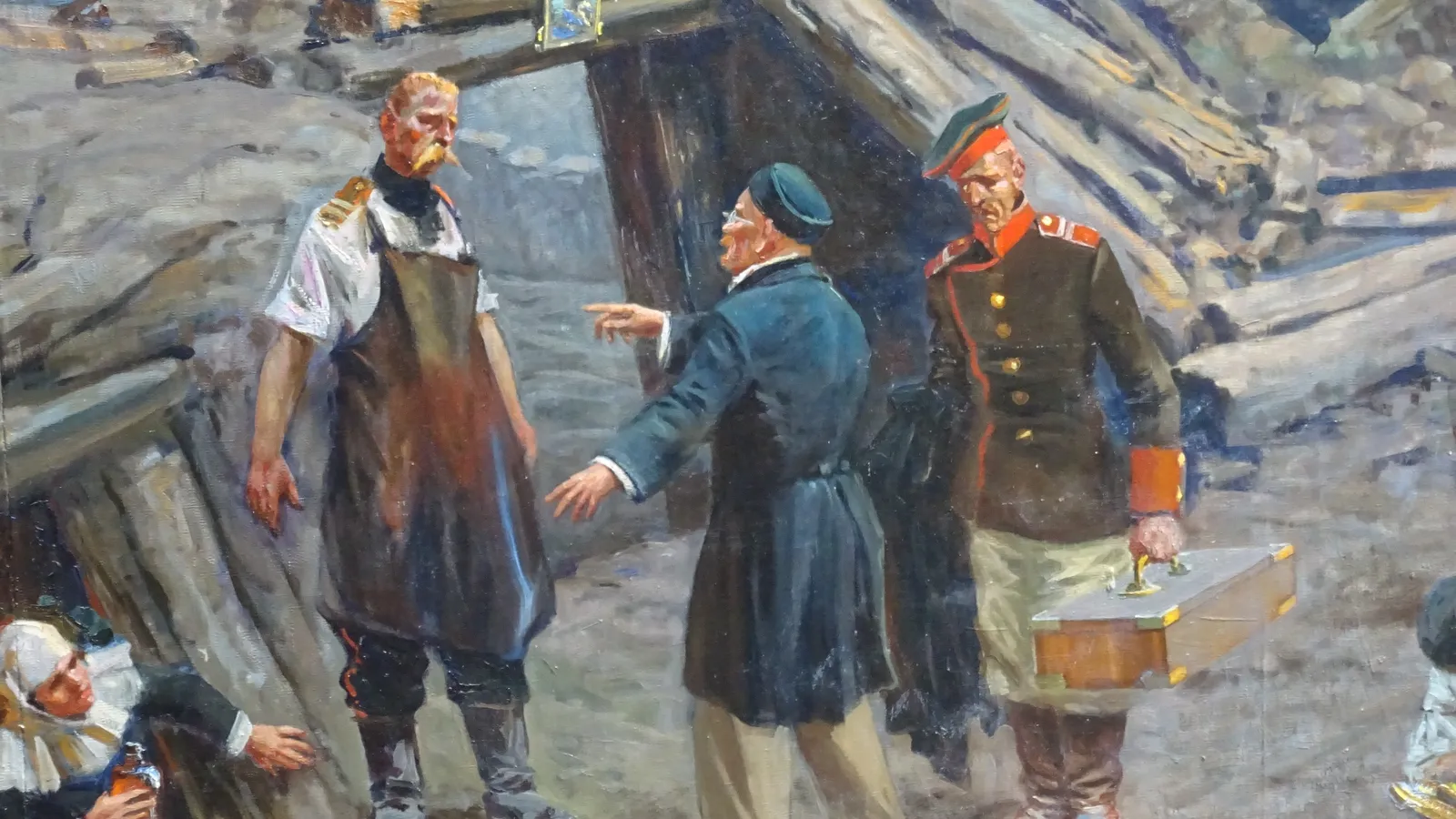
In the Crimean War, Pirogov worked through the siege of Sevastopol. During 1854–1855 he introduced the mass use of anaesthetic in operations at the front, says the Dictionary of Scientific Biography. He also brought a system for sorting wounded soldiers into five categories, into the Russian army, an early form of triage.
The cast idea came from art, not medicine. Pirogov saw a sculptor laying linen strips soaked in liquid plaster, then wrapped injured limbs in coarse cloth dipped in a plaster mixture, according to a history of casting in The Open Orthopaedics Journal. That review dates the idea to around 1852; the Dictionary of Scientific Biography gives 1851. After the war he improved it by cutting sail cloth to a pattern shaped for each part of the body and soaking it in plaster before putting it on (Szostakowski et al., 2017).
That review is Sharma and Prabu, 2013. Mathijsen's bandages became hard within minutes, and after his death plaster bandages became widespread and replaced most other forms of splint (Szostakowski et al., 2017).
Why does plaster of Paris set hard? A worked example
Plaster of Paris is made by heating gypsum, calcium sulphate dihydrate, to about 120 °C so it loses part of its water (Szostakowski et al., 2017). Add water and the powder turns back into the dihydrate and gives off heat (Sharma and Prabu, 2013), setting to a hard, porous mass within 5 to 15 minutes (Szostakowski et al.).
You can check how much water the reaction itself uses. The equation is CaSO4·½H2O + 1½ H2O → CaSO4·2H2O.
Molar mass of the hemihydrate: 136.14 + (0.5 × 18.02) = 145.15 g/mol.
Moles in 100 g of plaster: 100 ÷ 145.15 = 0.689 mol.
Water needed: 0.689 × 1.5 = 1.03 mol, and 1.03 × 18.02 = 18.6 g.
So 100 g of plaster locks away only about 18.6 g of water as crystal water. A wet bandage soaks up more than that; the extra makes the paste easy to spread and dries off slowly: a cast is not fully dry for about 72 hours (Sharma and Prabu, 2013). For the full chemistry, read why plaster of Paris sets hard when mixed with water.
If hydrates and water of crystallisation feel shaky, the Fermi Concept Library has a lesson for every concept in chemistry, each with its place in the map. To practise mole calculations like the one above, the Fermi Problem Library has worked problems with a step-by-step solver that explains the reasoning rather than printing an answer.
What can a student learn from Pirogov?
Pirogov's two biggest wartime moves were borrowed ideas, used fast and then studied with care. Try the same habit on your own work:
Borrow across subjects. He got the cast from a sculptor. When a physics problem stalls, ask how a chemistry or maths idea would frame it.
Test on yourself first. He tried ether on himself before patients. Before an exam, test a new method on a past paper, not on the real thing.
Count your outcomes. He studied the harm anaesthesia caused, not only the wins. Keep a short log of which mistakes cost you marks.
Sort before you act. Triage works for a revision list too: what is urgent, what can wait, what is already fine.
Next time you see a cast on a friend's arm, you are looking at a sculptor's trick that a war surgeon carried into medicine more than 170 years ago.


