

On this page
When you mix a powdery white scoop of plaster of Paris with water, it thickens into a spreadable paste and, within minutes, solidifies into a rock-hard block. Many students assume the mixture simply dries out like wet clay or mud by evaporating moisture into the surrounding air. In reality, plaster of Paris hardens through a chemical reaction that does the exact opposite: it consumes liquid water and locks it permanently into a solid crystalline network.
Plaster of Paris is calcium sulphate hemihydrate, represented by the chemical formula CaSO₄·½H₂O. The fractional coefficient indicates that two formula units of calcium sulphate share a single molecule of water of crystallisation: (CaSO₄)₂·H₂O. When mixed with water, the hemihydrate rehydrates to form calcium sulphate dihydrate (CaSO₄·2H₂O), commonly known as gypsum:
CaSO₄·½H₂O + 1½H₂O → CaSO₄·2H₂O
As early as 1887, French chemist Henri Le Chatelier investigated this transformation in his doctoral research, later translated in his 1905 treatise on hydraulic mortars. Le Chatelier proved that the hardening of plaster is not a simple physical drying process, but a continuous dissolution-precipitation cycle governed by the relative solubilities of the two hydration states.
What is the difference between plaster of Paris and gypsum?
The difference between plaster of Paris and gypsum lies in their water of crystallisation—the fixed number of water molecules chemically incorporated into the salt's crystal lattice. Gypsum is a naturally occurring mineral composed of calcium sulphate dihydrate. According to the NIST Chemistry WebBook data on calcium sulfate dihydrate, gypsum has a molar mass of 172.17 g/mol and a standard enthalpy of formation of −2022.6 kJ/mol. When heated, gypsum sheds three-quarters of its bound water to yield plaster of Paris, with a lower molar mass of 145.15 g/mol.
In school chemistry, water of crystallisation often confuses students because the crystals appear completely dry. As covered in our Class 10 guide on acids, bases, and salts, salts such as hydrated copper sulphate (CuSO₄·5H₂O) and gypsum contain water molecules embedded within their geometric lattices without exhibiting liquid wetness. Heating drives this water off, altering both crystal geometry and physical strength.
For students who struggle to picture how ions and water molecules arrange themselves in three dimensions, the Fermi Simulation Lab offers interactive simulations for ideas that are easier to see than to read.
How does the dissolution-precipitation reaction work step by step?
The setting process follows four distinct physical and chemical stages, systematically documented by A. J. Lewry and J. Williamson in their 1994 investigation in the Journal of Materials Science:
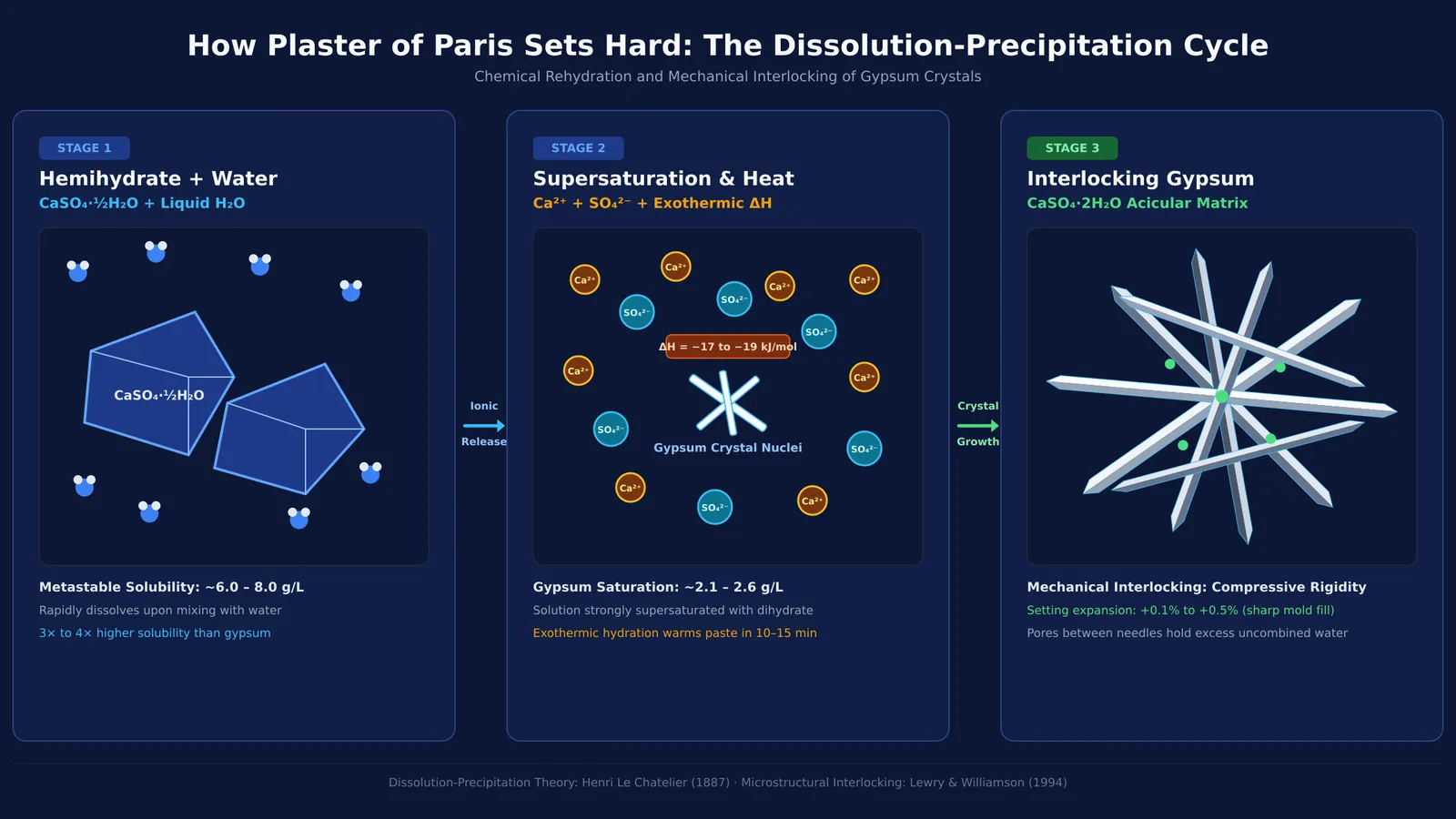
Rapid dissolution: When plaster powder meets water, calcium sulphate hemihydrate dissolves rapidly. At 25 °C, the hemihydrate has a metastable solubility between 6.0 and 8.0 g/L, which is roughly three to four times higher than the solubility of gypsum (approximately 2.1 to 2.6 g/L).
Supersaturation and nucleation: Because the dissolved ion concentration quickly exceeds the saturation threshold of gypsum, the liquid phase becomes heavily supersaturated with respect to the dihydrate. Microscopic gypsum crystal nuclei promptly precipitate out of solution.
Acicular crystal growth and mechanical interlocking: As demonstrated in Lewry and Williamson's follow-up study on microstructure development, gypsum precipitates as long, needle-like (acicular) monoclinic crystals. As these needles grow in all directions, they interpenetrate, tangle, and mechanically lock into one another, creating a rigid three-dimensional scaffold that gives set plaster its compressive strength.
Exothermic warming and setting expansion: As detailed by Chen and colleagues in their 2021 study on hemihydrate hydration, the conversion from hemihydrate to dihydrate releases between 17 and 19.3 kJ/mol of hydration heat (roughly 118 to 133 J/g of binder), causing the setting paste to feel noticeably warm within 10 to 15 minutes. Crucially, the thrust of growing needle crystals causes a slight linear expansion of 0.1% to 0.5%. Rather than shrinking as it sets, the paste expands slightly, pressing against moulds to capture fine surface detail.
Why is heating gypsum above 373 K a common exam trap?
In chemical manufacturing and laboratory preparations, temperature control is critical. As documented in Le Chatelier's treatise on hydraulic mortars, gypsum is carefully heated to 373 K (100 °C) in rotary kilns to produce plaster of Paris:
CaSO₄·2H₂O → CaSO₄·½H₂O + 1½H₂O
If gypsum is heated above 373 K—especially beyond 393 K (120 °C)—it loses all its water of crystallisation to become anhydrous calcium sulphate (CaSO₄). This anhydrous salt is known as "dead burnt plaster." Dead burnt plaster hydrates sluggishly and completely loses the ability to set into a hard mass within a practical timeframe.
CBSE Class 10 question papers often frame this as an assertion-reason question or a two-mark reasoning problem. Students revising for their board exams can reinforce these reaction conditions by reviewing balancing chemical equations in Class 10 and practising key experimental setups in CBSE Class 10 science diagram practice.
How much water does plaster of Paris need to set?
A helpful way to grasp water of crystallisation is to calculate the stoichiometric mass of water needed to fully hydrate a given mass of dry plaster of Paris.
Suppose you have 100 g of pure calcium sulphate hemihydrate (CaSO₄·½H₂O):
Find the molar mass of hemihydrate: Using standard atomic weights from the NIST Chemistry WebBook, anhydrous CaSO₄ has a molar mass of 136.14 g/mol. Adding half a mole of water (0.5 × 18.015 g/mol = 9.01 g/mol) gives a molar mass of 145.15 g/mol for CaSO₄·½H₂O.
Calculate the moles of hemihydrate: In 100 g of plaster, you have 100 g / 145.15 g/mol = 0.6889 mol of hemihydrate.
Determine stoichiometric water moles: The balanced hydration equation requires 1.5 moles of H₂O per mole of hemihydrate. Therefore, 0.6889 mol × 1.5 = 1.0334 mol of water is chemically consumed.
Calculate stoichiometric water mass: 1.0334 mol × 18.015 g/mol = 18.62 g of water.
Compute the final mass of set gypsum: 100 g of plaster binds 18.62 g of water to produce 118.62 g of gypsum (CaSO₄·2H₂O).
In actual studio and construction practice, workers add more than 18.62 g of water per 100 g of plaster. As Lewry and Williamson observed in their investigation on microstructure and strength, practitioners typically use a water-to-plaster ratio between 0.5 and 0.8 (50 to 80 g of water per 100 g of plaster) to make the slurry fluid enough to pour into moulds. The excess water not chemically consumed fills the microscopic pores between the interlocking gypsum needles and evaporates slowly over subsequent hours, leaving behind a lightweight, porous, and rigid structure.
If you are working through salt stoichiometry or chemical equation problems, the Fermi Problem Library offers worked problems with a step-by-step solver that explains the reasoning rather than printing an answer.


