On this page
You have probably seen it forwarded on WhatsApp: fill petrol early in the morning, because cool petrol is denser and you get more for your money. The physics is real. The conclusion is not. Here is the calculation.
Why do people say petrol is better in the morning?
You pay for petrol by the litre, not by the kilogram. Warm a liquid and it expands, so the same mass of fuel takes up more litres. Cooler petrol would pack slightly more fuel into each litre.
The rule is ΔV = γVΔT, where γ is the coefficient of volume expansion, V is the starting volume and ΔT is the temperature change (OpenStax University Physics Volume 2, section 1.3, which writes the coefficient as β). The coefficient of volume expansion of gasoline (petrol) is 950 × 10⁻⁶ per °C, according to Table 1.2 of the same OpenStax chapter. That is about 0.1% per degree, and roughly four and a half times water's 210 × 10⁻⁶ per °C. If you have met density falling as ρ(1 − γΔT), this is the same idea seen from the other side: see how density changes with temperature.
How much extra petrol would a cooler morning give?
Take the most generous case first. Pretend the petrol itself is 10 °C cooler at 7 am than at 2 pm, and you fill 40 L. Using γ = 950 × 10⁻⁶ per °C from OpenStax:
Fractional change: γΔT = 950 × 10⁻⁶ × 10 = 0.0095, or 0.95%.
Extra petrol: 40 L × 0.0095 = 0.38 L, a little under 400 mL.
In money: 0.95% of the bill, about ₹9.50 for every ₹1,000 you spend.
For a scooter taking 5 L: 5 × 0.0095 = 0.0475 L, under 50 mL.
So even if the fuel cooled as much as the air does, you would gain under 1%. And it does not cool like the air.
Does petrol in underground tanks change temperature during the day?
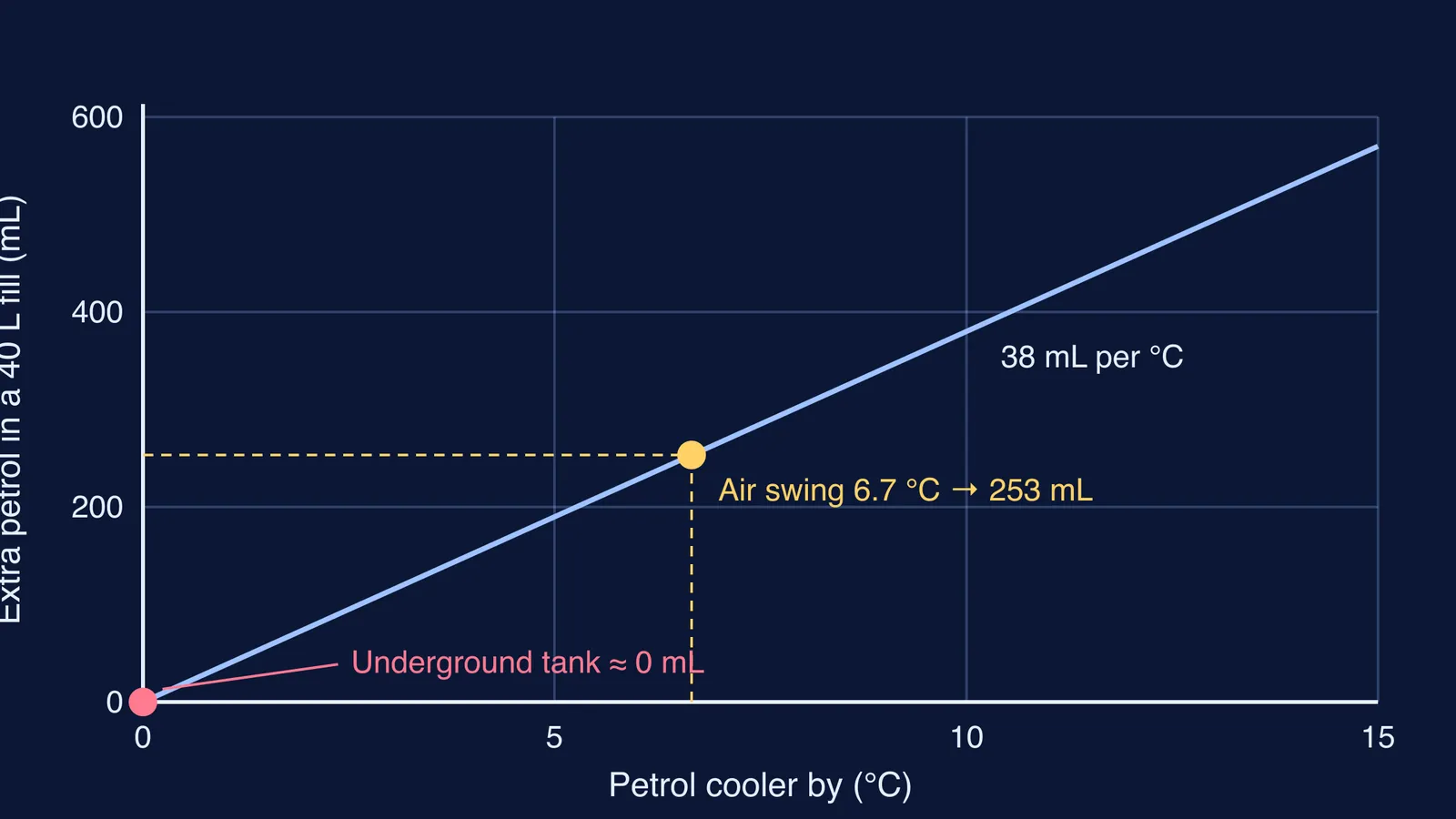
Barely. Pumps draw from tanks buried under the forecourt, and the ground above insulates the fuel from the day's heating and cooling. Consumer Reports tested this at its Auto Test Center in Colchester, Connecticut, which has an underground tank like a filling station's. While the air temperature between fillings varied by as much as 12°F (about 6.7 °C), the fuel in the tank stayed at a steady 62°F (about 17 °C). The UK fact-checker Full Fact rated the morning claim false for the same reason: the tanks are deep enough to be isolated from temperature changes above ground.
Now redo the sum. If the tank's temperature does not change, ΔT is zero and so is your gain. Allow a generous 0.5 °C drift anyway: 40 L × 950 × 10⁻⁶ × 0.5 = 0.019 L, or 19 mL. That is under 0.05% of the bill, less than 50 paise per ₹1,000.
One honest wrinkle: Consumer Reports found the first few gallons ran warmer, because fuel in the pump dispenser had warmed in the sun; the temperature dropped by between 8°F and 17°F from the first gallon to the tenth. After the first few gallons, fuel leaving the nozzle varied very little between morning and afternoon. As an illustration, if the first 10 L of a fill came out 5 °C warmer than the tank, you would get 10 × 950 × 10⁻⁶ × 5 ≈ 0.048 L less fuel, about 48 mL. Still tiny.
So when should you fill petrol?
Whenever it suits you. Here is a four-step check for this or any "expansion saves money" claim:
Ask which temperature matters. Here it is the fuel at the nozzle, not the air.
Look up γ (or α for a solid's length) in a textbook table.
Multiply γ × V × ΔT, then convert the answer to millilitres and rupees.
Compare it with what the effort costs you, such as a special early trip.
What about E20, petrol blended with 20% ethanol (what E20 petrol is, and why ethanol is added)? The OpenStax table lists ethyl alcohol's coefficient as 1100 × 10⁻⁶ per °C, so a rough weighted average for a 20% blend is about 980 × 10⁻⁶ per °C. Multiply that by a ΔT near zero in the tank and the answer still rounds to nothing.
How does this show up in physics exams?
ΔV = γVΔT is a standard textbook question. The OpenStax worked example fills a 60.0 L steel tank at 15.0 °C and warms it to 35.0 °C: 1.10 L spills, because petrol expands more than the steel tank does. For solids, the same idea becomes αLΔT, as in why railway tracks have gaps.
If you want more problems like these, the Fermi Problem Library has worked problems with a step-by-step solver that explains the reasoning rather than printing an answer. If α, β and γ still blur together, the Fermi Concept Library gives each concept in physics its own lesson and its place in the map.
Next time someone forwards the morning-petrol tip, send them the sum: 950 × 10⁻⁶ × 0 is still zero.