On this page
Fill a petrol tank in India today and about one-fifth of what goes in is not petroleum at all. According to the Press Information Bureau's Ethanol Blended Petrol Programme FAQ of July 2026, nearly 20 percent of every litre of petrol sold in India is now domestically produced ethanol. That blend is called E20, and the chemistry behind it is on your syllabus.
What is E20 petrol?
E20 is petrol that contains 20 percent ethanol and 80 percent conventional petrol by volume. The number after the E is just the ethanol percentage: E10 is 10 percent ethanol, E100 is pure ethanol.
Ethanol (CH3CH2OH) is a renewable fuel made from plant material collectively called biomass, as the US Alternative Fuels Data Center puts it.
India reached E20 in steps. The PIB FAQ says blending stuck at around 1.5 percent until 2014 because sugarcane alone could not supply enough ethanol, until the National Policy on Biofuels of May 2018 added maize and surplus grain. Blending then rose from about 8.1 percent in 2020-21 to 19.2 percent in 2024-25, and to 20 percent for November to June of 2025-26.
Where does the ethanol in petrol come from?
It comes from fermentation, which you study as anaerobic respiration in yeast. Sugarcane juice and molasses supply sugar directly; maize and rice supply starch, which is first broken down into glucose. Yeast then converts the glucose, without oxygen, into ethanol and carbon dioxide:
C6H12O6 → 2 C2H5OH + 2 CO2
Distillation then separates the ethanol from the watery mixture. In the grain route described by the Alternative Fuels Data Center, grain is ground into flour and fermented, leaving distillers grains and carbon dioxide as coproducts. Our explainer on how methanol and ethanol are made industrially shows the plant-scale view.
Why is ethanol added to petrol?
The government's PIB FAQ gives these reasons and figures, counted since Ethanol Supply Year 2014-15:
Less imported oil: about 316 lakh tonnes of crude oil substituted, saving more than ₹1.97 lakh crore in foreign exchange.
Farm income: more than ₹1.66 lakh crore transferred directly to farmers.
Emissions: about 952 lakh tonnes of CO2 emissions reduced; the FAQ says E20 can reduce lifecycle carbon emissions by nearly 40 percent.
Better anti-knock quality: ethanol has a Research Octane Number of about 108.5, compared with 84.4 for petrol, raising the effective octane of Indian petrol to around 95.
A higher octane number means the fuel resists igniting too early under compression; see what the octane number of petrol means. Ethanol also carries an oxygen atom in every molecule, so it is called an oxygenate. Its complete combustion is:
C2H5OH + 3 O2 → 2 CO2 + 3 H2O
There is a real debate, too: Mongabay India reported in July 2026 that researchers are questioning groundwater use and the diversion of maize from food and animal feed.
Does E20 reduce mileage?
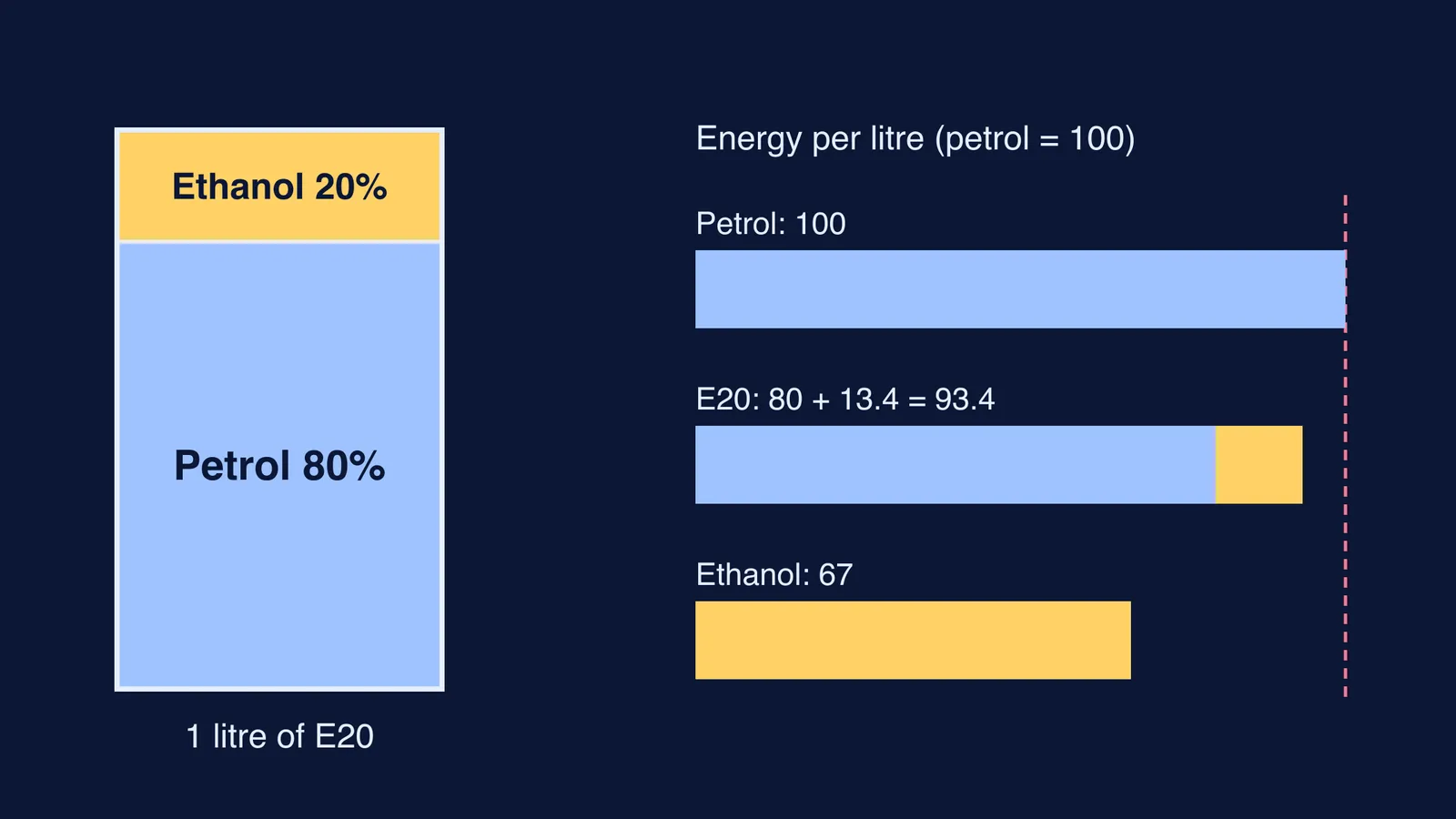
A little, and you can work out why. Ethanol holds less energy per litre than petrol: the Alternative Fuels Data Center lists one gallon of E100 as having 67 percent of the energy of a gallon of petrol.
Worked example, taking petrol as 100 energy units per litre:
Petrol share: 0.80 × 100 = 80 units
Ethanol share: 0.20 × 67 = 13.4 units
E20 total: 93.4 units, about 6.6 percent less energy per litre than pure petrol
If a scooter did 50 km per litre on pure petrol and nothing else changed, energy alone would predict 50 × 0.934 ≈ 46.7 km per litre. The PIB FAQ says some vehicles may see a 3 to 5 percent drop, which would mean about 47.5 to 48.5 km per litre. The FAQ adds that real-world mileage depends more on driving habits, tyre pressure, servicing and air-conditioner use than on fuel type. For more practice, see how to calculate the calorific value of a fuel.
What should you remember about E20 for exams and at the pump?
Use this checklist, built from the PIB FAQ and AFDC fuel data:
Define it: E20 is 20 percent ethanol and 80 percent petrol by volume.
Write the fermentation equation and name the conditions: yeast, no oxygen.
Balance the combustion of ethanol: 1 C2H5OH, 3 O2, 2 CO2, 3 H2O.
Keep two properties apart: ethanol raises octane, but lowers energy per litre.
For any blend with ethanol fraction x, energy per litre is roughly (1 − x) × 100 + x × 67.
Manual says E10? The PIB FAQ says manuals reflect the standard at certification; if worried, ask the service centre.
The Fermi Simulation Lab has interactive simulations for ideas that are easier to see than to read, and the Fermi Problem Library has worked problems with a step-by-step solver that explains the reasoning, if blend arithmetic trips you up.