

On this page
The octane number on a petrol pump is often misunderstood as a measure of a fuel's power or energy content. In reality, it is simply a measure of stability.
Many drivers assume that choosing the premium grade will give their car an extra boost of energy, but the chemistry of the fuel tells a different story. If you understand how a cylinder compresses gas, the octane rating becomes a clear warning label about heat, pressure, and the physics of combustion.
What does the octane number measure?
The octane number of petrol is a measure of a fuel's ability to resist spontaneous combustion when compressed in an engine. According to the U.S. Energy Information Administration (EIA), the octane rating is based on the pressure at which a fuel will spontaneously combust (auto-ignite) in a testing engine. A higher rating means the fuel can withstand a tighter squeeze before it ignites on its own.
Engines work by compressing a mixture of air and fuel inside a cylinder, which is then ignited by a spark plug at a precise moment. This creates a smooth, controlled flame front that pushes the piston down to generate power.
If the fuel is too unstable, the rising heat and pressure of compression can cause the remaining unburned fuel to explode spontaneously before the flame front reaches it. This premature, uncontrolled secondary combustion creates a violent pressure spike known as "engine knock." Over time, the shockwaves from knocking can crack pistons and damage internal engine components because the energy hits the piston while it is still moving upwards.
How is the octane rating calculated?
The octane scale is based on two reference chemicals that represent the extremes of knock resistance. The name itself comes from the 18 isomers of C₈H₁₈, specifically the highly stable compound iso-octane, as described by the EIA.
The EIA notes that iso-octane is highly resistant to auto-ignition and is assigned an octane rating of 100, while normal heptane knocks easily and is assigned an octane rating of 0.
Because of this standard, a fuel's octane number compares its knock resistance to these two chemicals. A regular fuel rated at 87 behaves like a specific reference blend of iso-octane and heptane. The fuel itself is a complex mixture of hundreds of different hydrocarbons, but its stability precisely matches that simple reference blend.
In the United States, the number shown on the pump is the Anti-Knock Index (AKI). This index is calculated by averaging two laboratory tests: the Research Octane Number (RON), determined under idle conditions, and the Motor Octane Number (MON), determined under higher engine speeds. Other parts of the world, including Europe and India, primarily display the RON, which typically reads slightly higher for the exact same fuel.
Why does compression cause knocking?
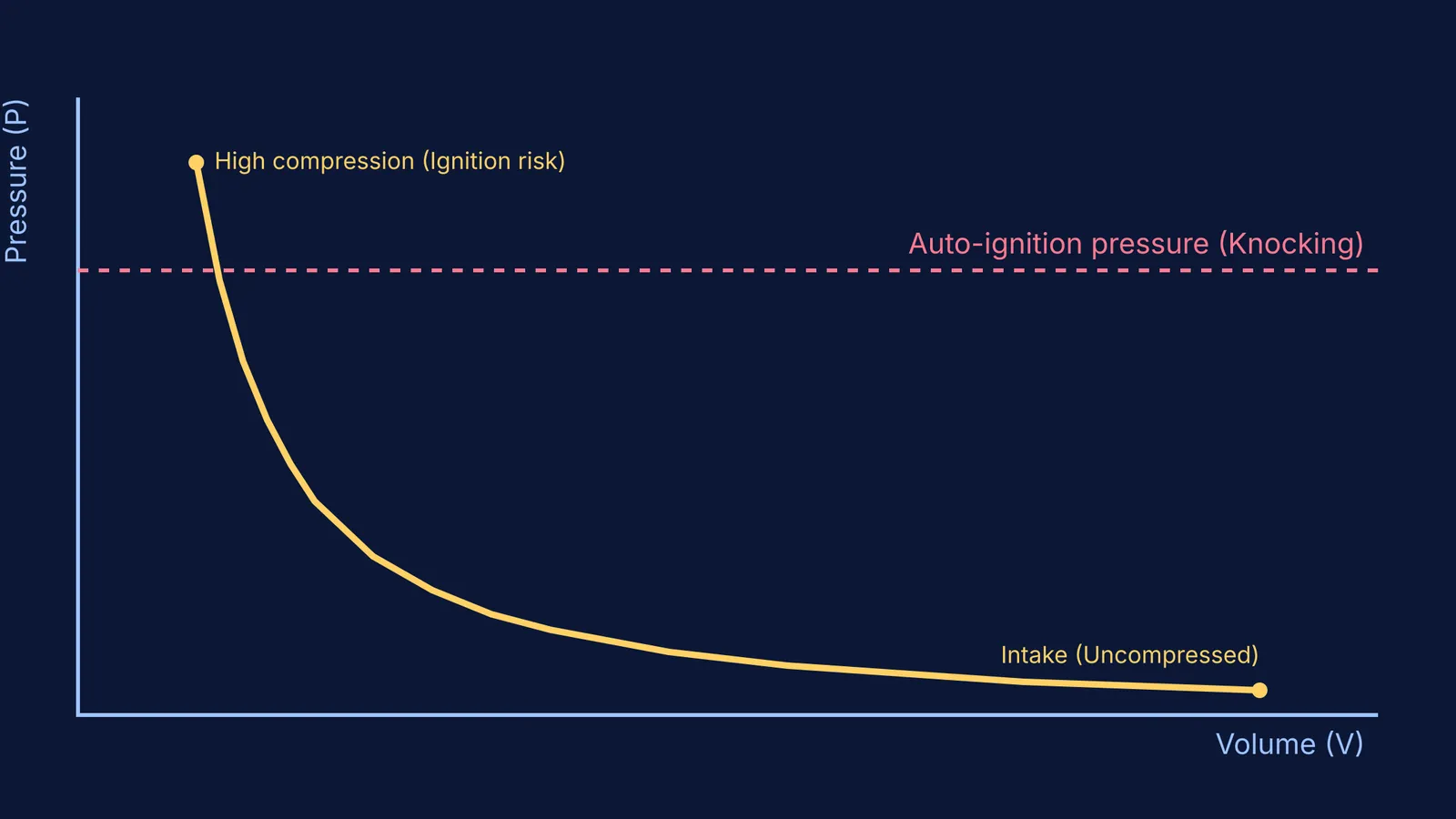
When a gas is compressed quickly, it heats up. Unlike the free expansion of an ideal gas where no work is done and the temperature stays constant, a piston moving up in a cylinder performs mechanical work on the gas mixture.
As the volume of the air-fuel mixture shrinks, its pressure and temperature both rise sharply. You can explore how these variables are mathematically linked by converting PV and PT graphs of ideal gas processes. For the ideas that are easier to see than to read, you can run an interactive piston model in the Fermi Simulation Lab to watch the temperature spike as the volume drops.
If the temperature exceeds the fuel's auto-ignition point before the spark plug fires, the fuel detonates. High-performance engines use higher compression ratios to extract more mechanical work from each stroke. Because they squeeze the gas tighter, they generate significantly more heat and require higher-octane fuels to survive that environment without knocking.
Should you buy premium petrol?
A common misconception is that high-octane fuel contains more energy or is more "explosive." In fact, high-octane fuel is actually harder to ignite. The EIA explains that modern engines detect knocking and compensate by delaying the spark, which protects the engine but reduces efficiency and power output if you use a lower-octane fuel than recommended.
If your car's manual calls for regular 87-octane petrol, filling up with premium will not make it faster or cleaner. Using a higher octane than required provides no benefit, because the engine does not compress the fuel enough to risk knocking in the first place.
However, using regular fuel in a car designed for premium can cause problems. As the engine adjusts to the lower octane, it will not run at its peak mechanical efficiency.


