

On this page
In Class 8 you read a calorific value off a table and multiply. In Class 11 you are given an enthalpy of combustion in kJ/mol and must turn it into heat per gram yourself. That conversion is where marks go, and it is also the fair way to compare fuels.
What is calorific value, and how is it different from enthalpy of combustion?
The school definition is that calorific value is the amount of heat produced when 1 kg of a fuel burns completely, measured in kJ/kg, as given in Teachoo's notes for Class 8 Chapter 6, Combustion and Flame. Its table gives LPG 55,000 kJ/kg and hydrogen 150,000 kJ/kg, the highest of any fuel listed.
The standard enthalpy of combustion, ΔcH°, is the heat released when one mole of a substance burns completely, written as a negative number because heat leaves the system. Calorific value is per mass, enthalpy of combustion is per mole, and molar mass connects them. To revise the enthalpy basics, see our guide to building Hess's law cycles for enthalpy calculations.
How do you calculate calorific value from enthalpy of combustion?
Use three steps:
Take the magnitude of ΔcH° in kJ/mol. Calorific value is quoted as a positive number.
Divide by the molar mass in g/mol. The answer is in kJ/g.
Multiply by 1000 if the question wants kJ/kg. Note that kJ/g is numerically the same as MJ/kg.
Here are real numbers from the NIST Chemistry WebBook:
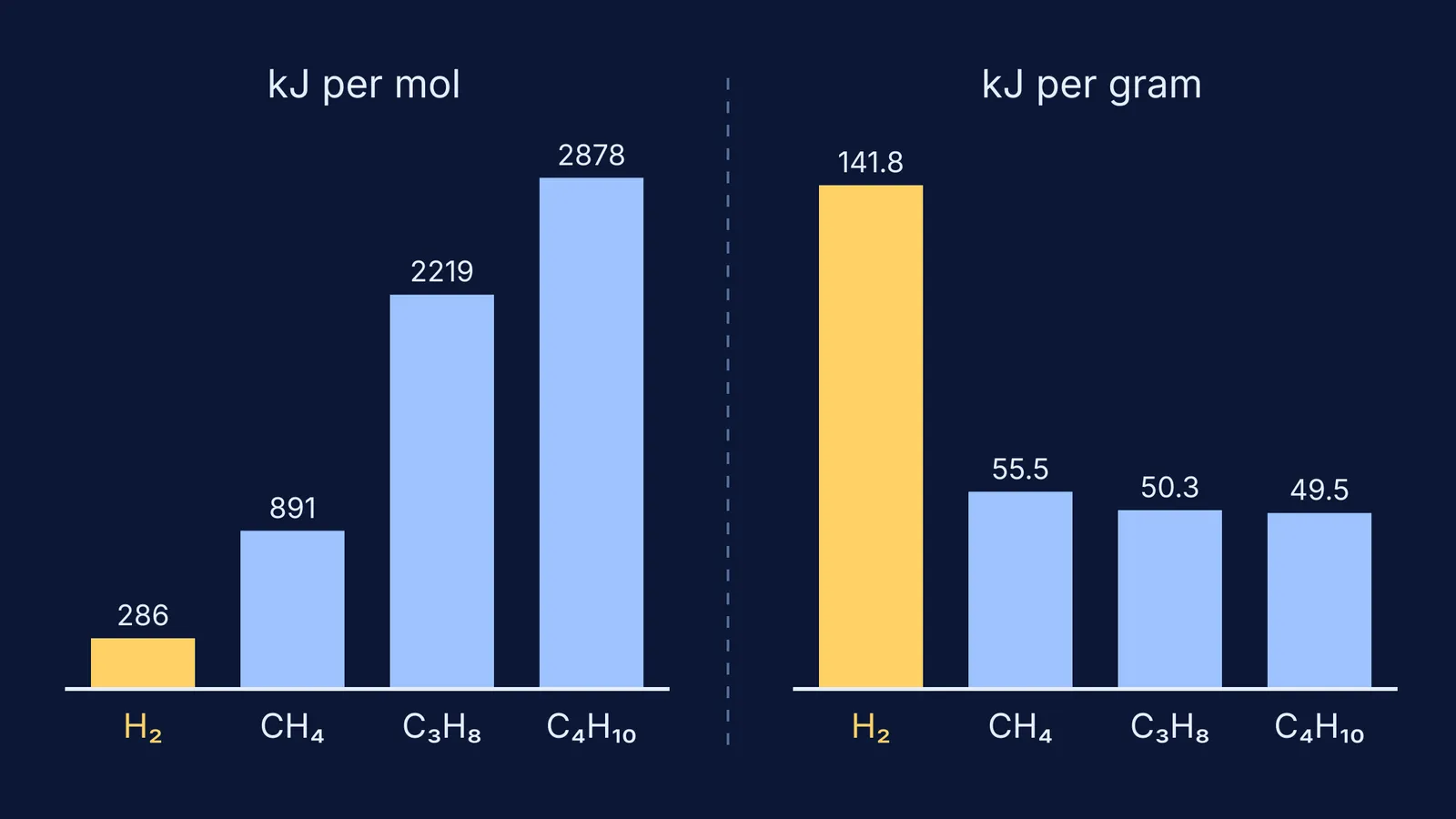
Butane: ΔcH° = −2877.5 kJ/mol and molar mass 58.12 g/mol, so 2877.5 ÷ 58.12 ≈ 49.5 kJ/g (NIST, butane).
Propane: ΔcH° = −2219.2 kJ/mol and molar mass 44.10 g/mol, so about 50.3 kJ/g (NIST, propane).
Methane: ΔcH° = −890.7 kJ/mol and molar mass 16.04 g/mol, so about 55.5 kJ/g (NIST, methane).
Hydrogen: burning H₂ to liquid water releases the enthalpy of formation of water, 285.83 kJ/mol (NIST, water). Dividing by H₂'s molar mass of 2.016 g/mol (NIST, hydrogen) gives about 141.8 kJ/g.
LPG is mostly propane and butane, so working from the pure gases puts it near 50 kJ/g. The table's 55,000 kJ/kg is higher than either pure gas gives, so treat it as a classroom figure. In an exam, always use the number the question gives you.
If the water leaves as steam, use NIST's gas-phase value for water, −241.83 kJ/mol, instead.
Why does hydrogen win per gram but lose per mole?
Using the NIST values above, per mole butane wins by about ten times (2877.5 against 285.8 kJ/mol). Compare per gram and hydrogen wins by nearly three times (141.8 against 49.5 kJ/g). A mole of hydrogen weighs only about 2 g, while a mole of butane weighs 58 g. Fuels are bought, carried and burnt by mass, so per-gram figures are the fair comparison.
Per volume, the picture changes again. The US Department of Energy notes that hydrogen has the highest energy per mass of any fuel, but its low density at ordinary temperature and pressure gives it very low energy per unit volume.
How do you solve calorific value numericals for Class 8 and Class 11?
The Class 8 questions use the textbook table values.
Q1. How much heat does 2 kg of LPG release? 2 × 55,000 = 110,000 kJ.
Q2. What mass of hydrogen gives the same heat? 110,000 ÷ 150,000 ≈ 0.73 kg.
Q3. A 4.5 kg sample of fuel releases 180,000 kJ when it burns completely. Find its calorific value. 180,000 ÷ 4.5 = 40,000 kJ/kg, which falls in the biogas range of the table.
For the theory behind these, see our post on fuels, fire and flame zones for Class 7 and 8.
The Class 11 question uses the per-gram figures worked out from NIST butane and NIST water data.
Q4. How many grams of butane, and of hydrogen, are needed to heat 1 kg of water from 25 °C to 100 °C? Take c = 4.18 J g⁻¹ K⁻¹ and assume all the heat reaches the water.
Heat needed: q = m c ΔT = 1000 × 4.18 × 75 = 313,500 J = 313.5 kJ.
Butane: 313.5 ÷ 49.5 ≈ 6.3 g.
Hydrogen: 313.5 ÷ 141.8 ≈ 2.2 g.
Which mistakes cost marks in these numericals?
Keeping the minus sign. Calorific value is positive. ΔcH° is negative.
Multiplying by the molar mass instead of dividing. Check the units: kJ/mol ÷ g/mol = kJ/g.
Mixing J and kJ in the q = m c ΔT step.
Ignoring the state of water when the question specifies steam.
Most are mole-to-mass slips; our list of mole concept errors and a routine to catch them helps.
If you get stuck on a particular numerical, the Fermi Problem Library has worked problems with a step-by-step solver that explains the reasoning rather than printing an answer. If enthalpy itself feels shaky, the Fermi Concept Library gives each chemistry concept its own lesson.


