

On this page
If you are revising alcohols for Class 12 boards or JEE Main, two industrial processes keep coming back: how methanol and ethanol are made on a large scale. The NCERT Class 12 Chemistry chapter on alcohols, phenols and ethers covers both in section 7.5. Here is each process, a worked calculation and a revision checklist.
How is methanol produced industrially?
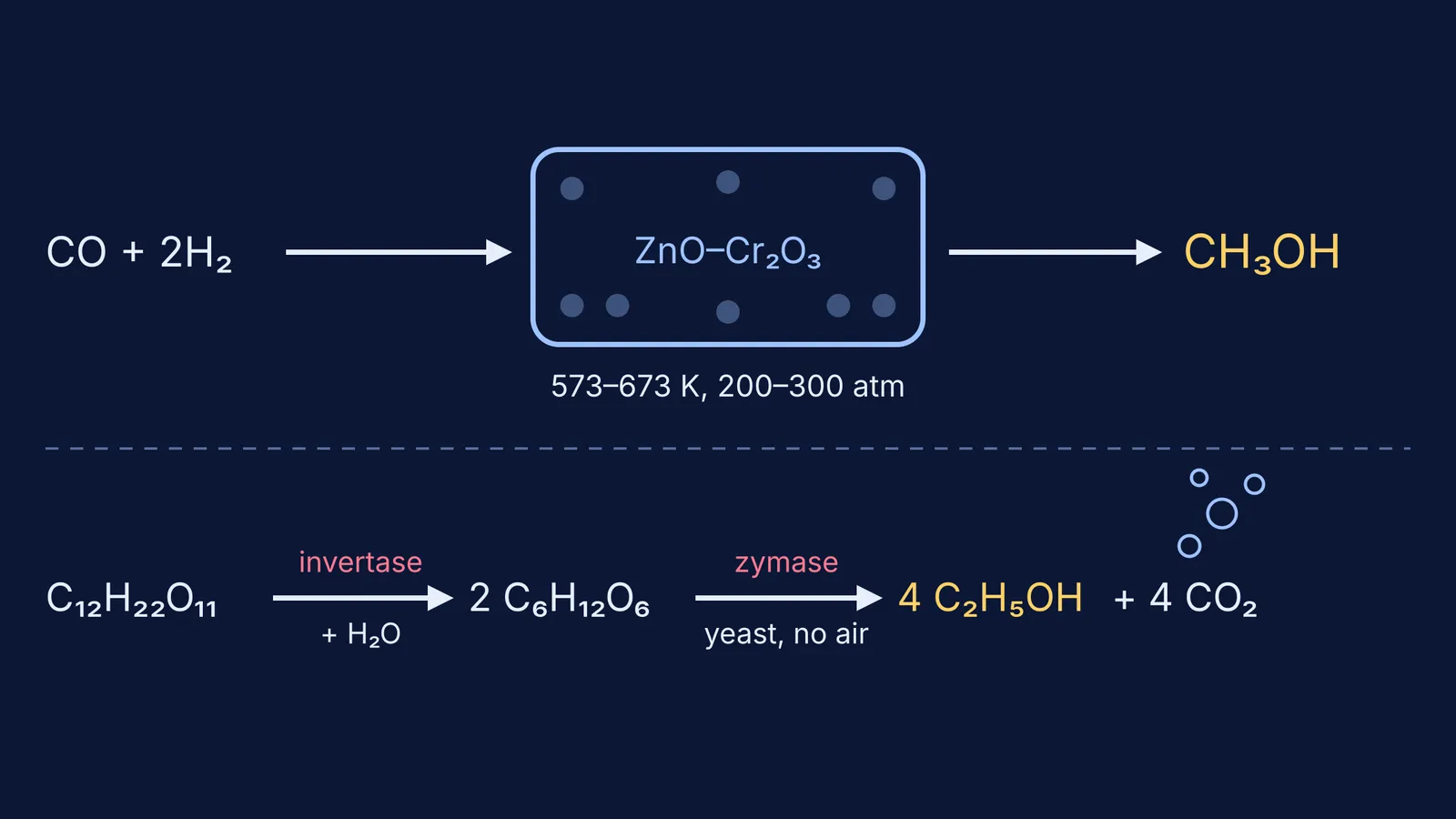
Methanol, CH3OH, used to be called wood spirit because it was made by destructive distillation of wood, as the NCERT chapter explains. NCERT says that today most methanol is made by catalytic hydrogenation of carbon monoxide at high pressure and temperature, over a ZnO–Cr2O3 catalyst.
The equation to learn is CO + 2H2 → CH3OH, with ZnO–Cr2O3 written over the arrow and 200–300 atm and 573–673 K written under it (NCERT, section 7.5).
Le Chatelier's principle explains the high pressure: three molecules of gas become one, so higher pressure shifts the equilibrium towards methanol. The catalyst speeds the reaction without being used up; see our post on how many times faster a reaction goes when a catalyst lowers the activation energy.
Methanol boils at 337 K and is highly poisonous: even small amounts can cause blindness. It is used as a solvent in paints and varnishes, and mainly to make formaldehyde.
Your textbook's catalyst is close to the original industrial one. A 2019 review by Bowker in ChemCatChem describes BASF's high-temperature, high-pressure process from the 1920s, which used oxide catalysts, especially mixed Cr2O3–ZnO. Much later ICI developed a copper–zinc–alumina (Cu/Zn/Al2O3) catalyst that works at lower temperature and pressure; the first plant using it ran in 1966. Copper is very sensitive to sulphur poisoning, so the process needed a desulphurisation unit, and the review links it with the switch from coal to natural gas.
How is ethanol made from molasses?
The NCERT chapter describes fermentation as the oldest way to obtain ethanol commercially. The sugar comes from molasses, sugarcane or fruits such as grapes, and it is converted in two enzyme steps.
Invertase breaks sucrose into glucose and fructose: C12H22O11 + H2O → C6H12O6 + C6H12O6.
Zymase, an enzyme found in yeast, ferments glucose and fructose: C6H12O6 → 2C2H5OH + 2CO2.
Fermentation is carried out without air. If air gets into the mixture, oxygen oxidises ethanol to ethanoic acid. NCERT also notes that zymase stops working once the alcohol content goes above 14 percent (NCERT, section 7.5). Ethanol for industrial use is made unfit to drink by adding copper sulphate (for colour) and pyridine (for a foul smell). This is called denaturation.
Yeast is alive, so temperature matters too, as our balloon simulation of yeast fermentation at different temperatures shows. Large amounts of ethanol are also made by hydrating ethene, a route compared in our post on ethanol from ethene versus bromoethane.
In India, molasses ethanol also goes into petrol. A November 2022 Cabinet release on the Ethanol Blended Petrol Programme priced ethanol from C-heavy molasses, B-heavy molasses and sugarcane juice separately, and noted that the government had moved the 20% blending target forward from 2030 to the 2025-26 ethanol supply year.
How much ethanol can 1 mol of sucrose give?
This checks that you understand both NCERT equations. Use the molar masses C12H22O11 = 342 g/mol, H2O = 18, C6H12O6 = 180, C2H5OH = 46 and CO2 = 44.
Step 1: 342 g of sucrose and 18 g of water give 2 mol of hexose (glucose and fructose), which is 360 g.
Step 2: each mol of hexose gives 2 mol of ethanol and 2 mol of CO2, so 2 mol of hexose gives 4 mol of each.
Ethanol: 4 × 46 = 184 g. CO2: 4 × 44 = 176 g.
Check: 184 + 176 = 360 g, the same mass you started with in step 2.
So 342 g of sucrose can give at most 184 g of ethanol, about 54% of the sugar's mass. For methanol the arithmetic is simpler: 28 g of CO and 4 g of H2 give 32 g of CH3OH, with every atom ending up in the product.
If you get stuck on a stoichiometry step like this, the Fermi Problem Library has worked problems with a step-by-step solver that explains the reasoning rather than printing an answer.
What do exams ask about these two processes?
Methanol: CO + 2H2, ZnO–Cr2O3, 200–300 atm, 573–673 K, written on the arrow.
Methanol is called wood spirit and can cause blindness.
Ethanol: invertase comes first, then zymase, the enzyme found in yeast.
Fermentation runs without air. With air, you get ethanoic acid.
Zymase is inhibited above 14% alcohol (NCERT, section 7.5).
Denaturing agents: copper sulphate and pyridine.
Boiling points: methanol 337 K, ethanol 351 K.
If enzymes or catalysts still feel hazy, the Fermi Concept Library has a lesson for every concept in chemistry and biology. Pick one gap and close it before your next mock test.


