

On this page
Two reactions in your syllabus both end in ethanol, CH₃CH₂OH. One adds water across a double bond. The other swaps a bromine atom for an OH group. They are often compared side by side because the conditions, the mechanism and the waste are all different.
How is ethanol made by hydration of ethene?
The equation is C₂H₄ + H₂O ⇌ C₂H₅OH, and the forward reaction is exothermic, as Chemguide's page on ethanol manufacture explains.
In industry, ethene and steam are passed over phosphoric(V) acid coated on solid silicon dioxide at 300 °C and about 60 to 70 atmospheres (Chemguide, hydration mechanism).
The acid is a true catalyst. The mechanism has three steps:
The π electrons of C=C grab a proton from the acid, giving the ethyl carbocation, CH₃CH₂⁺.
A lone pair on a water molecule attacks the carbocation.
The dihydrogenphosphate(V) ion, H₂PO₄⁻, removes a proton from the oxygen, giving ethanol and regenerating phosphoric(V) acid.
Why these conditions? A lower temperature would favour the exothermic forward reaction, but it would be too slow, so 300 °C is a compromise. Ethene is used in excess, because too much steam dilutes the catalyst and can even wash it off its support (Chemguide).
Only about 5% of the ethene is converted on each pass through the reactor, but removing the ethanol and recycling the unreacted ethene gives about 95% overall conversion (Chemguide).
How is ethanol made by hydrolysis of bromoethane?
The equation is CH₃CH₂Br + OH⁻ → CH₃CH₂OH + Br⁻, or with the potassium written in, C₂H₅Br + KOH → C₂H₅OH + KBr.
The haloalkane is heated under reflux with a solution of sodium or potassium hydroxide, usually in a 50/50 mixture of ethanol and water (Chemguide, halogenoalkanes and hydroxide).
This is an SN2 reaction: the hydroxide ion attacks the δ+ carbon as the bromide ion leaves, all in one step, and the rate depends on two species colliding (Chemguide, SN2 mechanism).
The trap is the word “aqueous”. Higher temperatures, concentrated hydroxide and pure ethanol as the solvent push the same reagents towards elimination, which gives ethene instead of ethanol (Chemguide). Bromoethane is a primary haloalkane, so with aqueous KOH it gives mainly substitution. If “hydration” and “hydrolysis” still blur together, our explainer on how water adds versus how bonds split sorts them out.
Which route makes ethanol more efficiently?
Start with the conditions (Chemguide, hydration):
Hydration: gas phase, 300 °C, about 60 to 70 atm, solid phosphoric(V) acid catalyst, continuous flow with recycling.
Hydrolysis: liquid phase, heated under reflux, aqueous KOH (often ethanol–water), no catalyst.
Side reaction: hydrolysis competes with elimination to ethene.
By-product: hydration has none; hydrolysis makes potassium bromide.
Yield and atom economy are different numbers. Yield tells you how much product you actually got. Atom economy, an idea chemist B. M. Trost set out in Science in 1991, asks how much of the reactants ends up in the product you want; exam calculations use mass.
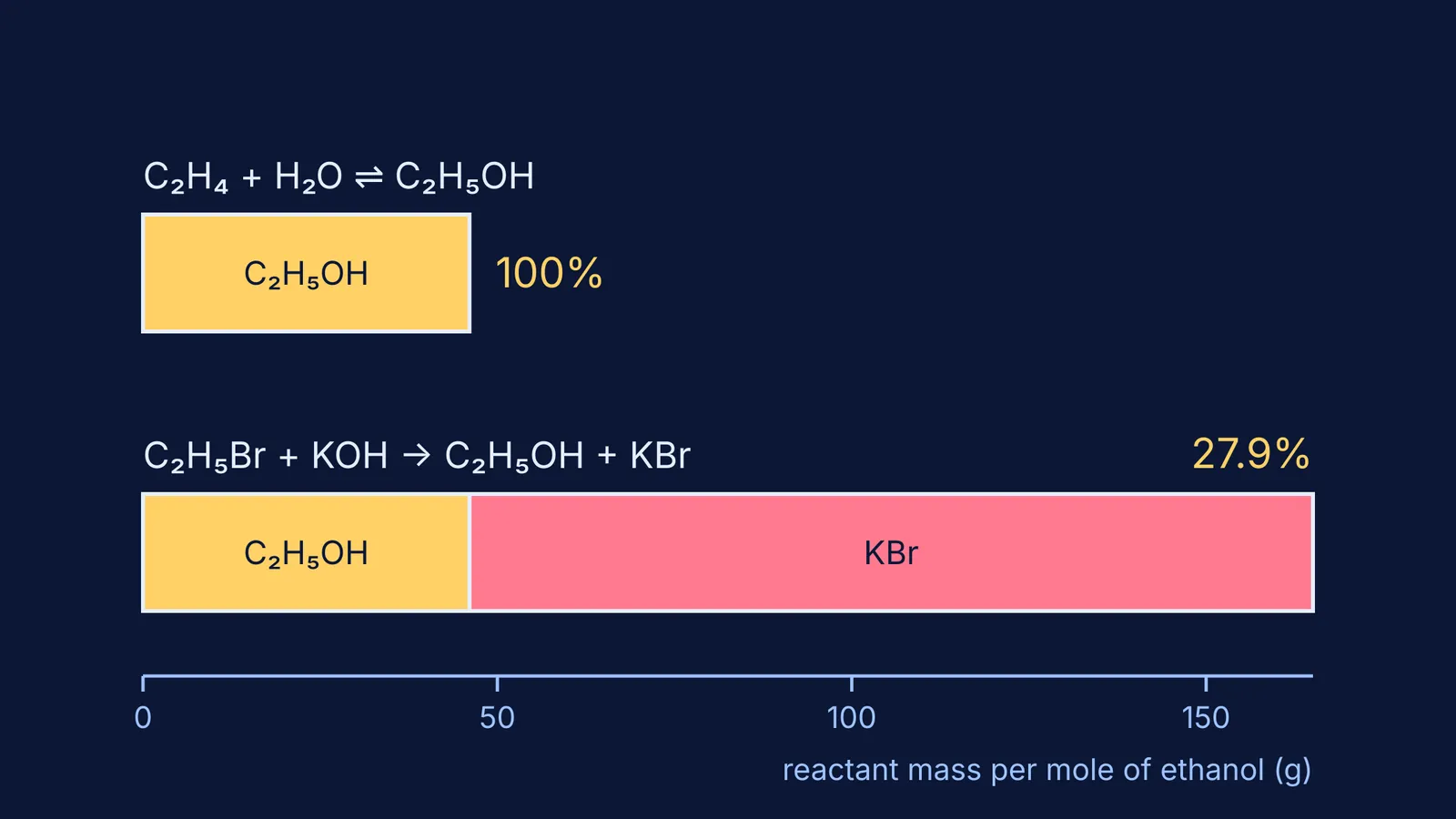
Here is the worked example, using molar masses from PubChem: ethanol 46.07, ethene 28.05, water 18.015, bromoethane 108.97, KOH 56.106 and KBr 119.00 g/mol.
Hydration: 46.07 ÷ (28.05 + 18.015) × 100 = 100%. Every atom of ethene and water ends up in ethanol.
Hydrolysis: 46.07 ÷ (108.97 + 56.106) × 100 = 46.07 ÷ 165.08 × 100 = 27.9%.
The other 72.1% of the mass leaves as KBr.
So hydration wins on atom economy and, with recycling, reaches about 95% overall conversion (Chemguide). Hydrolysis needs only a heated flask, but most of the reactant mass ends up as salt. For that reason, hydrolysis of bromoethane is better thought of as a lesson in nucleophilic substitution than as a way to make ethanol in bulk.
How do you write this comparison in an exam?
Use this five-line plan for a “compare the two methods” question:
Write both balanced equations, with state symbols if asked.
Name the reaction type: electrophilic addition via a carbocation, versus SN2 nucleophilic substitution.
Give the conditions in full: catalyst, temperature, pressure or reflux, and the solvent.
Name the competing reaction: elimination to ethene, favoured by hot, concentrated KOH in ethanol.
Compare atom economy with numbers, and say which one gives a by-product.
If step 2 is where you lose marks, the Fermi Concept Library has a lesson on every concept in chemistry, each placed in a map so you can see how addition and substitution connect. To practise the arithmetic in step 5, the Fermi Problem Library has worked problems with a step-by-step solver that explains the reasoning rather than printing an answer.
Next, see how these routes fit with carbonyl reductions and Grignard reagents in our guide to methods of preparing alcohols. You can also run the reaction in reverse with the laboratory preparation of ethene by dehydrating ethanol.


